TRANSMISSION // 2611.13032v1
How an imperfect matter-wave lens could reveal atomic interactions
Source published
A theoretical study and three-dimensional simulations examine how an anharmonic lens can create an Airy-like pattern in a Bose–Einstein condensate—and how interactions may alter it. The authors estimate high sensitivity under idealized conditions, but this is a model-based proposal, not a demonstrated measurement.
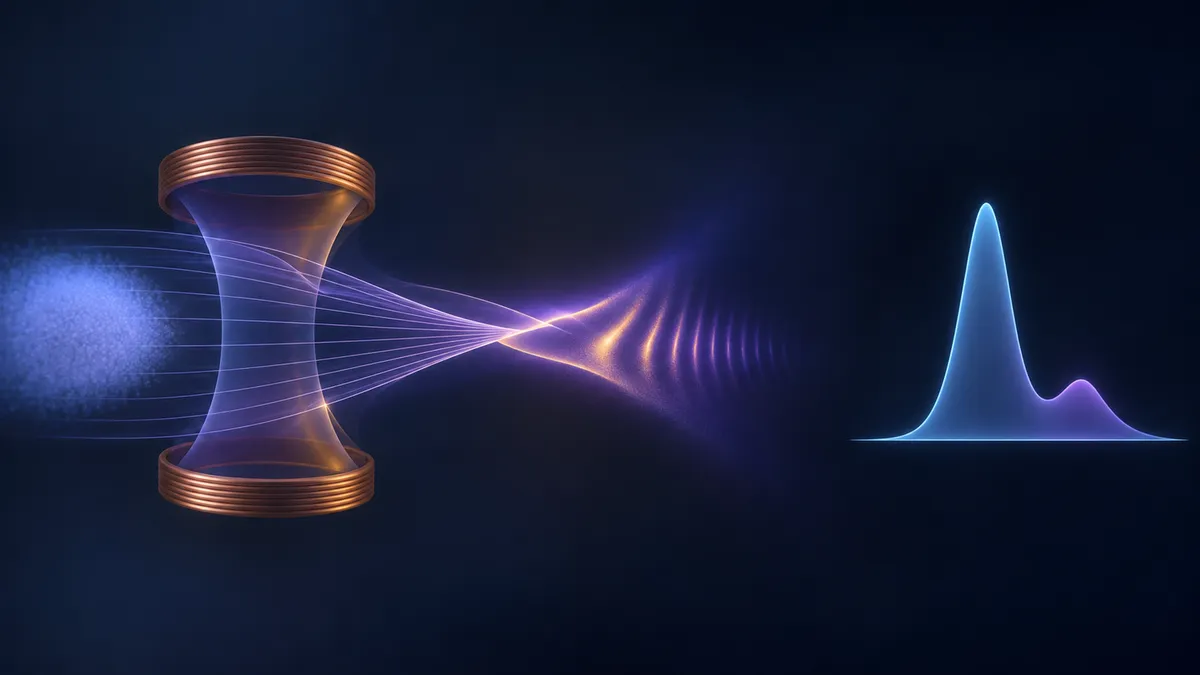
When a lens focuses different parts of a wave differently, the resulting pattern can have a distinctive folded shape. Researchers explore how this effect might arise in a Bose–Einstein condensate—and whether changes to the pattern could reveal interactions among its atoms.
In wave physics, caustics form when many trajectories crowd together. The concentration predicted by a simple ray picture is smoothed out in a real wave, producing a structured pattern. Near a generic fold-shaped caustic, that pattern can be described by an Airy function.
Joachim Guyomard and colleagues investigate whether an imperfect magnetic lens can produce such a fold in a Bose–Einstein condensate, a gas whose atoms behave collectively as a matter wave. They also ask whether interactions among the atoms alter the pattern in ways that could help measure the interaction strength.
From a focus to a fold
The study considers a lens that is mostly harmonic—its potential has the idealized shape used in a simple focusing model—but includes anharmonic terms, or departures from that shape. In the harmonic picture, neighboring classical trajectories converge at a common focus. A leading cubic aberration makes the focusing depend on where each trajectory starts. Rather than meeting at one point, the trajectories form an envelope: a fold caustic.
The researchers first build a semiclassical model linking classical trajectories to the phase of a quantum wave. Near the fold, they describe the wave using an Airy integral. They then compare this prediction with numerical simulations of the condensate.
The simulations solve the three-dimensional Gross–Pitaevskii equation, a standard model of a condensate’s wavefunction and mean-field interactions. The setup and parameters are based on an existing atom-chip lens experiment. However, this study is theoretical and computational; it does not report a new experimental observation of the predicted caustic.
A common pattern, and changes near focus
In calculations without interactions, patterns made with different lens durations align when rescaled to the appropriate length. This collapse onto a common profile supports the predicted universal fold pattern. The Airy-based approximation also agrees well with the non-interacting simulation for the parameters examined. The authors attribute residual differences to simplifying assumptions, including the condensate’s finite size and higher-order lens effects.
Interactions change the simulated dynamics near the focus. The caustic concentrates the matter wave, increasing local density and making mean-field effects more important. The researchers report changes in both near-focus density and the distribution of momentum along the focusing axis. In particular, the interacting simulation develops a secondary momentum-space feature that is absent from the non-interacting evolution. The authors interpret the pattern as an interaction-driven departure from single-particle caustic behavior, with some condensate moving out of the high-density region.
The team also estimates how much information about the effective interaction strength is carried by the one-dimensional position distribution along that axis. They calculate classical Fisher information, a measure of how sensitively measurement outcomes depend on a parameter, and test maximum-likelihood estimates on simulated samples. For 100,000 sampled points, they report a relative uncertainty of 2.7 × 10⁻³ under their model. This is a result from simulated data, not a precision demonstrated by an experimental apparatus.
What remains uncertain
The findings suggest a possible sensing approach: create a caustic with a matter-wave lens, then infer interaction strength from changes in the pattern. But the estimated sensitivity depends on assumptions. The calculation uses Gross–Pitaevskii mean-field dynamics and idealized position measurements. The authors say real experimental performance would require accounting for finite imaging resolution, uncertainty in atom number, and other nuisance parameters. Assessing sensitivity to beyond-mean-field quantities would require a corresponding dynamical model and a separate analysis.
The work therefore offers a theoretical framework and identifies a potentially useful signal; it does not establish that the proposed precision is achievable in practice. It is an arXiv preprint, and its claims should be understood as the authors’ reported results rather than as independently confirmed findings. More broadly, the study explores how lens imperfections—usually treated as deviations from ideal focusing—might create structured matter-wave patterns that carry information about the gas.
- Bose–Einstein condensate
- matter waves
- caustics
- Airy function
- mean-field interactions
- quantum sensing
Related reading
Automatically matched by shared topic keywords. These links do not imply that the sources agree or establish a consensus.
Quantum computing proposal puts ‘over-squeezed’ atoms to work
Source published
Shared keywords: bose einstein condensate
When a quantum sensing limit depends on the model
Source published
Shared keywords: quantum sensing
Two microwave tones sharpen a quantum sensor in boron nitride
Source published
Shared keywords: quantum sensing
Designing a quantum sensor by shaping its answer
Source published
Shared keywords: quantum sensing
How to read a noisy atom interferometer’s ellipse
Source published
Shared keywords: quantum sensing