TRANSMISSION // 2611.12980v1
MADSNet turns spike-camera signals into images
Source published
Spike cameras record light as rapid binary signals rather than ordinary frames. MADSNet is a spiking neural network designed to reconstruct intensity images from those signals. In the reported tests, it improved reconstruction scores over several comparison models and was faster and lower in estimated energy than one artificial-neural-network baseline. Those efficiency gains do not apply to every comparison, and the energy figures are estimates, not direct measurements on neuromorphic hardware.
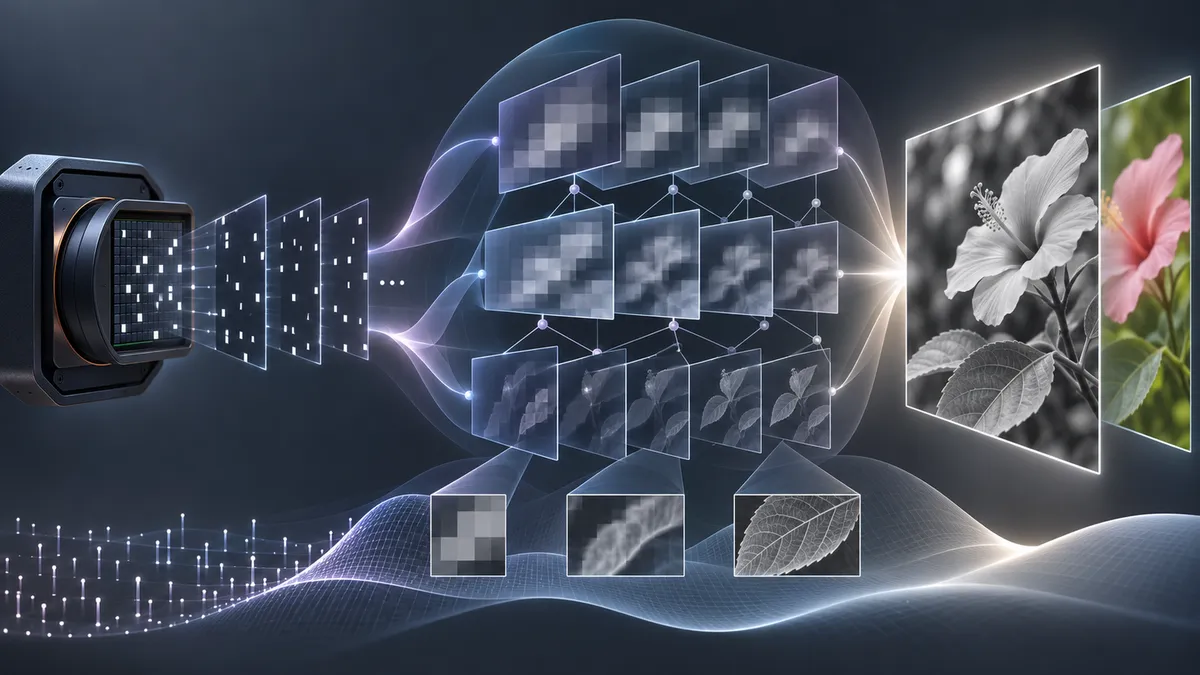
A conventional camera records pixel values over an exposure interval. A spike camera instead records whether each pixel’s accumulated light has crossed a threshold, producing a stream of binary signals. How can a computer recover a detailed intensity image from that stream—and do so efficiently? Li and colleagues propose MADSNet, a spiking neural network that combines features at different scales, gathers broad spatial context, and converts spike-based features into image intensities.
From spikes to a picture
In a conventional camera, each pixel collects light over an exposure interval, so fast motion can blur the result. A spike camera works differently: each pixel accumulates incoming light and emits a binary spike when it reaches a threshold, then resets and starts accumulating again. Brighter regions generally produce more frequent spikes. This captures rapid changes, but the output is not a conventional image.
Reconstructing intensity from these signals is difficult because a short binary spike sequence can be consistent with different underlying light patterns. The network must infer continuous pixel values from sparse observations affected by motion and photon-arrival noise.
MADSNet—short for Multi-scale Axial-attentive Dense Spiking Network—aims to solve this problem while retaining the event-driven computation associated with spiking neural networks (SNNs). Its spiking layers use accumulate-only operations, in contrast to the multiply–accumulate operations common in conventional artificial neural networks (ANNs).
A staged reconstruction
MADSNet uses an encoder–decoder: it first builds a representation of the input spike frames, then turns that representation into an intensity image. Its opening module processes input at several spatial scales to capture local detail and broader patterns. Axial spike attention gathers context along horizontal and vertical directions without building a full two-dimensional attention map. A dense bottleneck connects intermediate features so later stages can reuse earlier information. In the decoder, pixel-shuffle upsampling restores image resolution, and a fusion block bridges discrete spike-domain features and continuous-valued output pixels.
The authors evaluated grayscale reconstruction on the SREDS benchmark and tested transfer to color reconstruction on RBSS. They also report visual comparisons on real-captured grayscale and color spike streams. For grayscale evaluation, they followed the SSIR protocol and used the first 22 ground-truth frames in the validation split. These tests evaluate reconstruction performance; they do not demonstrate deployment on dedicated neuromorphic hardware.
What the comparisons show
On SREDS, MADSNet recorded a peak signal-to-noise ratio (PSNR) of 37.232 decibels. The paper reports this as 4.30 dB above the spiking baseline SSIR and 1.94 dB above the ANN-based Spk2ImgNet. PSNR measures agreement with a reference image, with higher values indicating closer pixel-level reconstruction under that metric. MADSNet also scored better than SSIR on the reported structural-similarity and learned perceptual metrics. This does not mean it led on every measure: the authors note that it did not achieve the best value on every no-reference quality metric.
In the RBSS color-transfer experiment, MADSNet scored 29.36 dB PSNR, compared with 24.31 dB for SSIR. It also exceeded SSIR on the other two reported metrics, while the dedicated color method SSL-CSC had slightly higher PSNR. The results suggest that the architecture transfers to this color setting, not that it is uniformly superior to specialized color methods.
The efficiency comparison is specific to the reported setup: an NVIDIA RTX 4090 and the tested input resolution. MADSNet’s inference latency was 20.4 milliseconds, compared with 305.4 milliseconds for Spk2ImgNet and 3.3 milliseconds for SSIR. The authors estimate energy using operation counts and per-layer spike firing rates, rather than reporting a direct hardware power measurement. By that estimate, MADSNet used about one-fortieth the energy of Spk2ImgNet. But it used more estimated energy, memory, and time than SSIR. Its efficiency advantage is therefore relative to that ANN baseline, not every spiking alternative.
Ablation tests, which remove or replace one component at a time, showed lower SREDS scores when key modules—including the multi-scale stem, attention, dense bottleneck, upsampling, or fusion—were removed or changed. Such tests indicate which design choices mattered within this model and setup; they do not establish that the same components will help across other datasets or hardware.
What remains uncertain
These are benchmark results, not a guarantee of performance with every camera, scene, or deployment. The grayscale evaluation follows a prior protocol, and the color experiment tests transfer on a separate benchmark. The paper’s table notes that results for some existing methods are taken from prior work, making consistent comparison conditions important. The energy advantage is estimated, and MADSNet is explicitly slower and more energy-intensive than the shallower SNN baseline SSIR. The authors identify hardware deployment and further model slimming as future directions.
The supplied evidence gives conflicting signals about publication status: its metadata identifies an arXiv item, while the paper text bears an IEEE Transactions on Image Processing heading. The available material does not resolve the work’s publication or peer-review status, so it should not be described as either a confirmed journal publication or an unreviewed preprint. Independent assessment and reproduction would help establish how well the results generalize.
- spike cameras
- spiking neural networks
- image reconstruction
- neuromorphic vision
- computer vision
Reviewed cross-references
These connections were reviewed by a model, not independently fact-checked by a human. Similarity does not imply agreement; consult the original papers and the evidence below.
HyVox pairs two kinds of chips to cut speaker-identification energy
Supporting evidence: In separate evaluations, both papers report efficiency advantages for spiking systems over ANN baselines: MADSNet reports about 15× lower latency and 1/40 the estimated energy versus Spk2ImgNet on SREDS, while HyVox reports lower latency and energy than embedded ANN baselines for speaker identification. These are task-specific results with different measurement bases, not a direct comparison or evidence of a general advantage.
Model review: · openai-codex/gpt-6-luna
Evidence and provenance
Selected excerpts, not complete papers. PDF extraction can omit figures or damage equations, tables and reading order; sources may be preprints.
2611.12980v1 — Original paper
Excerpt reference:
static/papers/2611.12980v1.md:111-173
Basis: Paper text
Source SHA-256:3174867a7e30c6d9979fb79826773f4f318b3fabbe8d27c071ac07c463f0be322611.03735v1 — Original paper
Excerpt reference:
static/papers/2611.03735v1.md:13-49
Basis: Paper text
Source SHA-256:f3e9327ac24fab4ae1aede2c2481889c9497dccd944e5ca688f5a6c52c46d17b
Related reading
Automatically matched by shared topic keywords. These links do not imply that the sources agree or establish a consensus.
A Surgical Tool Blocks the View. Can Earlier Frames Fill the Gap Without Guessing?
Source published
Shared keywords: computer vision, image reconstruction
HaNDF uses object shape to guide more plausible digital hand poses
Source published
Shared keywords: computer vision
Spiking AI estimates power-converter wear from current signals in simulations
Source published
Shared keywords: spiking neural networks
Can modular spiking networks learn to choose actions?
Source published
Shared keywords: spiking neural networks
HyVox pairs two kinds of chips to cut speaker-identification energy
Source published
Shared keywords: spiking neural networks