TRANSMISSION // 2611.12973v1
Testing Pulsar Evolution Before Simulating a Whole Star Cluster
Source published
Maria Rah reports seven controlled tests of a pulsar-evolution routine intended for NBODY6++GPU. Two implementations agree to better than 0.1%, but full cluster integration and important compact-binary physics remain future work.
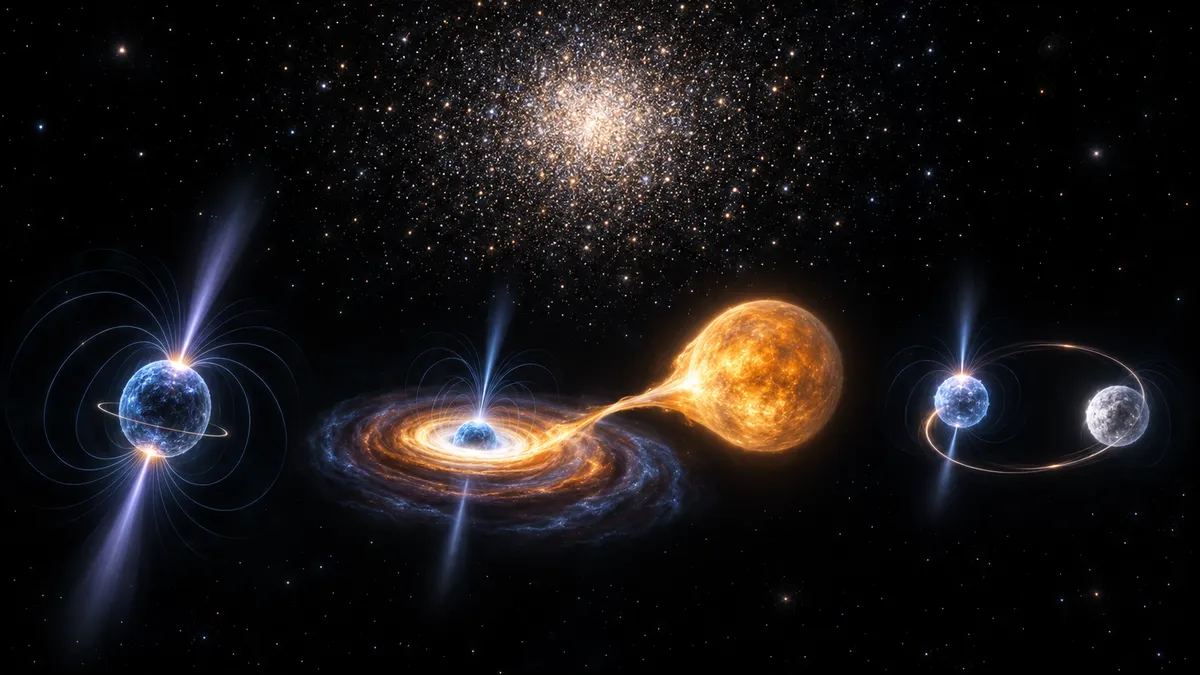
A simulation can track a neutron star through a crowded cluster without describing how its rotation and magnetic field change. A new preprint tests software designed to fill that gap, using simplified cases that make numerical mistakes easier to identify.
Pulsars are rotating neutron stars whose observable properties depend on their spin and magnetic fields. In globular clusters, interactions and binary companions add further complications. Material transferred from a companion can accelerate a neutron star’s rotation, producing a recycled millisecond pulsar. Modelling these changes alongside the motion of thousands of stars requires more than calculating gravitational trajectories.
In a new preprint, Maria Rah presents standalone tests of a pulsar-evolution routine intended for NBODY6++GPU, a program for simulating star clusters. The central question is whether the routine reproduces specified equations and benchmarks before it is connected to a full cluster simulation. The work does not yet demonstrate that complete integration.
Seven controlled cases
Rah tests seven configurations: a young isolated pulsar, an isolated millisecond pulsar, an accreting pulsar, a pulsar in a dense cluster core, a wide binary, a neutron-star pair and a neutron-star–black-hole pair. These cases separate processes that would otherwise operate together, making discrepancies easier to trace.
The study compares two implementations. One uses Python with adaptive Runge–Kutta integration through SciPy; the other uses Fortran with a fourth-order Hermite integrator. Both track magnetic field strength, rotation period and period derivative—the rate at which that period changes—over 100 million years.
Recording those three quantities at 101 times for seven scenarios produces 2,121 paired values. Rah reports agreement better than 0.1% throughout, with maximum fractional differences of about 0.067% for period and 0.093% for period derivative. Agreement between implementations supports numerical consistency, but does not independently establish that their shared physical assumptions describe real pulsars.
Braking, recycling and an imposed limit
The young-pulsar case provides a benchmark with an analytical solution. Its magnetic field decays exponentially, with a prescribed decay timescale of 500 million years, while magnetic dipole braking slows its rotation. Rah reports that the period grows from 0.1 seconds to 2.26 seconds over 100 million years.
An early version counted the influence of magnetic-field decay twice, producing excessive braking. Removing the redundant contribution brought the calculation into agreement with the analytical benchmark. This illustrates the value of testing an isolated process before embedding it in a more complicated simulation.
The isolated millisecond pulsar evolves more slowly, changing from a 3.0-millisecond period to approximately 3.20 milliseconds. Rah places its results in the region occupied by observed millisecond pulsars in clusters such as 47 Tucanae. This is a consistency check, rather than a prediction of an entire observed population.
The accreting case tests the opposite behaviour: spin-up. Starting at 2 milliseconds, the model receives material at one ten-billionth of a solar mass per year. After revisions to the accretion coefficient, Rah reports that the spin-up contribution initially exceeds magnetic braking by about fourteenfold.
The period reaches 1 millisecond after roughly 80 million years. Crucially, that endpoint is an imposed minimum period: the software then holds the period fixed and sets its derivative to zero. It is therefore not an independently predicted final spin. The reported negative period derivative describes the active spin-up phase, not the state after reaching the limit.
What remains untested
For the dense-core case, Rah reports environmental torques much weaker than magnetic braking. However, the manuscript gives inconsistent numerical descriptions: an environmental fraction of 0.036% in several places, but a magnetic contribution of 99.5% elsewhere. The qualitative conclusion is clearer than the exact fraction.
The wide-binary case also shows little additional influence on spin. The two compact-binary cases are more restricted: gravitational-wave orbital decay and tidal spin–orbit coupling are not active. Their identical spin histories consequently test the same magnetic-braking prescription, not the different orbital evolution of neutron-star and black-hole companions.
Rah separately examines a 105,000-particle cluster simulation to assess infrastructure, including neutron-star tracking and possible integration points. That assessment is distinct from running the new routine inside a complete cluster model.
Other limitations include the common exponential magnetic-decay prescription and the absence of the propeller effect, which can inhibit accretion. Several coefficients were revised using theoretical and observational expectations, so reproducing those expectations is not wholly independent evidence. The study’s clearest contribution is a documented set of controlled checks and corrections; broader predictive performance awaits integrated simulations and further physical development.
- pulsars
- neutron stars
- globular clusters
- numerical validation
- millisecond pulsars
- NBODY6++GPU
- accretion
Related reading
Automatically matched by shared topic keywords. These links do not imply that the sources agree or establish a consensus.
Why Bigger Telescopes Alone Cannot Perfect Pulsar Timing
Source published
Shared keywords: millisecond pulsars
Could daily pulsar observations probe a gravitational-wave blind spot?
Source published
Shared keywords: millisecond pulsars
Seven pulsar binaries sharpen measurements of stellar orbits and distances
Source published
Shared keywords: millisecond pulsars
Could nearby star clusters have helped populate the Milky Way’s crowded centre?
Source published
Shared keywords: globular clusters
AI trained on physics equations speeds up models of spinning neutron stars
Source published
Shared keywords: neutron stars