TRANSMISSION // 2611.12960v1
Matching People from Above: What Depth Cameras Can—and Cannot—Hide
Source published
Two IIT Patna competition entries matched people across overhead camera recordings using depth and RGB images. Their reported results favor one lightweight depth-based approach, but differing training setups, incomplete implementation details and unmeasured privacy benefits limit the conclusions.
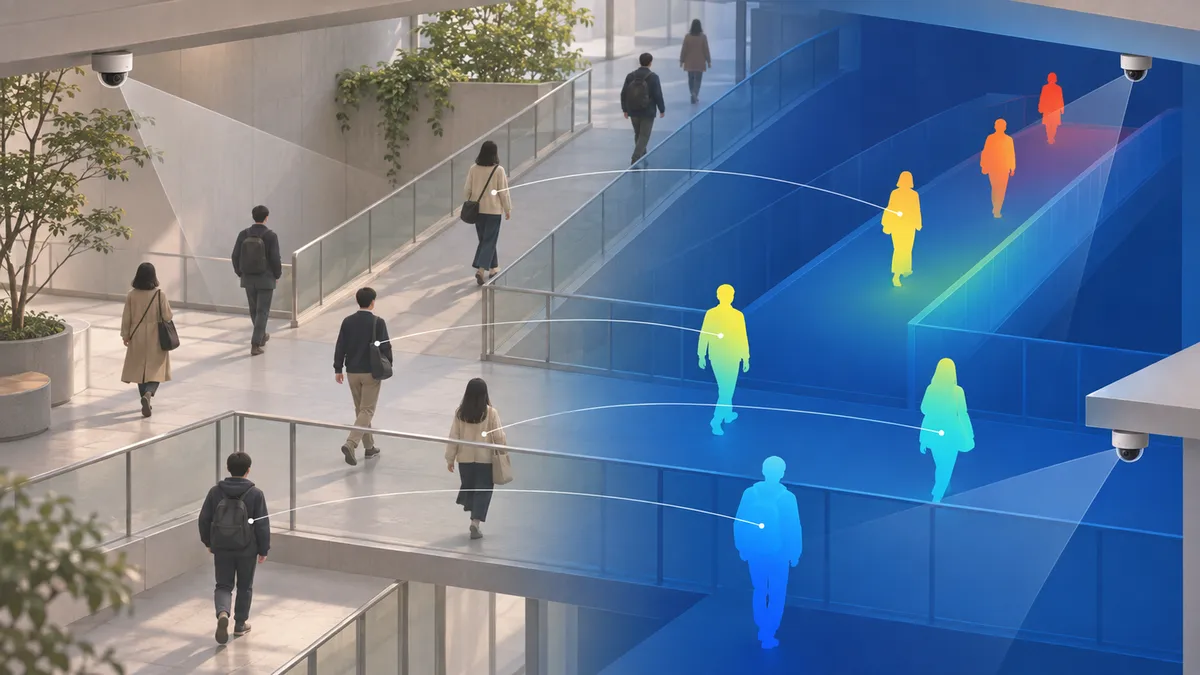
Overhead cameras reveal less of a face than cameras at eye level, while depth sensors record distance rather than clothing color. A competition report explores how machine-learning systems can still match people across these recordings—and why reduced visual detail is not the same as guaranteed privacy.
Recognizing a person without seeing their face
Person re-identification asks whether separate camera observations show the same person. It does not necessarily attach a name to that person: the immediate task is to match recordings. Conventional systems often use clothing colors and textures. Overhead views reduce facial visibility, while depth images replace ordinary appearance with measurements of body geometry.
The supplied paper describes two IIT Patna entries in the ICPR 2026 TVRID competition. It is an arXiv version-one preprint dated November 7, 2026. The supplied text does not establish that this report has undergone peer review; its findings should be read as reported competition results, not independently verified conclusions.
The test: short passages across different views
The TVRID dataset contains 86 people recorded by four synchronized Intel RealSense D455 overhead cameras. The cameras capture aligned RGB and depth streams at 15 frames per second, with flat, ascent, descent and oblique views. Each passage has incoming and outgoing observations.
Training uses 62 people. Test identities are separate, so the systems must match people they did not learn to classify during training. Each observation sequence, called a tracklet, lasts roughly two to three seconds. Changes in viewpoint and apparent body size complicate matching, especially when depth images lack clothing color and texture.
Evaluation covers incoming-versus-outgoing observations within a camera, ascent versus descent, and flat versus oblique views. A query tracklet is compared with candidate gallery tracklets, which the system ranks by similarity.
Two ways to represent depth
Methodology 1, or M1, converts single-channel depth images into three-channel images using a fixed JET color map. These artificial colors encode depth variation; they do not recover actual clothing colors or add new measurements. The conversion makes depth structure available in an input format suited to an image-pretrained network.
M1 uses OSNet, a network with about 2.2 million parameters that combines features at several spatial scales. Each frame becomes a 512-number representation. Training teaches the model to distinguish the 62 training identities, using label smoothing—a technique that softens the target labels rather than demanding absolute certainty. Training runs for 60 epochs, with image flips and random crops.
Methodology 2, or M2, uses separate, larger networks: ResNeSt-50d for RGB and ResNet-50 for depth, with about 27 million and 26 million parameters respectively. Depth images are copied into three identical channels rather than colorized. Each frame produces 2,048 features.
M2 averages frame features to describe a tracklet, then normalizes that representation. Averaging ignores frame order and is intended to reduce frame-level noise. When both modalities are available, M2 can also average their matching distances. The supplied results do not give a separate score for this fusion.
Both methods start from ImageNet-pretrained weights and use only the official TVRID data for task-specific training. Thus, “official training data only” does not mean learning entirely from scratch.
What the reported scores show
The competition uses two measures. CMC@1 records how often the highest-ranked candidate is a correct match. Mean average precision, or mAP, evaluates how well correct matches are ranked across the retrieval results.
On depth images, M1 reports 93.51% mAP and 90.42% CMC@1, compared with 86.26% and 80.34% for M2. That is a difference of 7.25 percentage points in mAP and 10.08 points in first-choice accuracy. M1 ranks fourth among 28 depth entries. Both exceed the reported depth-track averages of 57.19% mAP and 47.10% CMC@1.
M2 reports 99.63% mAP and 99.35% CMC@1 on RGB. The results table also lists slightly higher RGB scores for M1, but its detailed methodology describes only a depth pipeline. That limits interpretation of its RGB result.
What remains uncertain
The depth comparison does not isolate the effect of colorization. The methods also differ in architecture, training settings, supervision and aggregation. Without controlled experiments changing one component at a time, the results cannot establish which ingredient caused the advantage.
Some implementation details are unresolved. M1 does not clearly specify how normalized frame features become one tracklet representation. M2's description says the depth batch-normalization layer is retained before averaging, but elsewhere says it is removed during inference. No confidence intervals or repeated-run variability are reported.
Finally, matching accuracy is not a privacy measurement. The paper motivates overhead depth sensing as reducing facial and color information, but reports no quantified privacy evaluation. Its demonstrated goal remains linking observations of the same person. The findings support effective matching on this benchmark—not a guarantee of anonymity or equivalent performance in other settings.
- person re-identification
- depth sensing
- overhead cameras
- computer vision
- privacy
- tracklet aggregation
- preprint
Related reading
Automatically matched by shared topic keywords. These links do not imply that the sources agree or establish a consensus.
Can several camera views help find the same suitcase?
Source published
Shared keywords: computer vision
A robot's-eye view, generated from outside video
Source published
Shared keywords: computer vision
LEF-JEPA targets object structure without preserving every visual detail
Source published
Shared keywords: computer vision
Animal Identification Scores Can Hide Other Clues to a Match
Source published
Shared keywords: computer vision
GlobalPuzzle uses the whole picture to assemble eroded image fragments
Source published
Shared keywords: computer vision