TRANSMISSION // 2611.12958v1
A robotic laboratory links experiment planning with hands-on chemistry
Source published
An Embodied Science Agent combined AI planning, statistical optimisation and robotic handling to improve dye decolourisation over 15 experimental rounds. The preprint demonstrates an integrated laboratory workflow, but does not establish complete pollutant destruction or broad scientific autonomy.
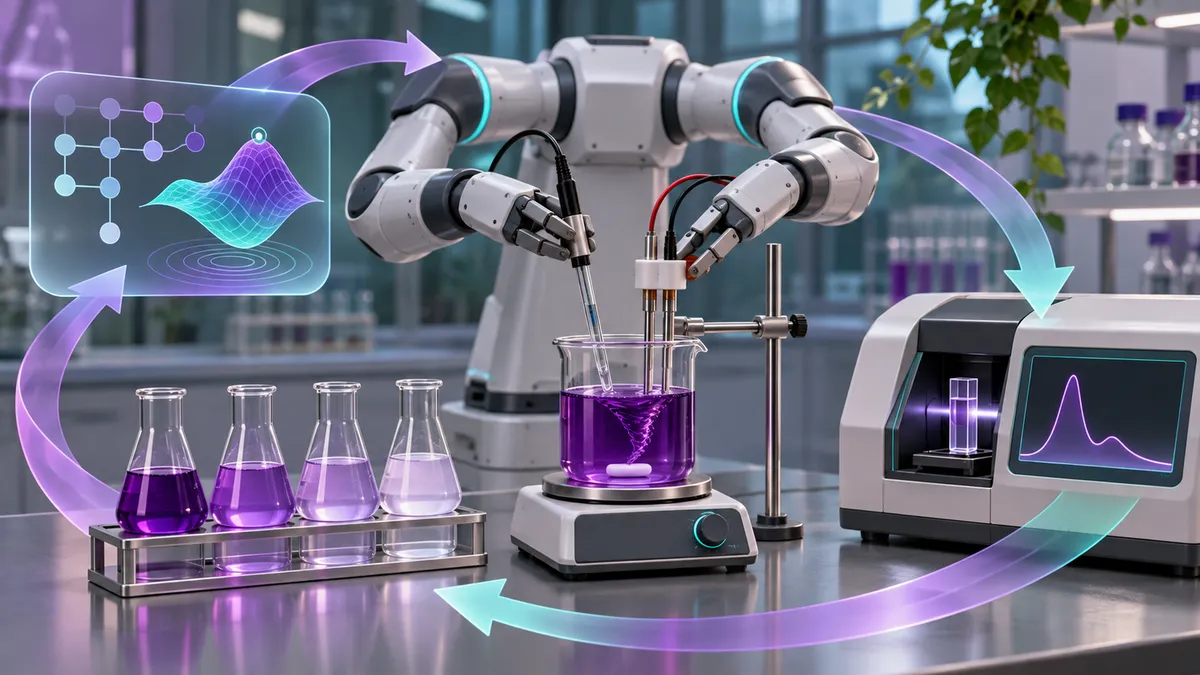
Choosing an experiment and physically carrying it out are different challenges. A new research prototype connects those tasks in a laboratory that adjusts treatment conditions, handles equipment and uses measurements to select its next experiment.
Connecting decisions to physical experiments
A self-driving laboratory needs more than software that writes experimental instructions. Instruments must be configured, probes positioned and results measured reliably enough to inform the next decision. In Embodied Science Agents: Making Embodied Experimental Design Learnable, Yihang Chen and colleagues describe a system intended to connect these activities.
Their Embodied Science Agent, or ESA, combines three kinds of learning: using past experiments to guide planning, using measurements to choose treatment conditions, and learning physical handling skills from demonstrations. The supplied paper is an arXiv version-one preprint dated 7 November 2026. It also carries a conference citation, but the supplied text does not establish its peer-review status.
How the system works
ESA has three main components. A Digital Agent plans procedures and retrieves relevant cases from a memory containing experimental contexts, actions and outcomes. Both successful and unsuccessful experiments can be stored, giving later planning access to earlier evidence.
An Embodied Agent operates equipment through three routes: direct software commands, interaction with graphical interfaces, and physical manipulation by a dual-arm robot. A connecting interface coordinates tasks, checks dependencies and incorporates safeguards such as physical-constraint checks and emergency-stop channels. These are described design features, not a quantitative demonstration of safety under every failure condition.
For physical handling, the researchers trained Action Chunking Transformer models to predict sequences of robot movements from camera images and the robot’s own position information. Language labels select specialised skills, such as moving an electrode rack. The demonstration dataset contained 480 trajectories across two experimental settings, with variation in object positions, lighting and other visual conditions.
This distinction matters: the robot’s handling skills were trained from demonstrations. The reported chemistry campaign does not show those motor skills continuously improving through online practice.
Searching for better treatment conditions
The chemical test involved Safranine T, a model dye pollutant, treated using an Electro-Fenton process. This process electrochemically generates hydrogen peroxide and supports iron cycling that produces highly reactive hydroxyl radicals. The setup used a composite cathode fabricated from waste Fenton sludge.
The system varied five parameters: acidity, applied voltage, aeration intensity, stirring speed and sodium sulfate concentration. Their listed settings define more than 200 million possible combinations. ESA did not test all of them; this figure describes the search space, not the experimental workload.
Instead, five initial experiments used Latin hypercube sampling, a method designed to spread starting points across the parameter space. Ten further experiments were selected using Bayesian optimisation.
Here, a Gaussian-process model estimates how treatment conditions relate to the measured result, while also estimating uncertainty. An upper-confidence-bound rule balances trying conditions predicted to work well against exploring conditions whose effects remain uncertain. Each new measurement updates the model.
The objective was final solution transmittance: the fraction of light passing through the treated liquid. A typical run included a 30-minute pretreatment and a 60-minute electrochemical treatment, followed by measurement and cleaning.
What the measurements showed
Across 15 rounds, reported transmittance increased from approximately 82% to 99.7%. Most intermediate results remained around 86–88%; round 14 reached 89%, followed by the much higher final reading. The full autonomous campaign reportedly took roughly 45 hours.
The increase was 17.7 percentage points, but transmittance is not directly proportional to dye concentration. Using the Beer–Lambert relationship between transmittance and absorbance, the authors calculate approximately 98.5% less residual dye concentration in the final result than in the baseline result. That is not the same as demonstrating 98.5% removal relative to the original untreated solution.
Nor does clearer liquid establish complete pollutant destruction. As the paper acknowledges, decolourisation measures removal of light-absorbing colour structures; it does not by itself demonstrate full mineralisation, or complete breakdown of the organic pollutant.
A separate manipulation case study showed successful rack movement and electrode insertion at three sampled starting placements. This supports limited spatial generalisation, rather than reliable handling of arbitrary laboratory layouts.
What remains uncertain
The paper does not report replicated optimisation campaigns or uncertainty intervals for the final improvement. It also lacks quantitative comparisons with alternative optimisers and component-removal experiments, so its claim that the combined architecture explains the performance remains unisolated. Fifteen measurements cannot establish that the best possible configuration was found.
Some reporting details also need clarification. The workflow claims no human intervention, while the device appendix says pH readings were recorded manually through a graphical interface. A typical recipe lists 100 millimoles per litre of sodium sulfate, outside the optimisation table’s 25–75 range.
The strongest supported conclusion is therefore specific: this prototype connected planning, robotic execution and measurement-driven optimisation in one dye-treatment workflow. Broader chemical transfer, repeatability and memory-driven improvement across tasks remain open questions.
- self-driving laboratory
- embodied AI
- robotic chemistry
- Bayesian optimisation
- Electro-Fenton treatment
- Safranine T
- decolourisation
Related reading
Automatically matched by shared topic keywords. These links do not imply that the sources agree or establish a consensus.
When a Robot Experiment Becomes Scientific Evidence
Source published
Shared keywords: embodied ai
When should a robot look ahead before moving?
Source published
Shared keywords: embodied ai
When shorter instructions trip up embodied AI agents
Source published
Shared keywords: embodied ai
AI coding agents build a robotics simulation benchmark
Source published
Shared keywords: embodied ai
A Navigation Memory That Recognizes Similar Routes Across Different Homes
Source published
Shared keywords: embodied ai