TRANSMISSION // 2611.12955v1
When a Time-Series AI Is Surprised, It Finds Its Boundaries
Source published
ConceptTime uses a forecasting model’s prediction errors to segment time-series data, group segments into learned concepts, and score how well an input fits its vocabulary. Across benchmark tasks, it was competitive with black-box classifiers and strongest among the interpretable methods tested, though performance varied. On fault-diagnosis operating-condition shifts, its fidelity score averaged 0.666 AUROC and a 0.719 false-positive rate at 95% OOD recall.
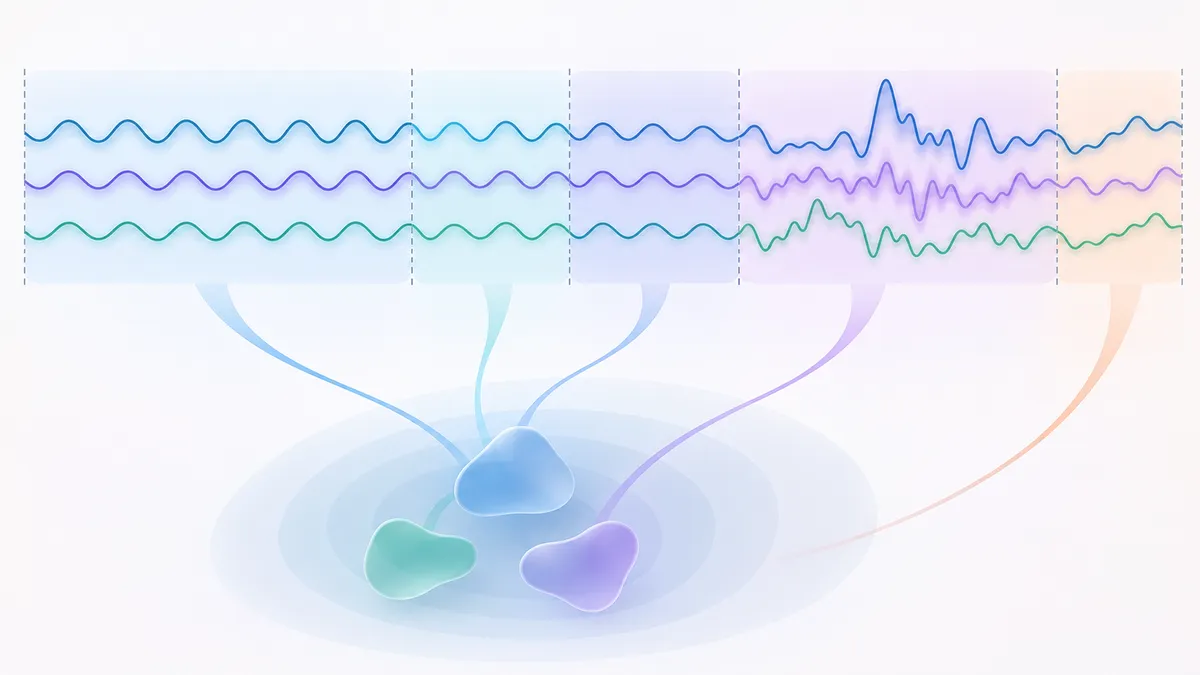
A sensor trace can mean different things in different contexts. For illustration, a quiet stretch might be expected after one pattern but surprising after another; the paper does not test this particular example. ConceptTime uses a forecaster’s mismatch with incoming data to choose segment boundaries and help build a vocabulary of patterns without hand-labeled concepts.
Many time-series classifiers produce a label without making clear which parts of a recording influenced it. A concept bottleneck offers one route to transparency: the model makes its decision through intermediate concepts that can be examined. But time series pose a challenge. To learn a pattern, a system needs to know where its segment begins and ends; to find those boundaries, it needs some idea of what patterns matter.
The paper introduces ConceptTime, which uses predictive surprise—the mismatch between a model’s forecast and what actually happens next—to address this problem. The authors investigate whether the same signal can guide segmentation, describe the segments, and flag inputs poorly covered by the learned vocabulary.
Forecasting, segmenting, grouping
ConceptTime first trains an autoregressive probabilistic model to predict each next observation from the preceding history. In the reported setup, it predicts a Gaussian distribution for each signal channel. When the actual observation is unlikely under that forecast, the model records greater surprise.
A length-constrained dynamic-programming procedure uses surprise scores to divide each recording into a chosen number of segments. It seeks a partition that captures surprise while keeping segment lengths within specified limits; it does not simply cut whenever a threshold is crossed.
The frozen forecasting model then helps summarize each segment. The summaries include what the model expected, how residuals differed from those expectations, and how surprise unfolded over time. The authors cluster these summaries into prototypes they call concepts. A lightweight classifier predicts labels from the sequence of concept assignments. The model-to-concept pipeline is deterministic and does not use class labels, which makes its steps inspectable. That property does not, by itself, guarantee that every learned concept will be readily meaningful to people: prototype meanings are interpreted after training.
ConceptTime also computes distances between segment summaries and their nearest prototypes. These distances contribute to an input-level fidelity score: higher fidelity means the input’s segments are better covered by the vocabulary; lower fidelity indicates poorer coverage. The authors propose using this score to support abstention or human review. It is not a measure of whether a classification is correct.
What the tests showed
The paper evaluates ConceptTime on public benchmarks spanning wearable activity signals, EEG, sleep staging, multivariate time series, and bearing-fault diagnosis. In the main classification comparisons, results are averaged across three random seeds. ConceptTime was the strongest interpretable method included, but it did not outperform every black-box model on every task. At full supervision it matched or exceeded some strong black-box baselines on Epilepsy, while trailing them on other datasets.
On the Epilepsy task, the reported accuracy with 1% of labels was 97.91%. This is a result on that benchmark, not evidence that the approach will require little labeled data across settings. In the appendix comparison, TSLANet outperformed ConceptTime at all three label budgets on UCI-HAR and Sleep-EDF.
The fidelity score’s OOD-detection results varied by evaluation. On synthetic noise and temporal-shuffle perturbations of HAR data, the authors report AUROC rising from 0.864 to 0.992 as noise severity increased. For shifts between fault-diagnosis operating conditions, mean AUROC was 0.666, with substantial variation across condition pairs. At 95% OOD recall, the mean false-positive rate was 0.719. On Epilepsy, softmax confidence ranked errors better than fidelity in the selective-prediction comparison.
Deletion tests offer another, narrower check: researchers remove patches in ranked order and track how classification accuracy falls. Under the paper’s specified deletion protocol, fidelity had lower deletion AUC than the compared methods on Epilepsy, while GradientSHAP did slightly better on HAR. A separate Epilepsy test using replacements that preserve valid concept assignments also found fidelity and GradientSHAP stronger than random ordering. These findings concern the tested classifier and deletion procedures; they do not establish a universal measure of patch importance.
What remains uncertain
The study reports results across 17 benchmark tasks and additional transfer, OOD, selective-prediction, and deletion evaluations. Those experiments provide evidence about the tested datasets, model settings, and perturbations, but do not establish performance in every real-world setting or readiness for clinical or industrial use. The authors also fix vocabulary size in advance, and people interpret prototype meanings after training. A prototype may reflect a sensor artifact as well as a meaningful event.
The paper identifies its venue as NeurIPS 2026; the source provided here does not independently verify publication details. More importantly, high fidelity should not be treated as proof of correctness, and low fidelity is not a diagnosis or a reliable measure of risk. Before consequential use, the authors say systems should be validated on data from the intended population, sensors, and operating conditions, with human oversight.
ConceptTime’s central idea is to use what a forecaster finds unexpected both to organize a time series and to describe it. Its benchmark results suggest promise for interpretable classification, while variable performance across evaluations shows why the fidelity score and classification results need testing in the settings where they might actually be used.
- time-series classification
- interpretable AI
- predictive surprise
- concept bottleneck
- out-of-distribution detection
Reviewed cross-references
These connections were reviewed by a model, not independently fact-checked by a human. Similarity does not imply agreement; consult the original papers and the evidence below.
A medical-language AI that explains predictions through concepts
Shared method: Both papers use concept bottlenecks without concept-presence annotations, but construct concepts differently: ConceptTime clusters predictive signatures from time-series segments, whereas the clinical-text framework scores concepts from a predefined ICD-10 vocabulary using cross-attention. This is a methodological connection, not evidence of equivalent methods or performance; the comparison is based on selected excerpts from preprints.
Model review: · openai-codex/gpt-6-luna
Evidence and provenance
Selected excerpts, not complete papers. PDF extraction can omit figures or damage equations, tables and reading order; sources may be preprints.
2611.12955v1 — Original paper
Excerpt reference:
static/papers/2611.12955v1.md:13-64
Basis: Paper text
Source SHA-256:04ff1b16844eb7d49a25a73fe324aef85ff593e48fbc097150cfb777313712f62611.12955v1 — Original paper
Excerpt reference:
static/papers/2611.12955v1.md:156-310
Basis: Paper text
Source SHA-256:04ff1b16844eb7d49a25a73fe324aef85ff593e48fbc097150cfb777313712f62611.13564v1 — Original paper
Excerpt reference:
static/papers/2611.13564v1.md:75-143
Basis: Paper text
Source SHA-256:b5e734075106ac6e728879063232ad4ca2da8ad767e33093bb191b942b7c6256
Related reading
Automatically matched by shared topic keywords. These links do not imply that the sources agree or establish a consensus.
A confidence check for AI managing computer processors
Source published
Shared keywords: out of distribution detection
A medical-language AI that explains predictions through concepts
Source published
Shared keywords: concept bottleneck
PLUS adds a class-specific signal to help AI spot unfamiliar images
Source published
Shared keywords: out of distribution detection
Reading the warning signs: an explainable way to stop failing web agents early
Source published
Shared keywords: interpretable ai
Prostate ultrasound AI uses past cases to explain predictions—and flags disagreement
Source published
Shared keywords: interpretable ai