TRANSMISSION // 2611.12945v1
Early X-rays may help reveal what powers gamma-ray bursts
Source published
Annarita Ierardi and colleagues report that the rapidly fading X-ray emission of gamma-ray bursts separates candidate stellar collapses from candidate compact-object mergers in their samples. Their preprint proposes a diagnostic for X-ray surveys, subject to brightness, viewing-angle and distance constraints.
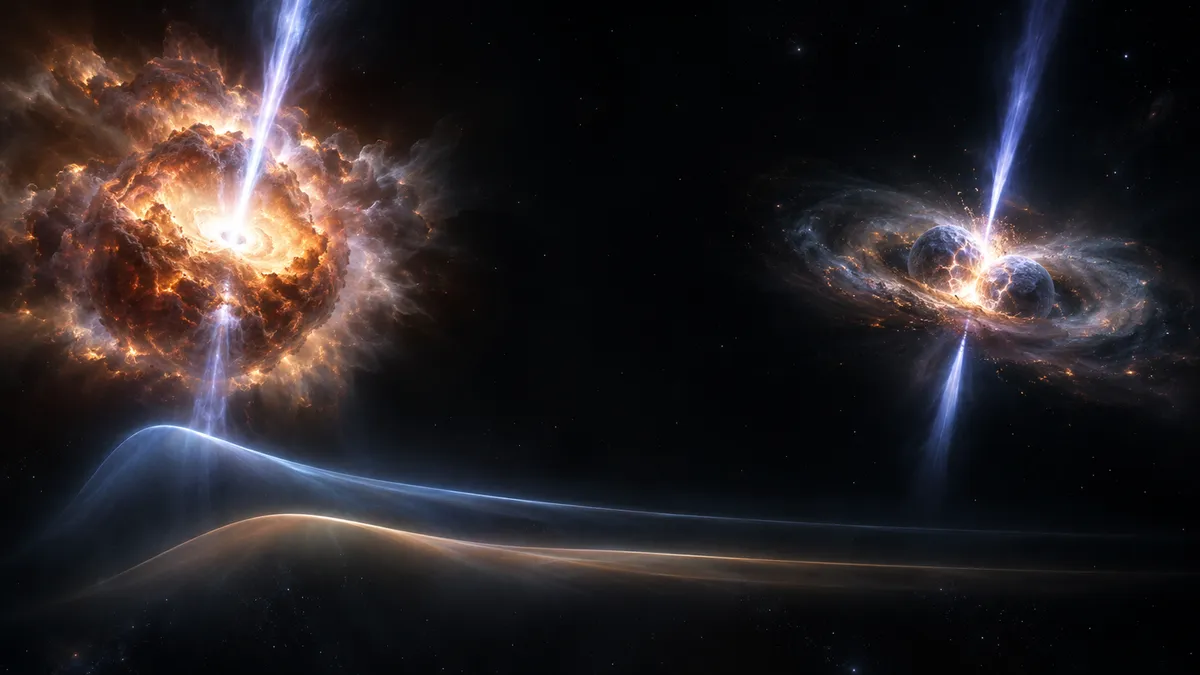
A gamma-ray burst’s duration does not always reveal its origin. A new analysis suggests that the brightness and spectrum of its early X-ray emission could provide another way to distinguish a collapsing massive star from a merger of compact objects.
Looking beyond burst duration
Gamma-ray bursts are brief, intense flashes powered by narrow jets moving at ultra-relativistic speeds. Two main origins are associated with these events: the collapse of a massive star, known as a collapsar, and the merger of compact objects, including pairs of neutron stars.
Astronomers traditionally distinguish short bursts, lasting roughly two seconds or less, from longer ones. Short bursts are generally associated with mergers and long bursts with stellar collapses. But duration is not a dependable identifier on its own. The source paper highlights a short burst associated with a supernova and long bursts associated with kilonovae, the thermal transients that indicate compact-object mergers.
In a preprint, Annarita Ierardi and colleagues investigate a different clue: the rapidly fading X-ray emission shortly after the initial flash. They report that its spectral properties and luminosity distinguish candidate collapsars from candidate mergers more clearly than the corresponding properties of the prompt gamma-ray emission.
Following the fading spectrum
The researchers selected 23 long gamma-ray bursts observed by the Neil Gehrels Swift Observatory as collapsar candidates. Each had a measured redshift, which enables distance estimates, and a bright, clearly identifiable X-ray steep-decay phase.
This phase is generally interpreted as the closing stage of the prompt emission. Its brightness drops sharply while its spectrum shifts from higher to lower energies. The team applied selection criteria designed to reduce contamination from later emission and prolonged flaring.
They divided the observations into time intervals and fitted spectra from Swift’s X-Ray Telescope and Burst Alert Telescope, using their combined coverage between 0.3 and 150 kiloelectronvolts. The fits accounted for absorption along the line of sight in both our Galaxy and the burst’s host galaxy.
Two descriptions of the radiation were tested. A physical synchrotron model describes emission from energetic electrons radiating in magnetic fields. An empirical model, the Band function, describes the spectrum’s shape without specifying its physical origin.
These fits yielded a characteristic spectral energy and an estimate of the flux integrated over a broad energy range. The authors then used redshifts to calculate source-frame spectral quantities and isotropic-equivalent luminosities: the power inferred if the measured radiation were emitted equally in every direction, rather than concentrated into a jet.
Separate patterns in early X-rays
Within the collapsar-candidate sample, characteristic spectral energy increased with luminosity under both models. The authors report strong correlations, with Spearman rank coefficients of 0.80 for the synchrotron cooling feature and 0.86 for the Band-model peak energy.
More importantly for classification, these X-ray measurements occupied regions distinct from those of merger candidates studied in the team’s previous work. The merger candidates occupied a lower-luminosity region in the synchrotron comparison.
One notable example was GRB 211211A. Despite its long duration, this burst has evidence linking it to a compact-object merger. Its early X-ray properties followed the merger-candidate pattern, rather than the collapsar-candidate pattern.
The authors also compared the X-ray measurements with prompt gamma-ray observations from Fermi. Under the synchrotron model, the X-ray relations appeared to extend the prompt-emission relations to lower energies. That continuity was less evident for collapsar candidates fitted with the Band function, showing that the interpretation depends partly on the spectral model.
A simpler diagnostic for X-ray surveys
Einstein Probe’s Wide-field X-ray Telescope observes a narrower energy range, from 0.5 to 4 kiloelectronvolts. That makes detailed measurements of spectral peaks and total radiated flux difficult.
To accommodate this limitation, the team refitted Swift spectra within that narrower band using a simple power law. They compared X-ray luminosity with photon index, a measure of spectral hardness. Collapsar candidates remained more luminous and generally softer than merger candidates.
As a test case, the authors examined EP 240801A, an Einstein Probe transient associated with a gamma-ray burst and a supernova. Its measurements fell in the collapsar-candidate region, consistent with that independent evidence.
Where the method applies
The proposed diagnostic is not a general classifier for every fast X-ray transient. The authors require evidence that the source is a gamma-ray burst viewed along its jet, together with a bright steep-decay phase. Their stated brightness criterion is a peak flux above 10⁻⁸ erg per square centimetre per second in the 0.3–10 kiloelectronvolt band.
A measured redshift is needed for strong constraints; without one, the authors suggest examining how the inferred properties change across possible redshifts. Einstein Probe’s lower sensitivity also means larger spectral uncertainties than Swift’s.
The findings therefore establish a promising separation in selected candidate samples, not a guaranteed identification for an arbitrary new event. Larger samples could test how broadly the diagnostic works and whether it remains useful beyond the original selection criteria.
- gamma-ray bursts
- early X-ray emission
- collapsars
- compact-object mergers
- Swift Observatory
- Einstein Probe
- spectral analysis
Related reading
Automatically matched by shared topic keywords. These links do not imply that the sources agree or establish a consensus.
Fading X-rays connect merger-driven gamma-ray bursts to their opening flash
Source published
Shared keywords: compact object mergers, early x ray emission, einstein probe, gamma ray bursts
Could a magnetar power GRB 241030A’s early X-rays?
Source published
Shared keywords: gamma ray bursts
Reshaping telescope grids could widen the search for gamma-ray bursts
Source published
Shared keywords: gamma ray bursts
Triangular Calibration Improves GALI’s Gamma-Ray Burst Localization in Tests
Source published
Shared keywords: gamma ray bursts
A narrow black-hole jet could explain a seven-hour gamma-ray burst
Source published
Shared keywords: gamma ray bursts