TRANSMISSION // 2611.12933v1
Human–AI teams run X-ray experiments with a traceable decision record
Source published
A preprint describes three synchrotron experiments directed by one scientist and coordinated by specialized AI agents. Audits of their exchanges trace how decisions, code changes and error corrections were shared, while highlighting continued reliance on human judgment.
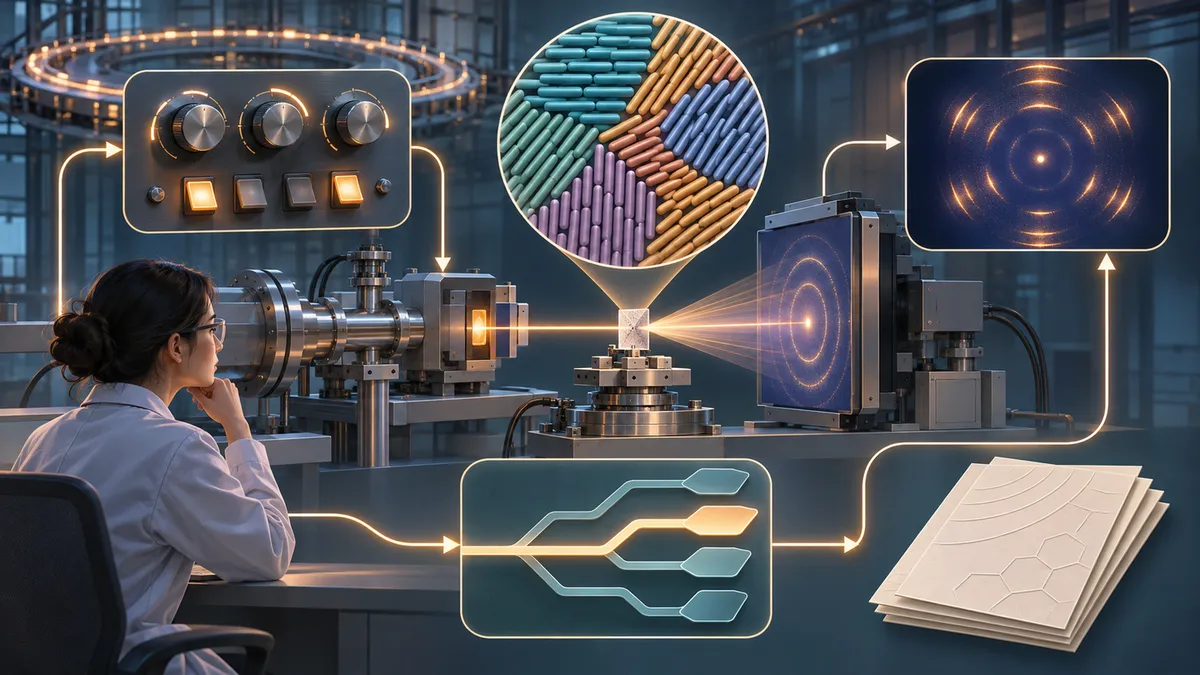
An autonomous experiment needs more than software that chooses the next measurement. Scientists also need to understand why that choice was made, who approved it and how mistakes were corrected. A new preprint presents a human–AI system designed to support both adaptive X-ray measurements and a detailed record of the collaboration behind them.
Closing the experimental loop
Gunik Luthra and colleagues report a system called VISION-CC that uses specialized coding agents to coordinate synchrotron X-ray experiments under a scientist’s direction. Across three sessions at Brookhaven National Laboratory’s National Synchrotron Light Source II, the team operated for more than 50 active hours and examined two nanoparticle superlattice samples.
In closed-loop experimentation, each measurement feeds into analysis, which informs where to measure next. This can adapt sampling to a scientific objective, but connecting instrument controls, analysis and optimization requires substantial engineering. The researchers investigated whether coding agents could help build and modify that workflow during beamtime—and whether their contributions could be audited afterward.
Specialized agents, established scientific tools
VISION-CC uses Claude Code’s agent-team infrastructure. A Team Lead translates the scientist’s objectives into tasks. Specialist agents handle instrument operation, scattering analysis, adaptive sampling and live reporting. Plain-text instructions define their responsibilities, scientific context and approval requirements.
The language models coordinate work and generate supporting code; established software performs the underlying scientific operations. Bluesky controls acquisition, SciAnalysis processes scattering data, and gpCAM runs Gaussian-process models. These models predict how measured quantities vary across the sample and estimate uncertainty, helping select subsequent measurement positions.
Separate runtime programs exchange requests and completion signals through files. This keeps the acquisition–analysis–selection loop distinct from the agents’ conversational coordination.
Human access to conventional controls remained available. A bridge connecting the agents to the beamline could be disconnected, while motor limits remained the primary safeguard against unsafe motion. The experiment therefore retained human supervision rather than transferring unrestricted control to the agents.
Mapping nanoparticle arrangements
The measurements used small-angle X-ray scattering, which provides information about nanoscale structure through scattering patterns. A central sample contained cadmium selenide/cadmium sulfide nanorods assembled into structures with twofold and sixfold packing signatures.
The scientist changed objectives across the sessions. Early measurements sought regions with strong scattering peaks. Later work located boundaries and mapped the orientations of coexisting lamellar and hexagonal structures. Sampling strategies and noise models were modified as those objectives evolved.
In the third experiment, the maps revealed sub-millimeter orientation domains and gradual changes in alignment. The mapped hexagonal grains showed no consistent orientational relationship to the lamellar structures. These are structural observations, not demonstrations of improved device performance.
Setup took 100–133 minutes across the three sessions. For 23 scientist-requested changes to the running experimental configuration, the median interval from request to the changed loop’s first measurement was 22 minutes. These timings document this deployment; they do not establish a general speed advantage across laboratories.
Tracing decisions and corrections
The researchers retained complete human–agent and agent–agent interaction transcripts. An audit pipeline classified messages and extracted individual ideas, decisions, findings and corrections. It then linked contributions to relevant earlier exchanges, code edits and reported results. Multiple model raters checked proposed links, with human annotators and models from another model family assessing samples or specified sets of chains.
This distinction between messages and contributions matters: one long message can contain several ideas or decisions. The Team Lead sent most messages and received credit for roughly half of the extracted contribution events. The human supplied about one-fifth of idea events, while making 51–55% of the decisions on ideas proposed by someone else.
Across sessions, 59–68% of correction chains involved multiple participants in introducing, catching or fixing an error. Between 44% and 52% of decisions drew on another participant’s idea or evidence. Methodological and scientific contributions together rose from 46% in the setup-heavy first experiment to 56–61% in later sessions.
One example shows why checking an output matters more than confirming a setting. The scientist noticed that measurement positions remained on a 0.05-millimeter grid despite a configured minimum step of 0.01 millimeters. The adaptive-sampling agent then corrected the implementation.
What the audit can—and cannot—show
The audit labels carry uncertainty. Its estimate that 61–67% of messages involved interpretation or judgment depended on how raters applied that definition. Human annotators disagreed with one another and tended to require interpretation to dominate a message, whereas the pipeline counted messages containing any interpretation.
The collaboration findings were more stable. Restricting the analysis to chains confirmed by both cross-family models still left most corrections involving multiple participants and an estimated 37–46% of decisions drawing on others’ input.
Nevertheless, the study covers only three experiments at one beamline, with one scientist and one agent platform. Its conclusions may not transfer to other teams or instruments. The work remains a preprint. It demonstrates a human-guided deployment and a way to inspect its recorded decisions—not a replacement for scientific expertise or a guarantee that every action is correct.
- autonomous experimentation
- human–AI collaboration
- X-ray scattering
- multi-agent systems
- decision provenance
- nanoparticle superlattices
- Gaussian processes
Related reading
Automatically matched by shared topic keywords. These links do not imply that the sources agree or establish a consensus.
An Optical Experiment That Can Revise Its Own Software
Source published
Shared keywords: autonomous experimentation
Faster noise modelling could sharpen studies of exoplanet atmospheres
Source published
Shared keywords: gaussian processes
When a Prediction Model Benefits From Forgetting Data
Source published
Shared keywords: gaussian processes
PanelGP links stock-return and risk forecasts, with limits on risk calibration
Source published
Shared keywords: gaussian processes
Can moving sensors learn where to look next?
Source published
Shared keywords: gaussian processes