TRANSMISSION // 2611.12917v1
Listening beneath the tracks: seismic noise at a proposed gravitational-wave site
Source published
A new borehole network in the Euregio Meuse-Rhine region is helping researchers map the ground vibrations that could affect the planned Einstein Telescope. The first seven months of measurements suggest that railway vibrations travel deep underground, while the quieter background looks broadly similar across four stations. The study is an early characterization, not a final verdict on the site: it measures only vertical motion and does not yet calculate the gravitational noise the telescope would experience.
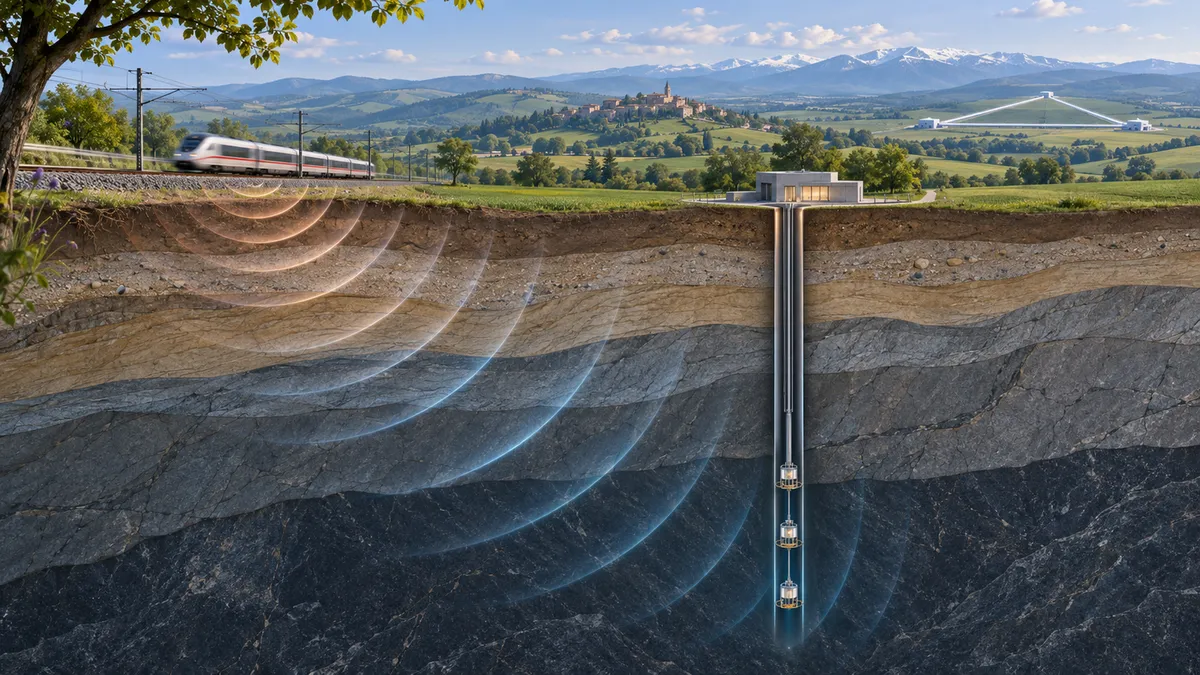
Gravitational-wave detectors need exceptionally steady ground. At low frequencies, even tiny motions can matter—not only because vibrations may travel through a detector’s supports, but because moving underground rock also changes the local gravitational pull on its test masses. Researchers studying a candidate site in the Euregio Meuse-Rhine region have begun measuring that environment with a network of borehole seismometers. What do the first measurements reveal about the quiet background and human-made disturbances—and how much can they tell us about the site’s suitability?
The Einstein Telescope is a planned gravitational-wave observatory designed to observe signals at lower frequencies than current detectors. That ambition makes its surroundings important. Ground motion can shake a detector mechanically, and shifting rock can also produce small changes in gravity that tug directly on its test masses. This second effect, called Newtonian noise, cannot be blocked by ordinary vibration isolation.
A new study reports early measurements from the Euregio Meuse-Rhine (EMR) candidate region, near the borders of the Netherlands, Belgium and Germany. The team’s question was not simply whether the ground is quiet. It was how the seismic background varies, how short-lived disturbances stand out from it, and how those disturbances travel through local geology. Those details will eventually help researchers model noise and plan ways to reduce it.
Listening at several depths
The researchers analysed data collected from January through July 2026 at four underground stations, alongside sensors at the surface. Three stations—Obsinnich (OBSN), Teuven (TEUV) and Beusdael (BSDL)—have recently instrumented boreholes; Terziet (TERZ), at about 250 metres depth, is a longer-running reference station. The borehole sensors sit roughly 260 to 320 metres underground. The team focused on the vertical component of ground motion.
Station placement matters. OBSN is about 60 metres from an active railway, and TEUV is about 200 metres from a railway tunnel. The researchers deliberately chose these locations to study how railway-related vibrations travel underground. BSDL is the only station in this set close to a possible detector corner-point location. The railway-side measurements therefore should not be read as typical noise levels at every proposed detector location.
To process the long records consistently, the team developed SiteChar, a Python framework that divides data into two-hour chunks. It identifies transients—temporary disturbances—using changes in the signal’s frequency content, then calculates separate spectra for the whole chunk, the longest detected quiet stretch, and individual events. This distinction matters: a long-term average can mix the persistent background with bursts from trains or other sources.
A similar background, but travelling disturbances
After detected fast transients were excluded, the four stations showed broadly similar background spectra. The authors describe this as a useful check on their detection and comparison method, not as proof that the entire region is uniform. The background still changed over time: above 1 hertz, levels varied by about 5–8 decibels over the day, and lower-frequency microseismic activity changed seasonally.
The full-chunk spectra told a different story. At frequencies above about 1 hertz, OBSN and TEUV stood out from the other stations because of transient activity. The catalogue and comparisons between stations indicate that railway traffic was a major source of these longer disturbances. Some events were detected even at stations more than two kilometres from the line and hundreds of metres underground. Comparing arrival times at different stations helped the researchers identify moving events; at TEUV and OBSN, the timing pattern was consistent with trains travelling in both directions.
In one example, a disturbance measured at a borehole greatly exceeded that station’s background at frequencies from 3 to 15 hertz. The study also found that the surface and underground sensors could carry related information during an event, even though their background signals became poorly correlated above roughly 1 hertz. These observations describe this network and event, rather than establishing a universal amount of vibration reduction with depth.
The catalogue includes other signals, too. The authors tentatively link some groups to railway passages or possible quarry blasts, but say individual sources cannot yet be assigned reliably. Very short, strong pulses at OBSN and BSDL may come from local mechanical or instrument effects; their origin remains unresolved, and the team excluded them from its main catalogue analysis.
What remains unknown
The study does not give a final Newtonian-noise estimate or decide whether the EMR site meets the telescope’s requirements. That calculation needs more than the vertical spectrum at a few locations: horizontal motion, the composition and spatial coherence of seismic waves, and detailed local geology all matter. The authors explicitly leave a full estimate to future work, alongside improved modelling and measurements at additional boreholes.
There are also limits to interpreting the event counts. The detection threshold is relative to the local background, so the same physical disturbance is easier to detect at night, when background levels are lower. Data coverage differs among stations, and the network was not designed as a balanced survey of prospective detector corners. The tentative source classifications should therefore be treated as clues, not definitive identifications.
The paper is a preprint, so its findings have not necessarily undergone peer review. Its contribution is an initial measurement framework and a first account of how background vibrations and transients behave at these stations—not a final comparison of candidate sites or a prediction of detector performance. The authors report that the measurements will feed into three-dimensional geological and wave-propagation models intended to guide later estimates and mitigation strategies.
Source: L. D’Onofrio and colleagues, “First results from a borehole network for the seismic characterization of the Einstein Telescope Euregio Meuse-Rhine candidate site,” arXiv:2611.12917v1.
- Einstein Telescope
- seismology
- Newtonian noise
- borehole sensors
- gravitational waves
Related reading
Automatically matched by shared topic keywords. These links do not imply that the sources agree or establish a consensus.
Simulated detector network sharpens the search for neutron stars’ faint internal vibrations
Source published
Shared keywords: einstein telescope, gravitational waves
How the early Universe’s changing particle soup could reshape gravitational waves
Source published
Shared keywords: gravitational waves
A New Search Strategy for Gravitational Waves from Eccentric Neutron-Star Binaries
Source published
Shared keywords: gravitational waves
Cosmic phase-transition simulations reveal a two-scale gravitational-wave signal
Source published
Shared keywords: gravitational waves
Blazar jets could create a background that complicates high-frequency gravitational-wave searches
Source published
Shared keywords: gravitational waves