TRANSMISSION // 2611.12888v1
Why quantum spectral echoes can outlast rapid decoherence
Source published
A theoretical preprint finds that regularly spaced quantum energy levels can retain recurring interference peaks long after decoherence begins. The peaks fade through distinct stages, while faster-changing spectral fluctuations can prolong their survival in the authors’ model.
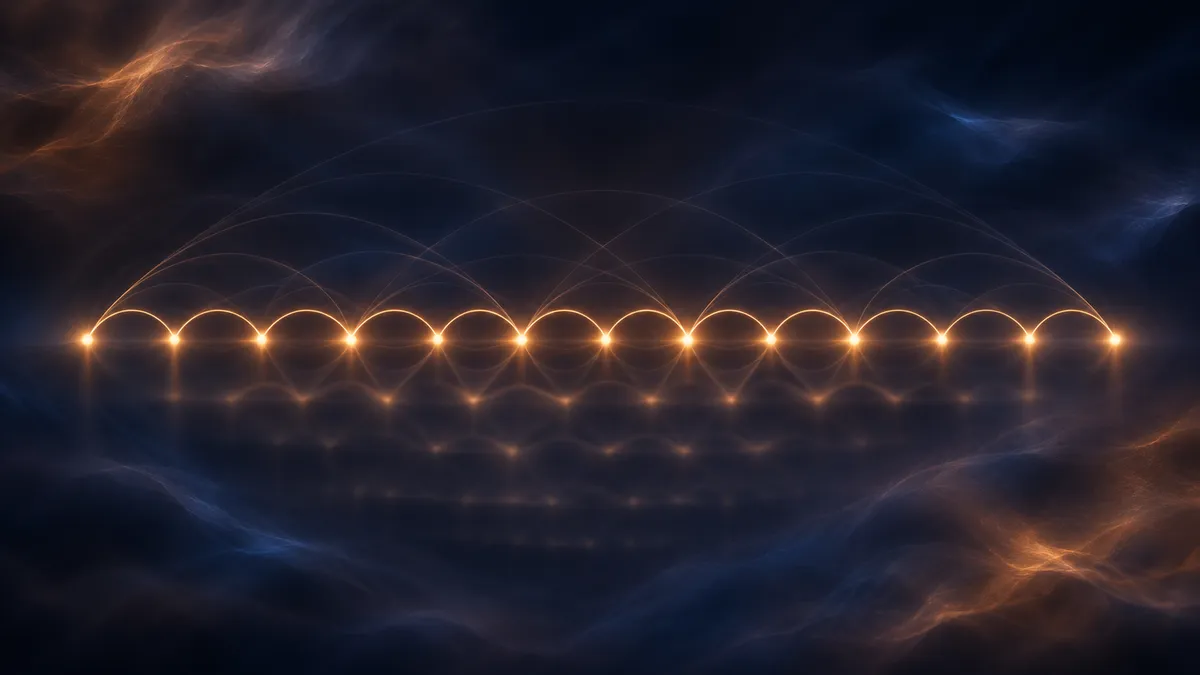
Environmental noise erodes quantum interference, but different signatures need not disappear together. Preethi Gopalakrishnan and Adolfo del Campo find that a repeating pattern associated with nearly regular energy levels can survive well beyond a system’s initial decoherence timescale.
A crystal made of energy spacings
The word “crystalline” here describes the arrangement of quantum energy levels, not atoms in a solid. In the simplest model, the allowed energies form an evenly spaced ladder, resembling a picket fence.
The researchers track this regularity using the spectral form factor: a quantity that combines interference contributions from pairs of energy levels. For the initial states considered, it also measures the probability of finding the evolving system back in its starting state.
With perfectly equal spacings, these contributions repeatedly line up. Sharp revivals occur at integer multiples of the Heisenberg time, the timescale associated with resolving the mean level spacing. The paper calls them Bragg peaks by analogy with the interference peaks used to reveal order in ordinary crystals.
The question is how these spectral echoes disappear when environmental noise weakens quantum coherence.
Why the echoes do not vanish immediately
In their preprint, posted on November 9, 2026, Gopalakrishnan and del Campo combine analytical calculations with numerical random-matrix studies. They begin with a perfectly regular spectrum and an energy-dephasing model: coherence between different energy levels decays, without changing their populations.
Crucially, widely separated levels lose coherence faster than nearby ones. In the model’s units, a pair separated by k level spacings has a coherence lifetime of 1/(γk²), where γ controls the dephasing strength.
This produces three stages. Initially, nearly all pairs can contribute to a revival. Next, widely separated pairs have lost coherence, but many closer pairs remain. Eventually, even adjacent-level coherences disappear, and the peaks approach the incoherent background.
In the broad middle stage, the coherent peak contribution falls as the inverse square root of γp, where p counts successive revivals. This is algebraic decay rather than exponential decay. At fixed system size, multiplying γp by four reduces this contribution by roughly a factor of two, provided the system remains within that intermediate regime.
The distinction matters because the initial decoherence rate grows approximately as the square of the number of levels in the ideal model. Yet the last surviving adjacent-level coherences last for a time of order 1/γ. Rapid initial loss of coherence therefore does not imply equally rapid disappearance of every spectral echo.
The peaks are not protected indefinitely: their final coherent contribution is exponentially suppressed, leaving a background of 1/d for d nondegenerate levels.
Imperfect spacing adds another way to lose order
Realistic spectral order need not be perfect. To explore deviations, the authors use the Dumitriu–Edelman random-matrix construction, whose parameter β controls the rigidity of the energy-level arrangement. Larger β produces more nearly regular spectra. Here β is a spectral-model parameter, distinct from the temperature weighting used to define the spectral form factor.
The researchers rescale the spectra to unit mean spacing so different realizations can be compared. One numerical example uses 512 levels, β = 500 and averages over 200 realizations.
Small spacing irregularities introduce phase mismatches at the expected revival times. These mismatches suppress peaks even without environmental dephasing. For the ensemble studied, the variance of relative level displacements grows logarithmically with separation.
The calculations identify a crossover revival order set by spectral rigidity. Before it, coherence across many level spacings remains important. After it, intrinsic phase mismatches have already removed much of that contribution. Observing this crossover requires sufficiently weak dephasing that adjacent-level coherences survive long enough.
Faster fluctuations can help, within limits
The authors then let the level displacements fluctuate in time while preserving their equal-time spectral correlations. They model this using an Ornstein–Uhlenbeck process, a Gaussian noise model with an adjustable memory time.
Slow fluctuations behave approximately like static spacing errors: phase mismatches accumulate persistently. Faster fluctuations allow successive contributions to partially cancel. This is motional narrowing, and it slows the growth of phase disorder, allowing revivals to persist to higher orders in the model.
This does not mean arbitrary noise protects quantum systems. The improvement concerns a specified model of fluctuating energies in a fixed eigenbasis; the separate energy-dephasing mechanism continues to destroy coherence.
The work is theoretical and presented as a preprint, not an experimental demonstration. Its central predictions concern specially ordered spectra, predominantly with equal weighting of energy levels, and use approximations for imperfect spectra. Within those limits, it suggests that varying dephasing strength could help distinguish different kinds of spectral order—and that noise memory matters alongside noise strength.
- quantum coherence
- spectral form factor
- energy dephasing
- random matrix theory
- spectral rigidity
- motional narrowing
Related reading
Automatically matched by shared topic keywords. These links do not imply that the sources agree or establish a consensus.