TRANSMISSION // 2611.12876v1
A common benchmark for simulating quantum computers made of light
Source published
A preprint compares how quickly one GPU can reproduce outcomes from several kinds of photonic quantum device. Its benchmarks measure demonstrated classical capability—not a boundary beyond which quantum advantage is guaranteed.
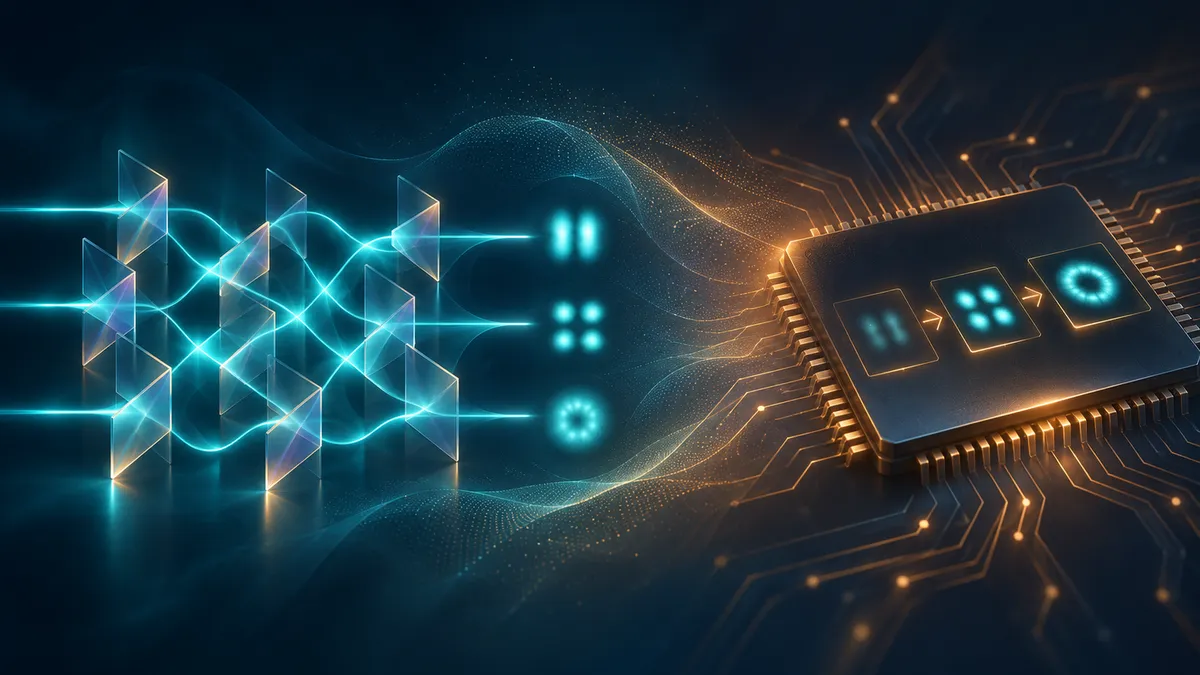
How many photons make a quantum computer too difficult for a conventional computer to imitate? There is no single answer: the light source, optical circuit, required accuracy and sampling speed all matter. A new study proposes a common benchmark while showing why its boundaries need careful interpretation.
A frontier defined by speed
Photonic quantum devices send light through networks of optical paths that mix it through interference. Detectors then record where photons emerge. Reproducing those random outcomes with the correct probabilities is a classical computing task called sampling.
In an arXiv preprint, Jean Senellart and colleagues propose comparing devices through a “simulability frontier”: the size at which their fastest implemented exact sampler produces one independent sample per second on specified hardware.
That is a benchmark of demonstrated classical capability, not proof that larger devices are impossible to simulate. An untested algorithm could perform better. Nor does crossing this frontier establish a useful quantum computational advantage.
The rate also describes sustained throughput from batches of samples, not a promise that an individual request finishes within one second.
Comparing different kinds of light
The researchers developed photonic-engines, an open-source library with GPU implementations for single photons, entangled photons from quantum emitters, coherent superpositions of vacuum and one photon, and squeezed light.
Rather than calculate and store every possible output probability, the samplers construct an outcome step by step. Each draw depends on the outcomes already selected. This avoids storing the complete distribution, although calculating the required probabilities remains expensive.
The team reports checking each sampler against a separate reference simulator that shares no code with it. Benchmarks use a common timing protocol, with records identifying algorithms, implementations and whether results were measured or modelled.
For the headline comparison, the hardware is one NVIDIA H100 GPU. The optical networks are full-depth, Haar-random interferometers—a standard mathematical ensemble of randomly mixing networks—with twice as many modes as illuminated inputs. Detectors resolve photon numbers, and no detection outcomes are discarded through post-selection.
Under those conditions, the reported one-sample-per-second crossings are:
- 38.3 inputs for single photons.
- 31.0 photons from one emitter producing an entangled linear cluster state.
- 50.0 vacuum–single-photon superposition sources, each with a one-half probability of emitting a photon.
- 41.5 squeezed-light inputs, each averaging 0.5 photons, from a calibrated timing model rather than a directly measured crossing.
The decimal values interpolate between integer device sizes; they do not describe fractional physical photons. Also, an input is not always a photon. Superposition sources can contribute vacuum, while squeezed sources have fluctuating photon numbers. The rows therefore compare specified source configurations, not equal numbers of detected photons.
Coherence and feedback have different costs
One comparison holds the probability of detecting a photon from each source at one half while changing its quantum coherence.
An incoherent mixture of vacuum and one photon reaches a frontier of 64.2 inputs. A coherent superposition, in which those components have a definite quantum relationship, reaches 50.0. For this sampler, the coherent case therefore becomes expensive at 14.2 fewer inputs.
The comparison uses the same sampler and kernel, helping separate the effect from differences between implementations. Nevertheless, the authors explicitly leave open whether a better algorithm could reduce the gap. It is not a proven universal cost of coherence.
Limited feed-forward has a much smaller effect. Here, photon counts measured partway through a circuit determine later optical operations. Measuring up to three modes shifts the single-photon frontier only from 38.3 to 38.1. That finding does not extend to arbitrarily extensive adaptive circuits.
Rare outcomes complicate the benchmark
The squeezed-light result needs particular caution. Its photon-number distribution has a long tail, and unusually bright outcomes can be disproportionately costly to simulate.
The quoted 41.5 crossing uses a truncated timing statistic that excludes photon numbers whose combined probability is at most one in 10,000. This truncation concerns the cost calculation, not a licence for the sampler to discard those outcomes. The paper warns that the statistic is not the average cost of a real 10,000-sample run: rare excluded outcomes can still occur.
“Exact” also means algorithmically exact, with finite numerical precision in practice. The study assesses rounding errors, and some squeezed-light calculations require more expensive arithmetic.
A benchmark, not a final verdict
For the tested samplers, costs grow exponentially in the relevant photon count, so doubling hardware speed buys only roughly one additional photon near the single-photon frontier. Algorithmic improvements can change that growth.
Architecture matters too. Devices processed one time step at a time can be limited by the quantum state carried between steps rather than total train length.
The study remains a preprint, restricted to specified hardware, detector assumptions and imperfection models. Approximate samplers are excluded, despite their importance for squeezed-light experiments. Its contribution is a reproducible comparison of exact sampling methods—not a universal photon threshold for quantum advantage.
- photonic quantum computing
- classical simulation
- boson sampling
- exact sampling
- quantum coherence
- squeezed light
- GPU computing
Related reading
Automatically matched by shared topic keywords. These links do not imply that the sources agree or establish a consensus.
Four algorithms extend classical simulation of photonic quantum circuits
Source published
Shared keywords: boson sampling, classical simulation, photonic quantum computing
When does photon entanglement still allow classical estimates?
Source published
Shared keywords: boson sampling
A looping photonic quantum computer design trades fewer components for repeated optical losses
Source published
Shared keywords: photonic quantum computing
A symmetry-based guarantee for simulating interacting fermions
Source published
Shared keywords: classical simulation
Why quantum spectral echoes can outlast rapid decoherence
Source published
Shared keywords: quantum coherence