TRANSMISSION // 2611.12861v1
Could primordial black holes explain Webb’s Little Red Dots?
Source published
A theoretical preprint finds that black holes born from early-universe fluctuations could grow into the massive objects thought to power some Little Red Dots without violating current limits on distortions of the cosmic microwave background. The result depends strongly on assumed growth histories and does not establish a primordial origin.
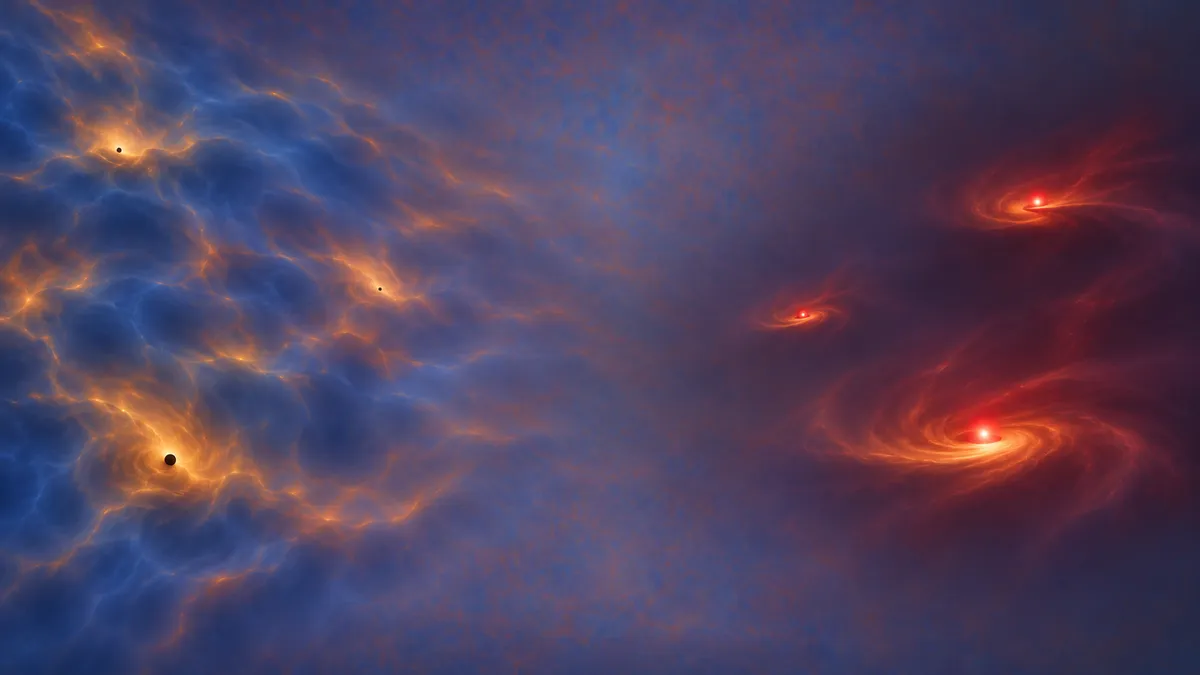
Webb’s compact Little Red Dots raise a difficult question: if they contain massive black holes, how did those objects grow so quickly? A new study explores whether primordial black-hole seeds, unusual fluctuation statistics and subsequent gas accretion can together satisfy an important cosmological constraint.
A possible head start
Little Red Dots are compact sources observed by the James Webb Space Telescope at high redshift, meaning their light comes from an early cosmic epoch. Some interpretations place black holes with millions of solar masses or more inside them. Building such objects rapidly from the remnants of the first stars can be challenging, motivating alternatives.
Shyam Balaji and colleagues investigate primordial black holes: hypothetical objects formed when unusually dense regions collapsed in the early universe, rather than after stars died. These could provide seeds with a head start in mass, growth time or both.
Their central finding is conditional: certain primordial-fluctuation models can produce enough seeds that, after modeled growth, match an adopted Little Red Dot population while respecting an existing microwave-background limit. This is a demonstration of compatibility within a model, not evidence that primordial black holes exist.
Why ancient light constrains black-hole seeds
The cosmic microwave background, or CMB, is the universe’s relic radiation. Its spectrum closely resembles that of an ideal thermal emitter. Small departures from that spectrum can reveal energy released in the early universe.
The fluctuations capable of forming primordial black holes also generate sound waves in the early plasma. As those waves dissipate, they heat the plasma and can leave a particular spectral departure called a mu-type distortion.
The study adopts a 95% confidence upper limit on the distortion’s magnitude of 0.000047, based on COBE/FIRAS measurements. Under conventional Gaussian statistics—the familiar bell-curve distribution—this constraint strongly restricts fluctuations capable of directly forming black holes heavier than roughly 10,000 solar masses. Making massive seeds is therefore not simply a matter of turning up the fluctuations.
Non-Gaussian statistics change the likelihood of rare, extreme fluctuations. Because black-hole formation depends on those extremes, changing their probability can increase seed production without requiring the same increase in overall fluctuation strength. But non-Gaussianity also changes the predicted CMB distortion; the researchers include that additional contribution rather than assuming it away.
How the researchers explored the possibilities
The team tested two shapes for an enhancement in the primordial power spectrum, which describes fluctuation strength across spatial scales. One is lognormal, a rounded peak in logarithmic scale; the other rises as a power law before being smoothly cut off.
They calculated black-hole formation using a compaction function, which measures how concentrated an excess of mass is within a region. Its collapse threshold depends on the fluctuation profile. They then evolved the seed masses using a simplified accretion prescription, neglecting mergers.
Growth occurs at the Eddington limit during active periods: a benchmark luminosity where outward radiation pressure balances gravity for the assumed inflowing material. A duty cycle specifies the fraction of time spent actively accreting. The model fixes the efficiency of converting accreted matter into radiation at 10%.
Bayesian sampling with Markov chain Monte Carlo explored combinations of fluctuation amplitude, scale, shape and non-Gaussianity. Some analyses used only the CMB constraint; others also required an adopted abundance of about one Little Red Dot per 10,000 cubic megaparsecs in comoving volume, with black holes exceeding one million solar masses at redshift seven.
What worked—and what depended on growth
Both spectrum shapes contained viable solutions with peak amplitudes around a few thousandths and non-Gaussianity parameters of order unity to tens. Here, amplitude describes primordial fluctuation power, not the fraction of matter becoming black holes.
With continuous Eddington-limited growth, the allowed distributions included both positive and negative non-Gaussianity. The negative branch arises from the model’s nonlinear collapse conditions: sufficiently negative values can restore black-hole production after more modest negative values suppress it. Continuous growth also leaves Gaussian solutions possible, so the analysis does not establish that non-Gaussianity is required.
Reducing the active growth time changes the picture. In the cut-power-law calculations, the negative branch disappears around a 10% duty cycle. Positive non-Gaussianity still permits solutions, but their predicted distortions approach the current observational limit. Slower growth requires heavier initial seeds, making the CMB constraint harder to satisfy.
What remains uncertain
The paper is an arXiv preprint, version one, posted on November 9, 2026. Its conclusions are theoretical and model-dependent. Not every Little Red Dot necessarily contains an actively accreting massive black hole, and their inferred masses and abundance remain uncertain.
The study also omits accretion-based observational constraints, which the authors say need recalculation for these non-Gaussian scenarios. It therefore does not demonstrate compatibility with every relevant observation. Its joint-data sampling monitors stability of inferred results rather than enforcing a direct autocorrelation-time convergence criterion.
Proposed CMB spectral-distortion experiments, including FOSSIL, PIXIE and SPECTER, could test the predicted signals. The immediate result is a surviving hypothesis under specified assumptions—not a solution to the origin of Little Red Dots.
- Little Red Dots
- primordial black holes
- James Webb Space Telescope
- cosmic microwave background
- spectral distortions
- non-Gaussianity
- black-hole accretion
Related reading
Automatically matched by shared topic keywords. These links do not imply that the sources agree or establish a consensus.
How JWST Could Trace the Seeds of the First Massive Black Holes
Source published
Shared keywords: black hole accretion, james webb space telescope, little red dots
JWST finds where a Little Red Dot’s red rise stops
Source published
Shared keywords: black hole accretion, little red dots
Cosmic microwave background could limit exceptionally massive primordial black holes
Source published
Shared keywords: cosmic microwave background, primordial black holes
Planck reanalysis finds a modest hint of inflation-era particle signatures
Source published
Shared keywords: cosmic microwave background
Why Astronomers Want a Bigger JWST Survey of the First Galaxies
Source published
Shared keywords: james webb space telescope, little red dots