TRANSMISSION // 2611.12860v1
Radio bursts offer tentative clues to gas around nearby galaxies
Source published
A study using precisely positioned fast radio bursts finds tentative evidence for extra ionized gas around nearby galaxies and hints that its density declines outward. The results remain statistically limited, with uncertainties from foreground gas, unknown burst distances and modeling assumptions.
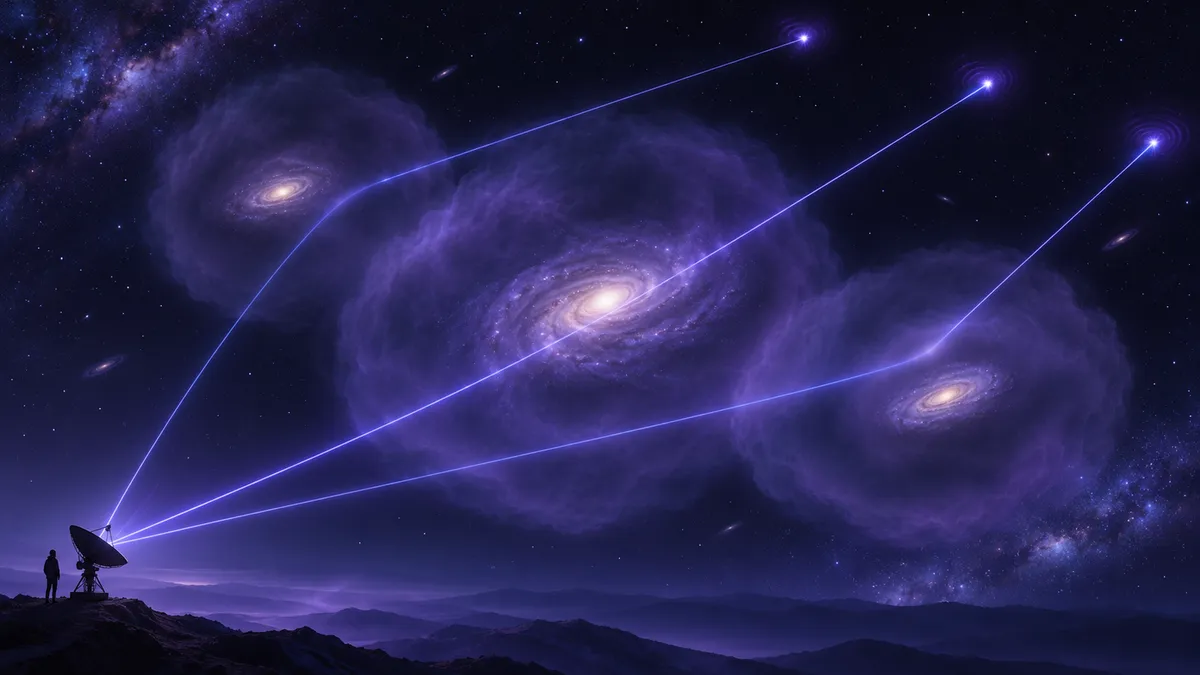
Gas surrounding galaxies can be too diffuse to reveal easily through its own light. A new preprint uses the frequency-dependent delays of fast radio bursts to probe that material, finding suggestive—but not definitive—evidence of its distribution.
Radio flashes as gas probes
Fast radio bursts, or FRBs, are brief radio signals whose passage through ionized gas delays lower-frequency waves more than higher-frequency ones. This delay measures dispersion measure, or DM: the accumulated free-electron density along the signal’s path. Its conventional unit, pc cm⁻³, combines distance in parsecs with electron density per cubic centimeter.
Affan Khadir and colleagues use this effect to investigate the circumgalactic medium, or CGM—the gas surrounding galaxies. Unlike X-ray emission, which strongly favors denser gas because its brightness depends on electron density squared, DM depends linearly on electron density. That makes FRBs useful probes of diffuse material.
The study is an arXiv preprint; the supplied evidence does not establish peer-reviewed publication. Its principal findings are tentative statistical signals, not definitive detections.
Combining many sightlines
The researchers started with 1,748 distinct FRB sources from the Second CHIME/FRB Baseband Catalog. Their median positional uncertainty was 32 arcseconds, helping establish whether a signal’s path overlaps a galaxy’s halo. They excluded a known nearby source without intervening halos and 26 bursts potentially affected by galaxy clusters.
They subtracted modeled contributions from the Milky Way’s disk and halo, then compared the remaining DMs with foreground galaxy positions. Most burst distances are unknown, so the analysis assumes that the overwhelming majority lie behind the nearby galaxy sample.
For the nearest-galaxy comparison, the team selected 1,592 galaxies between 1 and 50 megaparsecs away. Their adopted CGM boundary was 1.1 times the estimated virial radius, a characteristic halo scale. Sixty-six FRB sightlines crossed within that boundary.
For radial mapping, they expanded to 92,063 galaxies out to 150 megaparsecs. This yielded 628 matched FRBs within twice the adopted CGM radius. They stacked measurements—combining many different galaxies statistically—according to impact parameter, the projected distance between a burst’s sightline and a galaxy’s center.
An excess, and a tentative outward decline
In the nearer sample, halo-crossing bursts had a mean DM exceeding that of non-crossing bursts by 119 ± 44 pc cm⁻³. A million random reassignments of bursts to comparison groups produced an excess at least this large in 0.53% of trials. The authors report this as approximately 2.6 sigma evidence.
That p-value describes outcomes under the random-assignment test; it is not the probability that the halo interpretation is wrong. A comparison using medians gave a similar excess, suggesting that a few extreme measurements do not solely explain the result.
The larger sample showed a tentative decline in average DM with increasing projected distance from galaxy centers, with a reported p-value of 0.0046. The trend was driven mainly by galaxies with stellar masses between 10 billion and 100 billion solar masses. Other mass ranges did not show convincing declining profiles.
The team fitted a beta model, a simplified density profile with a central core and declining outer density. For the combined sample, its outer-slope parameter was 0.68, with uncertainties of roughly 0.15–0.16. The inferred central electron density spanned 0.0017–0.0211 electrons per cubic centimeter. This is an extrapolation, not a direct central measurement: core size and central density remain difficult to distinguish. The models were consistent within uncertainties with relevant X-ray stacking constraints.
Why the innermost region looks different
Very close to galaxy centers, the average DM instead dropped below the adopted background. The proposed explanation is that some bursts originate in the matched galaxies themselves, rather than behind them. Nearby bursts traverse less intergalactic gas, so subtracting a background representative of distant bursts creates an apparent deficit—not evidence of negative gas density.
A correlation model reproduced this feature with about 20 nearby FRBs. Separate host-association work described in the paper supported several candidate matches, but the interpretation does not securely identify all 20 hosts.
What remains uncertain
DM includes gas from burst hosts, intergalactic space and other intervening structures. A local-Universe simulation suggested that galaxy environments alone rarely reproduced the measured excess, but that conclusion depends on the simulation. Residual cluster contamination, incomplete galaxy catalogs, uncertain halo sizes and multiple overlapping halos remain complications.
Forecasts suggest that about 10,000 similarly localized FRBs could produce a roughly five-sigma halo detection. That is conditional on an assumed gas model without feedback-driven evacuation. A separate simulation favored burst redshifts around 0.4–0.75 for halo studies, but treated halo DM and total cosmic DM as independent despite their physical connection. These are planning estimates, not demonstrated future outcomes.
- fast radio bursts
- circumgalactic medium
- dispersion measure
- CHIME
- galaxy halos
- ionized gas
- astrophysics preprint
Related reading
Automatically matched by shared topic keywords. These links do not imply that the sources agree or establish a consensus.
A radio burst’s crowded path reveals the challenge of tracing cosmic gas
Source published
Shared keywords: circumgalactic medium, dispersion measure, fast radio bursts, ionized gas
CosmicGrain follows dust histories through a simulated galaxy
Source published
Shared keywords: astrophysics preprint, circumgalactic medium
Gas around galaxies echoes a peak in star-building efficiency
Source published
Shared keywords: circumgalactic medium
Why Bigger Telescopes Alone Cannot Perfect Pulsar Timing
Source published
Shared keywords: dispersion measure
Black hole spin alone may not keep massive galaxies from making stars
Source published
Shared keywords: astrophysics preprint