TRANSMISSION // 2611.12783v1
A half-speed rule for electrons at sharp magnetic edges
Source published
A theoretical preprint predicts that a particular average speed of magnetic edge channels approaches half the electron Fermi velocity when many channels are occupied. Calculations support the rule for conventional electrons and graphene, but it does not generally apply to smooth boundaries or direction-dependent electron motion.
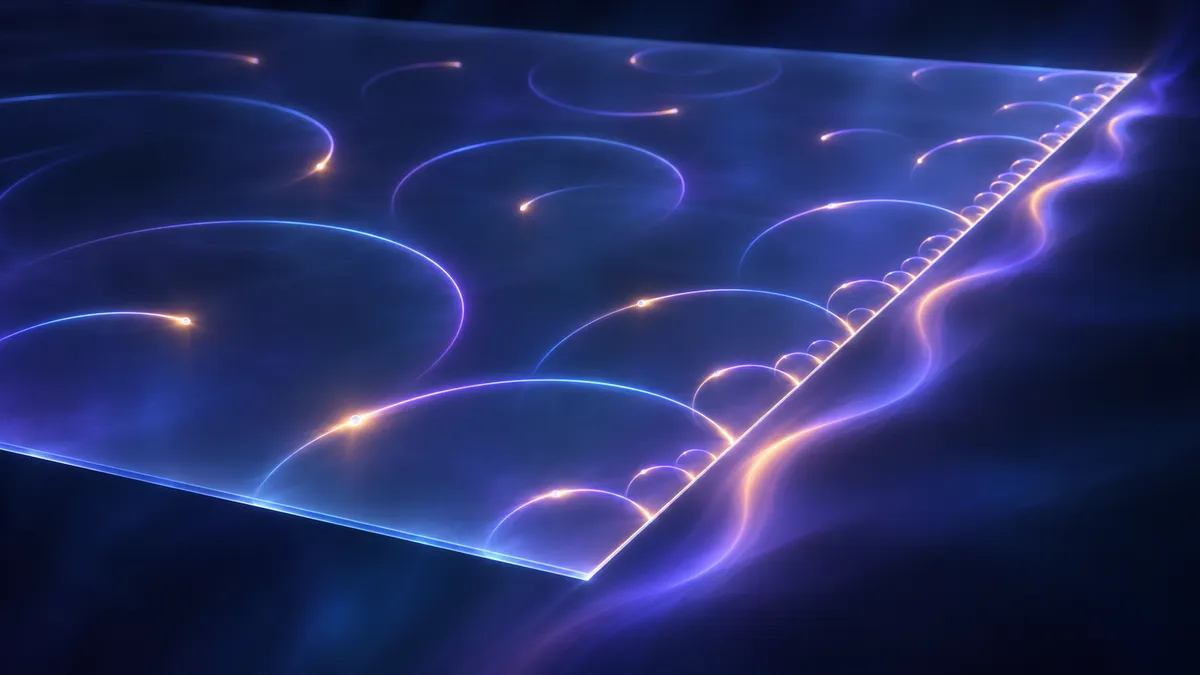
Electrons confined to a thin sheet can travel along its boundary in channels created by a magnetic field. These channels have different speeds. A new analysis finds a surprisingly simple rule for their collective drift velocity—provided the boundary is sharp and enough channels participate.
What is moving along the edge?
A magnetic field perpendicular to a two-dimensional electron system organizes electron energies into discrete groups called Landau levels. Near a boundary, confinement changes those energies and produces magnetic edge channels, which ordinarily carry electrons in a direction set by the magnetic field.
Each channel has a group velocity: the propagation speed obtained from how its energy changes with momentum along the edge. The relevant speeds here are evaluated at the Fermi level, the energy separating occupied and unoccupied states at zero temperature.
In their November 9 arXiv preprint, Ekaterina R. Sleptsova and Alexey A. Sokolik predict that the channels’ drift velocity approaches half the Fermi velocity under specified conditions. The Fermi velocity is the electron speed associated with the Fermi energy. This is a theoretical and numerical result, not a new experimental measurement; the supplied source is a preprint rather than evidence of completed peer review.
Why the kind of average matters
The drift velocity studied here is not the ordinary arithmetic average of channel speeds. It is their harmonic mean: take the reciprocal of each speed, average those reciprocals, then invert the result. For channels moving in the same direction, this makes slow channels particularly influential.
That choice follows from the physics, rather than convenience. A channel’s contribution to the edge density of states—the number of available electron states per energy interval and edge length—is proportional to its inverse velocity. Slower channels therefore contribute more strongly.
The same relationship connects drift velocity to quantum capacitance, which describes how much additional electronic charge can accumulate for a change in electrochemical potential. It also enters the propagation of edge magnetoplasmons: collective charge waves travelling along a boundary in a magnetic field.
Importantly, the predicted half-speed value is a drift contribution, not the complete magnetoplasmon speed. Electrostatic interactions provide another contribution.
How the researchers obtained the rule
The authors used a semiclassical description, combining classical electron trajectories with quantum restrictions on which trajectories are allowed.
In this picture, electrons curve through the sample under the magnetic field and bounce from a hard boundary, producing repeated “skipping orbits.” A hard edge is modelled as an abrupt, impenetrable wall. With isotropic dispersion—an energy–momentum relationship that is independent of direction—the uninterrupted orbits are circular.
Different permitted skipping paths advance along the boundary at different speeds. The researchers applied semiclassical quantization to select these paths and then averaged their inverse velocities at a fixed Fermi energy.
When many channels cross that energy, the discrete sum can be approximated by an integral. Evaluating it gives a drift velocity of one-half the Fermi velocity. Within this limit, the result holds for any isotropic, monotonically increasing dispersion assumed in the analysis. An arithmetic average instead approaches about 0.62 times the Fermi velocity, illustrating why specifying the average matters.
Numerical checks—and departures from half speed
The researchers also calculated quantum edge-channel energies and velocities for conventional electrons with a quadratic energy–momentum relationship, and for graphene’s effectively massless electrons with a linear relationship. They examined both zigzag and armchair graphene boundaries, which impose different quantum boundary conditions.
The calculated harmonic means oscillate as the Fermi energy passes successive Landau levels. Values evaluated halfway between neighbouring levels approach the half-speed prediction as more levels become occupied.
This is not an exact rule at every Fermi energy. Near the onset of a newly occupied channel, its speed can become extremely small and dominate the harmonic mean, driving the calculated drift velocity toward zero. For armchair graphene, small backward-bending portions of the channel dispersions also produce narrow intervals with negative calculated drift velocity.
Where universality stops
A smooth boundary created by electrostatic gates does not obey the same rule. There, channel speeds depend on the confining potential’s slope and shape, rather than having a universal relationship to the Fermi velocity.
Direction-dependent, or anisotropic, dispersion also changes the answer. For orbits with the required mirror symmetry, the authors derive a more general expression relating drift velocity to time averages of position and velocity around an orbit. Without that symmetry, their repeating-orbit analysis need not apply.
The semiclassical calculation neglects finite-channel corrections and phase effects. Disorder, interaction-driven changes to the edge, and additional upstream modes remain limitations or directions for further work. The result therefore offers a conditional benchmark for interpreting edge measurements—not a universal speed limit for all magnetic boundaries.
- magnetic edge channels
- quantum Hall effect
- drift velocity
- Fermi velocity
- graphene
- semiclassical quantization
- edge magnetoplasmons