TRANSMISSION // 2611.12738v1
A classical route to bounding uncertainty in quantum predictions
Source published
A mathematical preprint connects worst-case quantum predictions to ordinary probability, finding that quantum structure can tighten some uncertainty bounds without reducing measurement randomness.
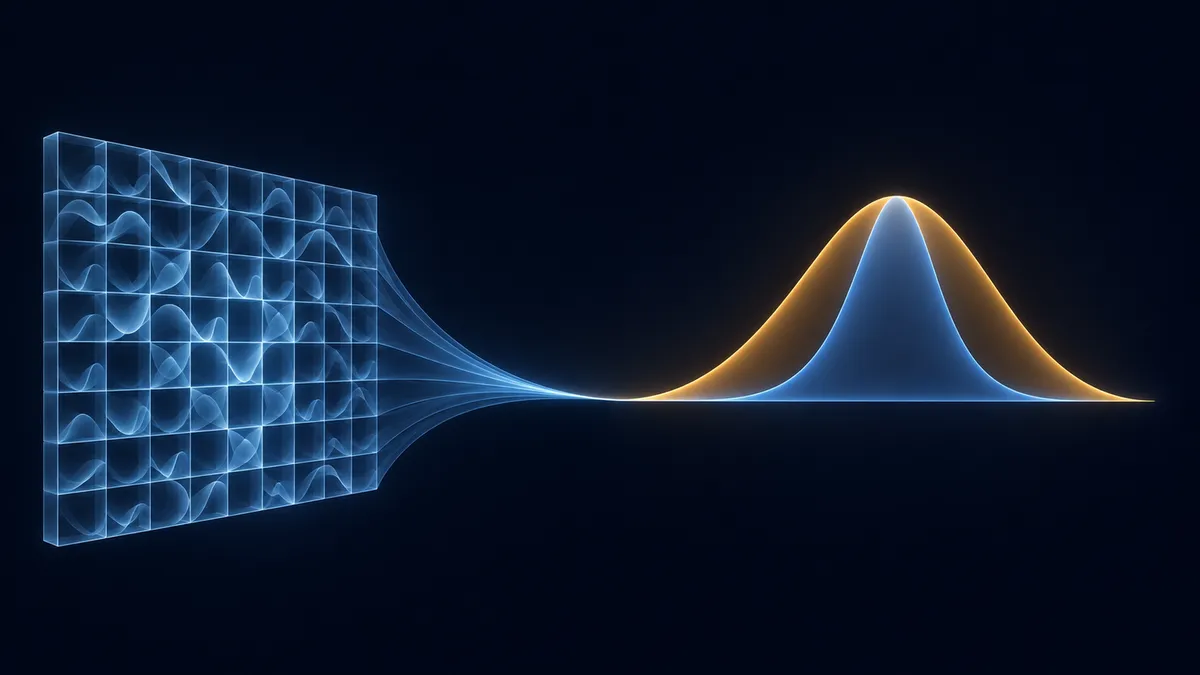
Knowing a quantum state approximately leaves a practical question: how wrong could a predicted average measurement be? Luc Rey-Bellet’s preprint develops an exact mathematical framework for answering that question—and identifies cases where treating the problem as ordinary measurement statistics gives unnecessarily loose bounds.
An error bar on the state, not just the measurement
A quantum state encodes predictions for measurements. An observable represents a measurable quantity, and its expectation is the average predicted over repeated measurements. If the state used in a calculation is imperfect, that predicted average can shift.
Rey-Bellet asks for the largest possible expectation among all states sufficiently close to a reference state. Closeness is specified by an information-based discrepancy measure and an uncertainty budget. A larger budget admits more alternative states, so the worst-case prediction can increase, eventually reaching the observable’s largest possible outcome. Applying the same calculation to the negative observable supplies a lower bound.
These are conditional guarantees: they hold if the true state lies inside the chosen uncertainty region. The method does not itself establish that an experimentally reconstructed state is accurate.
Turning a matrix problem into a scalar search
The paper studies the sandwiched Rényi family, indexed by a parameter called alpha, from one-half to infinity. Its members describe different ways of measuring state discrepancy. Important cases connect to fidelity, which measures state similarity; relative entropy; and max-relative entropy, which constrains how much one state can exceed another as a matrix.
For most calculations, the author uses a power-based normalization rather than the usual logarithmic Rényi divergence. The paper supplies conversions between their budgets. This matters: equal numerical budgets under different conventions need not represent equal uncertainty.
The method uses convex duality, which replaces a constrained optimization with an equivalent problem involving a penalty. Here it produces an exact search over one real parameter, with matrix expressions evaluated along the way. This simplifies the optimization’s structure; it does not eliminate matrix calculations or establish a computational speedup for large systems.
A classical distribution hidden in the calculation
The central result is what the author calls “classicalization.” For each reference state, observable and alpha, the paper constructs an ordinary probability distribution whose classical worst-case expectation exactly matches the quantum answer at every budget.
This auxiliary distribution has the same mean and lies within the same range of values as the observable. But it is generally not the Born distribution—the probabilities of actual measurement outcomes in the reference state. It can include continuous probability between the observable’s discrete eigenvalues. Those intermediate values are mathematical ingredients, not newly predicted measurement outcomes.
The construction combines existing results, including Heinävaara’s tracial joint spectral measure and Stahl’s theorem. Between alpha one-half and one, it also relies on a representation imported from a companion preprint. The contribution is the connection of these representations to the robustness problem across the family.
What “quantum deflation” means
The striking comparison concerns noncommutativity: the reference state and observable cannot be represented diagonally in the same basis. The paper finds that, above alpha one-half, this structure makes the auxiliary distribution’s variance strictly smaller than the Born variance. If the matrices commute, their distributions coincide. At alpha one-half they coincide even without commutation.
The smaller variance can tighten bounds that use variance to control worst-case shifts. It does not mean that actual measurement outcomes become less random. Their Born variance remains unchanged.
For small budgets and finite alpha, the worst-case excess grows approximately as the square root of the budget. Its coefficient depends on the auxiliary variance divided by alpha, so comparisons across alpha require accounting for that normalization. At alpha two, the square-root expression is exact over an interval, until the candidate worst-case state reaches the boundary of positivity.
A figure caption reports a three-level mathematical example in which, at alpha one, the auxiliary variance is 0.62 times the Born variance. That is not a measured improvement in a device, nor does it mean every uncertainty interval shrinks by 38 percent.
Classical probability inequalities then provide computable bounds. Sharp mean–variance–range certificates apply from alpha one-half through two. Improvements are not necessarily strict at every budget: saturation and variance-insensitive branches can erase the advantage. The framework also recovers established state-distinguishability inequalities and develops variance-sensitive refinements.
Scope and source status
This is a mathematical study, not an experimental demonstration. Its framework assumes finite-dimensional systems and a full-rank reference state. Infinite-dimensional extensions, other quantum divergence families and the typical size of the improvement in large systems remain open.
The source is version one of “Quantum Robustness via Sandwiched Rényi Divergences,” arXiv:2611.12738v1, posted November 9, 2026. The supplied evidence does not establish peer review or independent verification. This account uses extracted paper text; images were unavailable and equation extraction may be imperfect. The claimed result is an exact mathematical bridge—not evidence that quantum systems are universally resistant to uncertainty.
- quantum physics
- quantum states
- uncertainty quantification
- Rényi divergence
- robust optimization
- classical probability
Related reading
Automatically matched by shared topic keywords. These links do not imply that the sources agree or establish a consensus.
Helping AI learn from demonstrations that leave an uneven picture
Source published
Shared keywords: robust optimization
When spillovers make ignoring A/B test data the safest static estimate
Source published
Shared keywords: robust optimization
Sharing catastrophe risk when capacity and contract rules get in the way
Source published
Shared keywords: robust optimization
A better boundary for simulating quantum systems and their surroundings
Source published
Shared keywords: quantum physics
Four algorithms extend classical simulation of photonic quantum circuits
Source published
Shared keywords: quantum physics