TRANSMISSION // 2611.12651v1
A neutron ‘transistor’ controls spin through quantum interference
Source published
Researchers report a neutron interferometer that turns an unpolarized input into an output with controllable spin polarization. The experiment reached 77% polarization, demonstrating a neutron analogue of a spin transistor—not an electronic transistor replacement.
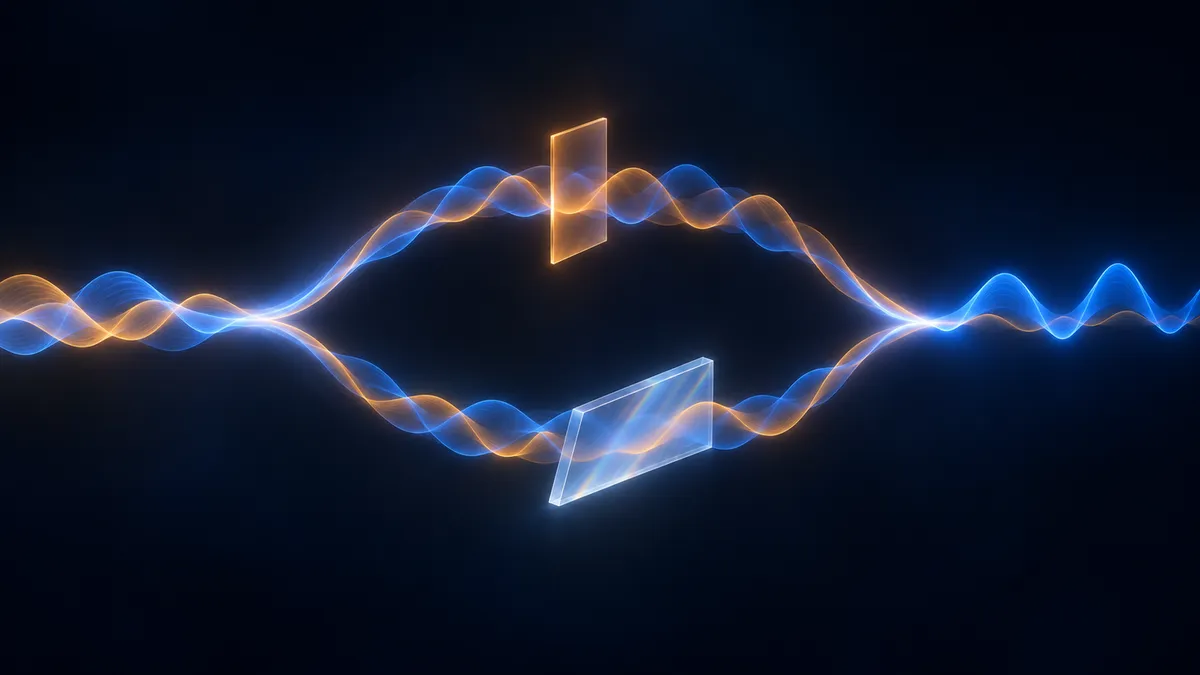
A transistor controls an output using a gate. In this neutron experiment, the gate controls quantum phases rather than a semiconductor’s electrical conductivity. By adjusting how two neutron paths interfere, researchers changed the spin balance of the emerging beam.
What the researchers demonstrated
Dusan Sarenac and colleagues report a “neutronic field-effect transistor”: an experimental arrangement that controls neutron spin polarization and, through a spin-selective analyzer, the transmitted neutron intensity. Their paper, posted as arXiv version 2611.12651v1 on November 9, 2026, is a preprint. The supplied source does not establish peer-reviewed publication.
The analogy is to the Datta–Das electron spin transistor, in which a gate controls spin rotation and a spin-selective drain determines how much current passes. Here, an unpolarized neutron beam supplies the input, magnetic and material-induced phase shifts provide the controls, and an analyzer selects the output. The reported result concerns neutron-beam control, not electrical amplification or a replacement for semiconductor transistors.
Splitting and recombining matter waves
The central instrument is a three-blade interferometer made from a single silicon crystal. Its first blade splits the neutron wave into two paths. The second redirects portions of those paths, and the third recombines them into two output beams. The researchers studied one output, called the O beam.
Interference depends on the relative phase of the two paths—their position within a wave cycle when they meet again. Rotating a quartz plate changes this relative phase because neutrons experience different refractive properties in quartz and air.
A separate control acts on spin, the neutron’s intrinsic quantum angular momentum. A 10-micrometer-thick magnetic permalloy film sits in just one path. Rotating the film changes the distance neutrons travel through it, tuning their spin rotation. Spin components aligned and opposed to the film’s magnetization acquire opposite phases, allowing interference to favor one spin component in the selected output.
This selection matters: the device produces polarization in a chosen output from an initially unpolarized beam. It does not demonstrate that every incoming neutron emerges in that output with the same spin.
How the experiment was measured
The measurements took place at the neutron interferometry beamline of the National Institute of Standards and Technology’s Center for Neutron Research. The incident neutrons had a wavelength of 0.271 nanometers.
The team first measured an O-beam interference contrast of 83%. Contrast describes the difference between the brightest and darkest interference settings relative to their combined intensity.
They then adjusted the magnetic film to produce a spin rotation of 180 degrees. At that setting, the ideal model predicts that changing the quartz-controlled phase leaves the total O-beam intensity unchanged while changing its spin polarization. An analyzer converts that changing spin balance into a changing transmitted intensity—the analogue of the transistor’s drain current.
To measure polarization, the researchers compared analyzer counts with a spin flipper switched off and on. This allowed them to compare the two spin components as they varied the quartz plate’s angle.
What the numbers mean
The maximum measured polarization was 77%, with a reported uncertainty of two percentage points. Polarization measures the imbalance between two spin populations; it is not the percentage of incoming neutrons successfully transmitted.
That polarization corresponds to a favored-to-unfavored spin population ratio of roughly eight to one. The authors identify the interferometer’s 83% contrast as the ceiling on achievable polarization in this setup. Their ideal model allows complete polarization, but the measured device did not reach it.
The phase-dependent polarization demonstrates the central behavior: a control applied within the interferometer changes the output spin balance, which a spin analyzer translates into intensity modulation.
Limits and possible uses
The reported figure uncertainties are statistical only. They should not be read as a complete accounting of systematic uncertainty. The study also does not demonstrate switching speed, amplification, integrated neutron circuits, or a working quantum computer.
The authors discuss potential uses in neutron scattering, materials analysis and quantum information. They also describe a route to individual-neutron spin readout, noting that the beam is dilute and detection events correspond to individual neutrons. Such readout would remain limited by imperfect polarization.
The established result is narrower: coordinated control of path phase and spin rotation can make a selected neutron output behave like the spin-selective output of a transistor.
- neutron interferometry
- spin polarization
- neutronic field-effect transistor
- quantum interference
- spintronics
- preprint
Related reading
Automatically matched by shared topic keywords. These links do not imply that the sources agree or establish a consensus.
How selecting quantum outcomes could make a clock appear to run ahead
Source published
Shared keywords: quantum interference
How photon-pair graphs make NOON states
Source published
Shared keywords: quantum interference
Quantum decay reversal is limited by an environment’s memory, preprint argues
Source published
Shared keywords: quantum interference