TRANSMISSION // 2611.12637v1
Comet Catalina’s ultraviolet excess raises a question about how comets release water
Source published
Swift observations reveal a compact ultraviolet excess around comet Catalina that standard water-breakup models cannot explain. Slow-moving hydroxyl radicals are one possibility, but other emitting molecules remain an important uncertainty.
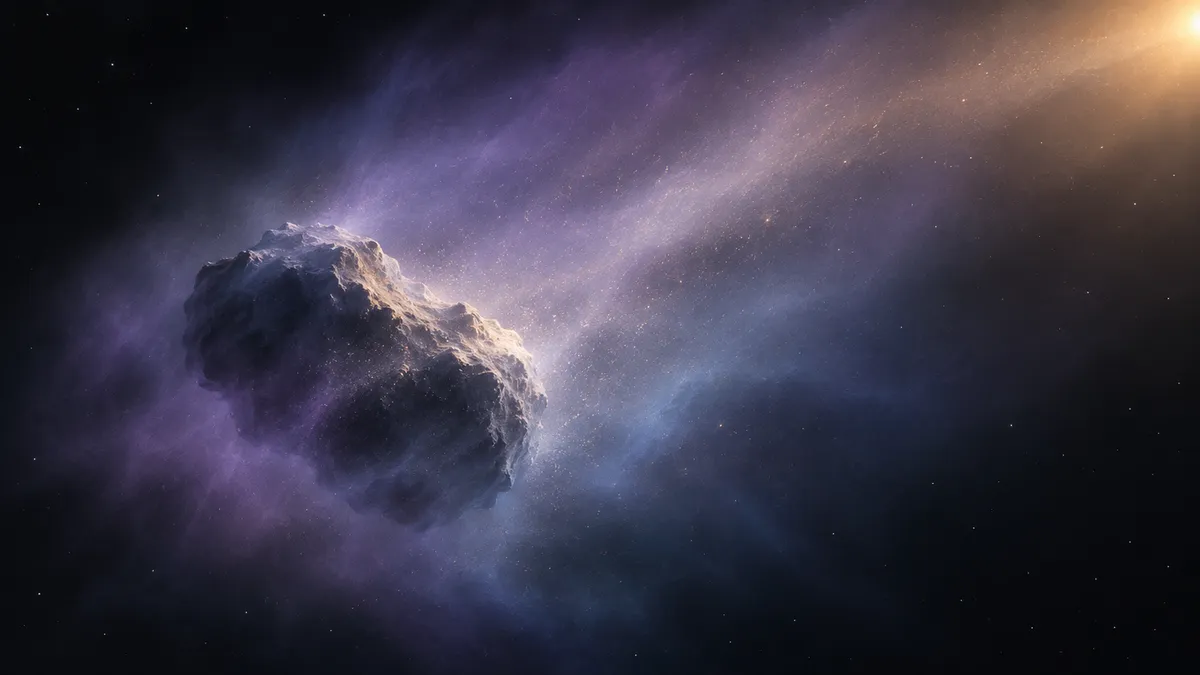
Astronomers usually estimate a comet’s water output by observing the fragments sunlight makes from water molecules. A new analysis of comet Catalina finds an extra ultraviolet component that complicates that calculation—and may trace a different release process.
Following a comet toward and away from the Sun
What produces the ultraviolet light close to a comet’s icy nucleus? For C/2013 US10, also called Catalina, the answer may involve more than water evaporating and then breaking apart in sunlight.
In a November 2026 preprint, Shawn Oset and colleagues analyze observations from the Swift spacecraft’s Ultraviolet/Optical Telescope. Their campaign covered 12 observing epochs between August 2014 and November 2016, following Catalina from 5.8 astronomical units inbound to about 5 outbound. One astronomical unit is the Earth–Sun distance.
The study combines those observations with a new processing pipeline and models of the comet’s surrounding cloud of gas and dust, or coma. Its central puzzle is a compact ultraviolet excess the authors call the Pale Blue Spot. The name is a nickname, not an identification of its composition or a claim about its appearance to human eyes.
Separating gas emission from reflected sunlight
Water is measured indirectly here. Sunlight breaks water molecules into fragments, including hydroxyl, or OH: one oxygen atom bonded to one hydrogen atom. OH absorbs and re-emits sunlight in ultraviolet bands.
Swift’s UVW1 filter collects this emission, but also sunlight reflected by dust and potentially light from other chemical species. The team used visible-light images to estimate and subtract the dust contribution.
That subtraction depends on dust color—how its reflectivity changes with wavelength—which was not independently known well enough. Rather than choosing one exact color, the researchers used a Bayesian probability distribution informed by other long-period comets. Their reference distribution assumes reflectivity increases by 20% per 1,000 angstroms, with a standard deviation of 3 percentage points. They emphasize that these are provisional estimates, not a measured color distribution for Catalina.
This uncertainty matters especially far from the Sun. Under the reference assumptions, inbound observations near 5.0 and 4.6 astronomical units yield signals interpreted as OH at roughly 4.5 and 4.7 times the quoted statistical noise. The earliest observation, at 5.8 astronomical units, does not provide a detection under those same assumptions.
Water output is a model-dependent inference
When the coma was sufficiently resolved, the team fitted its outer regions with a vectorial model. This describes water flowing outward and the additional velocity OH fragments acquire when sunlight breaks their parent molecules apart. Fits excluded the inner 50,000 kilometers, reducing sensitivity to dust and the unexplained excess.
The largest sampled water-production rate was approximately 2.49 × 10^29 molecules per second, measured inbound at 1.83 astronomical units. Its quoted fitting uncertainty is 0.14 × 10^29 molecules per second, not a complete accounting of all systematic uncertainties. The campaign did not continuously observe the comet through its closest approach to the Sun.
A sublimation model translates these rates into an equivalent ice-active area. After closest approach, this settled near 50 square kilometers. That is an inferred area needed to supply the modeled water output, not a directly imaged surface patch or a measurement of nucleus size.
Farther out, interpretation becomes less secure. Standard models extrapolate from light inside the measuring aperture to an extended gas cloud outside it. If the actual source is compact or grain-based, that extrapolation can substantially overestimate water production and the corresponding active area.
A small component with a strong local effect
The Pale Blue Spot occupies roughly the inner 20,000 kilometers. In the strongest case, the inferred near-nucleus OH column density reaches about twice the standard model prediction. Yet the excess is small compared with the overall signal: its OH-equivalent production is roughly 300–1,000 times lower than the water-production rate from outer-coma fits.
The feature is strongest before closest approach, weakens substantially afterward and eventually disappears from the resolved profiles. The authors argue that its extent and evolution are difficult to explain through instrumental blurring or plausible dust-color changes alone.
The emitting material remains unidentified
If the excess is OH fluorescence, its compactness suggests slower-moving radicals than ordinary water photodissociation produces. Simply evaporating water from slow icy grains does not solve this: the breakup of water still gives OH a substantial velocity kick.
The authors discuss alternatives such as direct release of trapped OH or other grain-related chemistry. Their proposal that irradiation-processed outer material is depleted during the encounter remains speculative.
Other emitters also remain possible. Carbon monosulfide, CS, is particularly important because Swift’s filter is sensitive to its emission, while its abundance and fragment velocities are uncertain. Some other contaminants appear too weak or too extended to explain the feature alone.
This is an observational analysis supported by modeling, not an experimental demonstration of a release mechanism. The preprint does not uniquely identify the excess emission. Spectroscopy, ultraviolet imaging and simultaneous measurements of icy grains would be needed to distinguish the competing explanations.
- comet Catalina
- C/2013 US10
- Swift UVOT
- ultraviolet astronomy
- hydroxyl radicals
- cometary water production
- icy grains
- Pale Blue Spot
Related reading
Automatically matched by shared topic keywords. These links do not imply that the sources agree or establish a consensus.