TRANSMISSION // 2611.12581v1
Rocky planets may look iron-rich because other ingredients are missing
Source published
Interior models of 14 rocky exoplanets suggest that selective depletion of elements could help explain why their inferred compositions differ from their stars. Eight are compatible with an Earth-like depletion pattern, but incomplete stellar chemistry and uncertain interiors limit the conclusion.
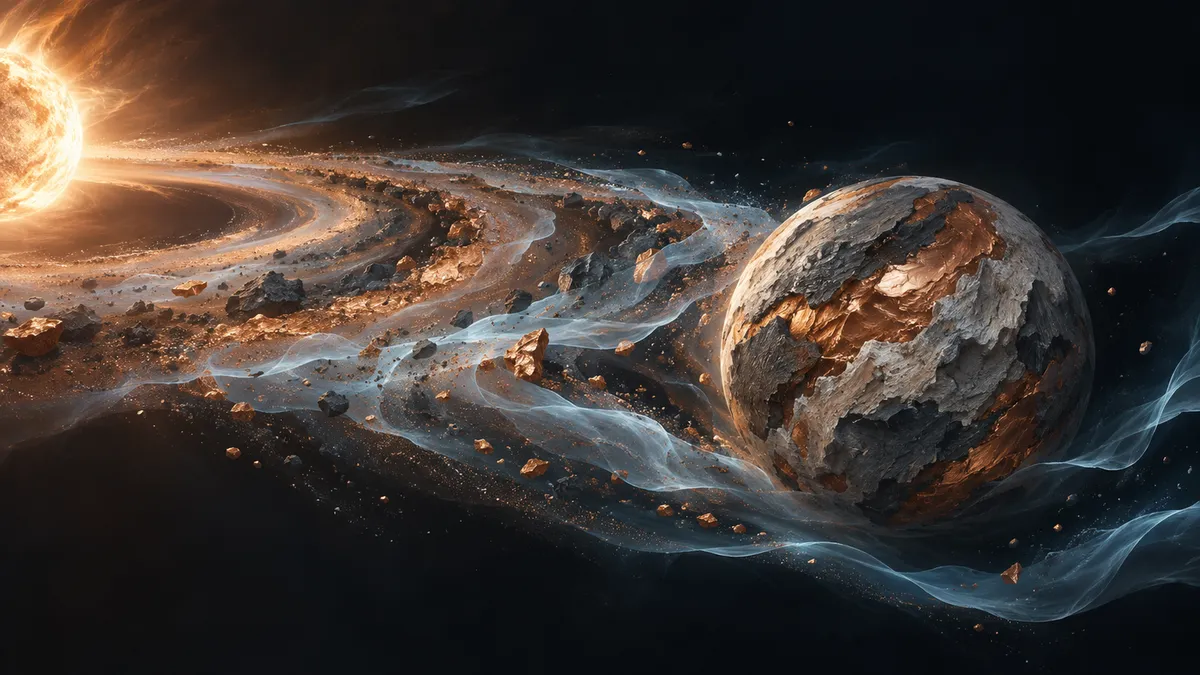
A high iron-to-silicon ratio does not necessarily mean a planet gained extra iron. It could mean that less silicon survived its formation. A new analysis explores whether this distinction helps explain the chemistry of rocky worlds beyond our Solar System.
An excess—or a missing ingredient?
Stars and their planets form from the same broad reservoir of material, but they need not retain the same chemical proportions. Earth, for example, is depleted in relatively volatile elements compared with the Sun. These are elements less readily incorporated into solids under the conditions used to describe planet-forming material.
That difference offers an alternative interpretation of apparently iron-rich exoplanets. A higher iron-to-silicon ratio can arise through extra iron, reduced silicon, or both. Although silicon is comparatively resistant to vaporization, modest differences in how elements enter and remain in planetary building blocks can change their ratios.
Yared Reinarz, Lorena Acuña-Aguirre and Haiyang S. Wang investigate whether rocky exoplanets show a depletion pattern resembling Earth's. Their paper is available as an arXiv preprint and is listed as accepted for publication in Astronomy & Astrophysics. It combines existing astronomical measurements with theoretical interior models; it does not directly measure the chemistry inside distant planets.
Working backward from mass and size
The researchers selected 14 planets using mass, radius and density criteria intended to identify rocky worlds without substantial volatile envelopes. Their search covered roughly half to ten Earth masses, with mass and radius uncertainties below 30%.
Mass and radius constrain average density, but density alone cannot uniquely reveal a planet's ingredients. A larger metallic core, more iron mixed into the mantle, or a different core alloy can produce overlapping possibilities.
To explore those possibilities, the team used two interior models: the Marseille Super-Earth Interior model and pyExoInt. Both describe layered rocky planets, but differ in their treatment of mineralogy and internal structure. Precomputed grids made it practical to sample many possible compositions using Bayesian statistical methods.
The analysis allowed core size and several chemical parameters to vary rather than fixing them to Earth values. This produced broader uncertainties than more restrictive calculations. The inferred planetary compositions were then compared with spectroscopic measurements of their host stars.
Looking for a chemical pattern
For each available element, the researchers compared its abundance relative to iron in the planet with the corresponding ratio in its star. They then examined how those differences varied with condensation temperature: a reference measure of how readily an element enters solids from cooling gas, not a measurement of the planet's present temperature.
An Earth-like trend means that relatively volatile elements, such as oxygen and sulfur, are more depleted than elements that condense at higher temperatures. It does not mean the planet has Earth's exact composition, surface conditions or history.
Eight of the 14 planets had fitted trends compatible with Earth's within the reported one-standard-deviation uncertainties. Four showed shallower trends. Kepler-21 b had a nearly flat trend, which the authors interpret as consistent with little relative depletion across the elements considered.
The remaining planet, TOI-431 b, produced an exceptionally steep fit. Its star lacked both oxygen and sulfur measurements, leaving too little chemical leverage for a reliable trend. The researchers excluded it from subsequent analysis.
Where both interior models returned converged results, their inferred trends agreed within uncertainties. However, pyExoInt did not converge for several planets, so the model comparison does not independently corroborate every individual result.
Missing sulfur matters
Only five planets had stellar measurements for all five elements considered: iron, magnesium, silicon, oxygen and sulfur. Eight lacked sulfur measurements, while TOI-431 lacked both sulfur and oxygen.
This incompleteness may influence the headline result. Planets without stellar sulfur measurements tended to have steeper fitted depletion trends. A pattern resembling Earth's can therefore reflect both planetary properties and which elements were available for comparison. Eight compatible cases are not eight confirmed detections of a particular formation process.
Another important assumption is that the planets have no water layer or substantial gas envelope. If a thin volatile envelope survived, a denser interior would be needed to reproduce the same mass and radius. The inferred core mass fraction could then be underestimated.
A plausible explanation, not a unique history
The study found no clear relationship between depletion slope and planet mass, orbital distance or estimated equilibrium temperature. The small, predominantly close-orbiting sample and measurement uncertainties could conceal real relationships.
Selective depletion is therefore a plausible contributor to moderate planet–star chemical differences, not a demonstrated explanation for every iron-rich world. Collisions that strip rocky mantles and other formation mechanisms remain possible, especially for extreme Mercury-like compositions.
The authors identify more precise planetary measurements and more complete, consistently measured stellar abundances as priorities. PLATO could extend such comparisons to longer-period rocky planets. For now, the central lesson is interpretive: a planet that appears enriched in one ingredient may instead be missing some of the others.
- rocky exoplanets
- planetary composition
- devolatilization
- stellar abundances
- interior models
- planet formation
- PLATO
Related reading
Automatically matched by shared topic keywords. These links do not imply that the sources agree or establish a consensus.
Low-resolution starlight reveals 133 candidate chemical families in the Milky Way
Source published
Shared keywords: stellar abundances
Could nova explosions explain the chemistry of phosphorus-rich stars?
Source published
Shared keywords: stellar abundances
Measuring the stars behind JWST’s planet spectra
Source published
Shared keywords: stellar abundances
A rare Sculptor star points to enrichment by two early stellar explosions
Source published
Shared keywords: stellar abundances
Gas persists inside the dust gaps of three planet-forming disks
Source published
Shared keywords: planet formation