TRANSMISSION // 2611.12556v1
Cosmic rulers constrain low-density shells, but do not reveal a unique one
Source published
A preprint combines galaxy-clustering measurements and supernova distances to test spherical variations in cosmic density. Several different profiles fit comparably well, and simulations show that the improvement over a homogeneous model does not establish a detection.
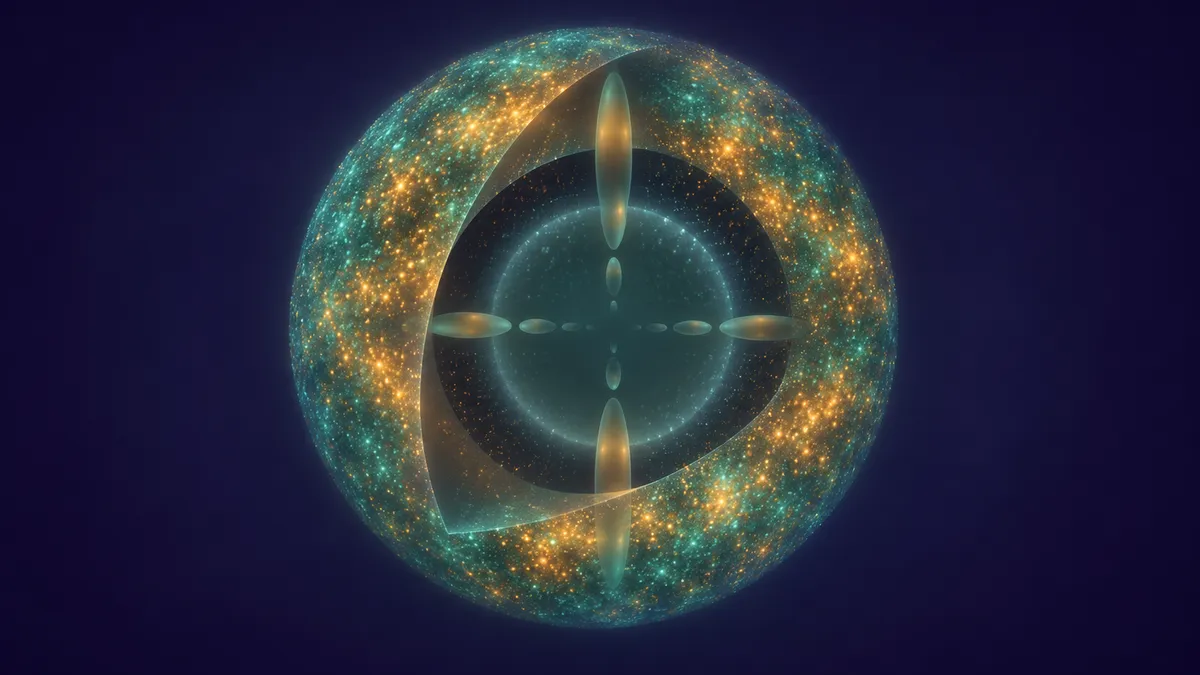
If cosmic expansion stretches a measuring rod differently along and across our line of sight, interpreting its apparent size requires more than calculating its distance. A new analysis follows both effects—and finds that current observations still leave markedly different density profiles possible.
What if the cosmic ruler stretches unevenly?
Sound waves in the early universe left a preferred separation in the distribution of matter. Astronomers observe this imprint, called baryon acoustic oscillations or BAO, in galaxy clustering. Its apparent size helps them investigate cosmic distances and expansion.
In a homogeneous cosmological model, expansion preserves the ruler’s comoving length: its physical growth is absorbed into the coordinates used to describe the expanding universe. But if density changes with distance from an observer, neighboring regions can expand differently. The acoustic feature can then stretch by different amounts along and across the line of sight.
In a November 9 preprint, Myrto Magklara and Leandros Perivolaropoulos investigate what BAO and Type Ia supernova observations can establish about such radial variations. Their result is a set of conditional constraints, not a discovery that we inhabit a cosmic void.
Following distances and rulers together
The researchers use Lemaître–Tolman–Bondi cosmology with a cosmological constant. This framework describes a spherically symmetric universe whose matter density can vary with radius. The observer sits at the symmetry center throughout: moving the density minimum outward creates an underdense shell around the observer, not an observer displaced from a void’s center.
Their main profile contains a density depression compensated by excess matter around it. They vary its depth, width and radial location, together with the matter density of the homogeneous exterior.
The calculation solves the nonlinear background expansion and the path of arriving light. It also follows how an initially common acoustic ruler is carried by the expanding matter. The theoretical model is then compared with existing observations; this is not a new experimental measurement.
Type Ia supernovae supply relative distances through their corrected brightnesses. Transverse BAO supplies distance divided by transverse ruler length. Combining the two can cancel their shared distance dependence and reveal relative ruler changes without fixing either the supernova luminosity or the initial ruler’s absolute length. Radial BAO adds information about expansion and ruler stretching along the line of sight.
A better fit, but more freedom
The primary comparison combines 13 DESI DR2 BAO measurements with 1,820 DES-Dovekie supernovae, retaining the released correlations between measurement errors. Both the inhomogeneous model and the homogeneous flat ΛCDM reference leave the initial ruler length and supernova brightness normalization free.
The best located inhomogeneous fit lowers the chi-squared statistic by 8.523. Lower chi-squared means closer agreement under the adopted error model, but the alternative also has three additional parameters. Most of the improvement comes from the supernovae, rather than DESI.
Crucially, different matter distributions fit almost equally well. One solution has a nearby narrow shell with a maximum density deficit of about 15.5% relative to the exterior. Another has a broader, more distant shell with a deficit of about 4.2%. Their total chi-squared values differ by only 0.647.
They imply different ruler histories. Between redshifts 0.11 and 0.65, the nearby solution predicts roughly a 10% decrease in the radial ruler, whereas the broad solution predicts about a 1% increase. These are model predictions, not direct measurements of ruler evolution.
Why this is not a detection
The authors generated 5,000 simulated datasets from the best-fitting homogeneous model. In 369 cases—7.38%—their restricted search found an improvement at least as large as the observed one. A more complete search could find additional qualifying cases, making that fraction a lower-bound estimate under the stated assumptions. It is not the probability that the homogeneous model is true.
The preferred geometry also changes when nearby supernovae are removed or a different supernova compilation is used. A separate test of a smooth transverse-ruler trend remains consistent with a constant ruler.
Where the interpretation remains conditional
Although the background calculation is nonlinear, its comparison with released BAO summaries uses local predictions at representative redshifts. Actual surveys combine galaxy pairs across finite redshift intervals. Illustrative averaging choices can switch which shell fits best; they are not measured survey-response functions.
The analysis also retains released supernova corrections rather than rederiving them within the inhomogeneous model. Its strength is therefore showing which particular geometries these data reject or permit under explicit assumptions—not uniquely reconstructing cosmic density.
Finally, in the local approximation with matching redshift weights, angular BAO and the transverse part of three-dimensional BAO measure the same distance-to-ruler ratio. Stretching their common ruler shifts both together, so it cannot alone explain a discrepancy between them.
- baryon acoustic oscillations
- Type Ia supernovae
- cosmic inhomogeneity
- Lemaître–Tolman–Bondi cosmology
- DESI
- cosmic expansion
Related reading
Automatically matched by shared topic keywords. These links do not imply that the sources agree or establish a consensus.
Could cosmic acceleration end? A dark energy preprint explores the possibility
Source published
Shared keywords: cosmic expansion, type ia supernovae
Galaxy clusters reveal an ancient cosmic ruler
Source published
Shared keywords: baryon acoustic oscillations, cosmic expansion
An apparent dark-energy reversal could require dark matter to lose mass
Source published
Shared keywords: cosmic expansion
Hiding cosmic answers to help astronomers test their methods
Source published
Shared keywords: baryon acoustic oscillations
Could a quantum horizon timescale shape cosmic expansion?
Source published
Shared keywords: cosmic expansion