TRANSMISSION // 2611.12549v1
A geometric fingerprint for the finite families of complex spinors
Source published
A mathematical preprint recovers the known finite classifications of complex spinors using momentum maps, constructs representative states, and proposes a revised relationship between two classes in dimension fourteen.
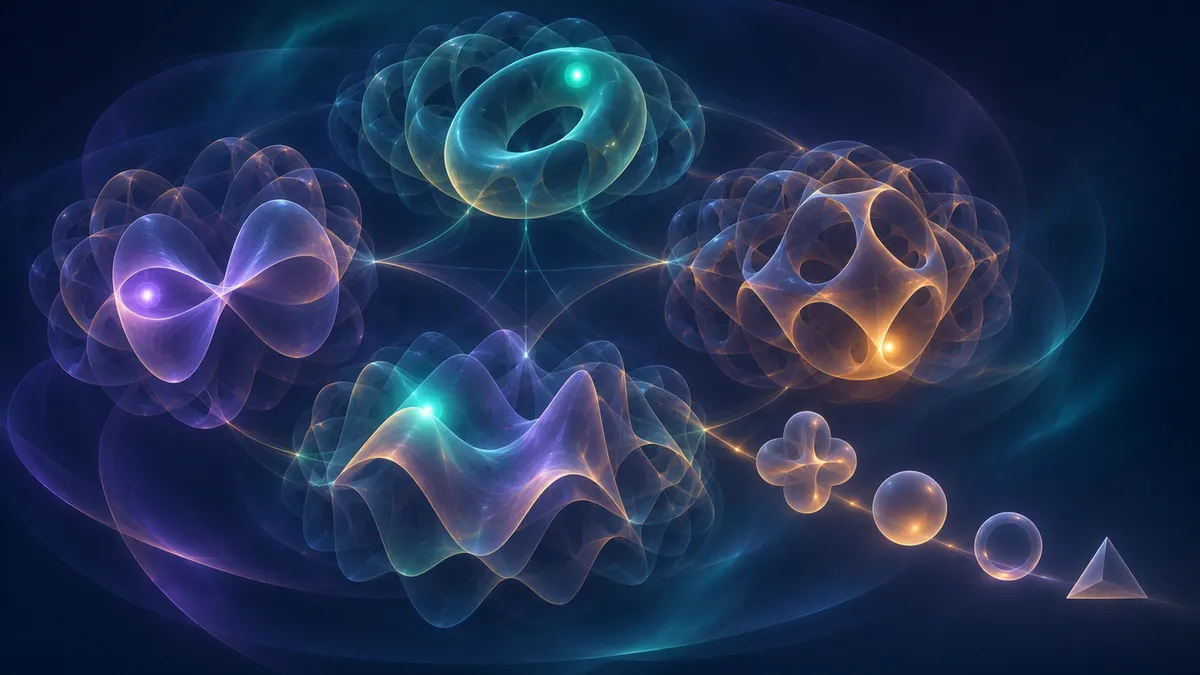
When do two complicated mathematical states count as the same? Bartłomiej Sikorski and Adam Sawicki revisit that question for complex spinors, finding geometric fingerprints that distinguish every class in the dimensions where only finitely many classes exist.
What is being classified?
Spinors are mathematical objects that carry representations of spin groups, the symmetry groups closely related to rotations. This paper studies complex spinors under complex spin transformations, which allow more than ordinary rotations.
Two nonzero spinors count as equivalent if one can be transformed into the other, allowing multiplication by any nonzero complex number. Ignoring that overall factor makes the classification projective. An orbit is the collection of states equivalent under the permitted transformations.
The dimension named in the paper belongs to the underlying vector space defining the spin group—not necessarily physical spacetime, and not the number of spinor components. In even dimensions, the authors study one half-spin representation, one of two sectors distinguished by chirality.
The finite classifications themselves are established results. The contribution is a momentum-map construction of their representatives and distinguishing values, a completeness argument independent of the classical classifications, and an analysis of limiting relationships between classes.
Turning states into geometric fingerprints
A momentum map collects expectation values of observables associated with the compact, rotation-like spin symmetry. Despite its name, it is not simply a measurement of a particle’s mechanical momentum.
Its squared norm supplies a quantity to minimize. Within each orbit in the finite cases, the authors construct a critical representative: a state where this quantity has no first-order change in any direction. These representatives attain the orbit’s minimum.
The critical representatives belonging to one complex orbit are all related by compact spin transformations. Expressing their momentum values in a standard symmetry region, called a Weyl chamber, therefore gives a consistent fingerprint. The authors find distinct fingerprints for every orbit within each finite case.
Importantly, the fingerprint is the full chamber momentum value, not just its length. Two different classes in dimension fourteen have the same minimum squared norm but different momentum values.
How the construction works
The authors use the Clifford–Fock model, which expresses spinors through configurations of empty and occupied fermionic modes. Each basis configuration is a pure spinor. Here, “pure” is a specific geometric condition involving the largest possible space of vector directions that annihilate the spinor; it does not merely mean that a quantum state is unmixed.
Representatives are built as sums of selected basis configurations. Their occupation strings are chosen to be sufficiently different: any two differ in at least four positions for the even-dimensional cases, or three for the odd-dimensional cases. This eliminates certain momentum components and makes the remaining momentum a weighted average of known vectors called weights.
The squared amplitudes supply the averaging probabilities. Finding critical amplitudes then becomes a linear-algebra problem: locate the point closest to the origin in the appropriate affine span and require its probabilities to be positive.
Constructing examples does not establish completeness. The authors also use Vinberg’s theory of graded Lie algebras and stabilizer actions to bound the possible orbits. They report exact-arithmetic computations checking orbit dimensions, momentum values and critical-point identities.
The finite cases—and where the method stops separating classes
The paper recovers these orbit counts:
- Odd dimensions 1, 3, 5, 7, 9 and 11: respectively 1, 1, 1, 2, 3 and 5.
- Even dimensions 2, 4, 6, 8, 10, 12 and 14: respectively 1, 1, 1, 2, 2, 4 and 9.
Dimension thirteen has infinitely many projective orbits, as does every dimension from fifteen onward. In thirteen, the authors exhibit a continuous family of inequivalent states whose momentum values all vanish. Momentum therefore ceases to be a complete fingerprint outside the finite range.
Dimension fourteen also lets the authors investigate degenerations: limits of transformed states that enter a different orbit. They show that the minimum squared momentum norm increases strictly under a proper degeneration between orbits containing critical points. Combined with explicit limiting constructions, this determines the closure order of all nine classes.
Their conclusion excludes an inclusion shown in Popov’s 1977 announcement: the two equal-minimum classes cannot degenerate into one another. This is a claim of the present preprint, not an independently verified correction here.
Physical meaning and limits
In even dimensions, the momentum map is proportional to the Majorana covariance matrix, which records quadratic fermionic correlations. Minimizing its norm maximizes an associated generalized entanglement measure within each class of invertible Gaussian transformations. The odd-dimensional action includes parity-changing transformations, so that physical interpretation cannot be transferred unchanged.
This is mathematical research, not an experiment or a demonstrated quantum-computing application. The source is version 1 of an arXiv preprint, posted on November 9, 2026; the supplied evidence does not establish peer-review status. Its strongest claims concern the stated representations and equivalence rules, not arbitrary quantum states.
- spinors
- momentum maps
- projective orbits
- representation theory
- fermionic states
- generalized entanglement
- mathematical physics
- preprint
Related reading
Automatically matched by shared topic keywords. These links do not imply that the sources agree or establish a consensus.
Entangled qutrits reach the quantum limit in a two-player hat game
Source published
Shared keywords: mathematical physics
A wave-equation route to building two-electron atomic functions
Source published
Shared keywords: mathematical physics
A locality bound for quantum fermions moving in continuous space
Source published
Shared keywords: mathematical physics
A sharp limit on density fluctuations in free-fermion lattices
Source published
Shared keywords: mathematical physics
A staircase formula for a hidden quantum symmetry
Source published
Shared keywords: mathematical physics