TRANSMISSION // 2611.12546v1
A compact calculation explores quantum topology on a fractal
Source published
A theoretical preprint uses a fractal’s repeating geometry to compress a quantum lattice model, calculating its energy spectrum beyond 100 million sites and investigating how topological behavior changes across length scales.
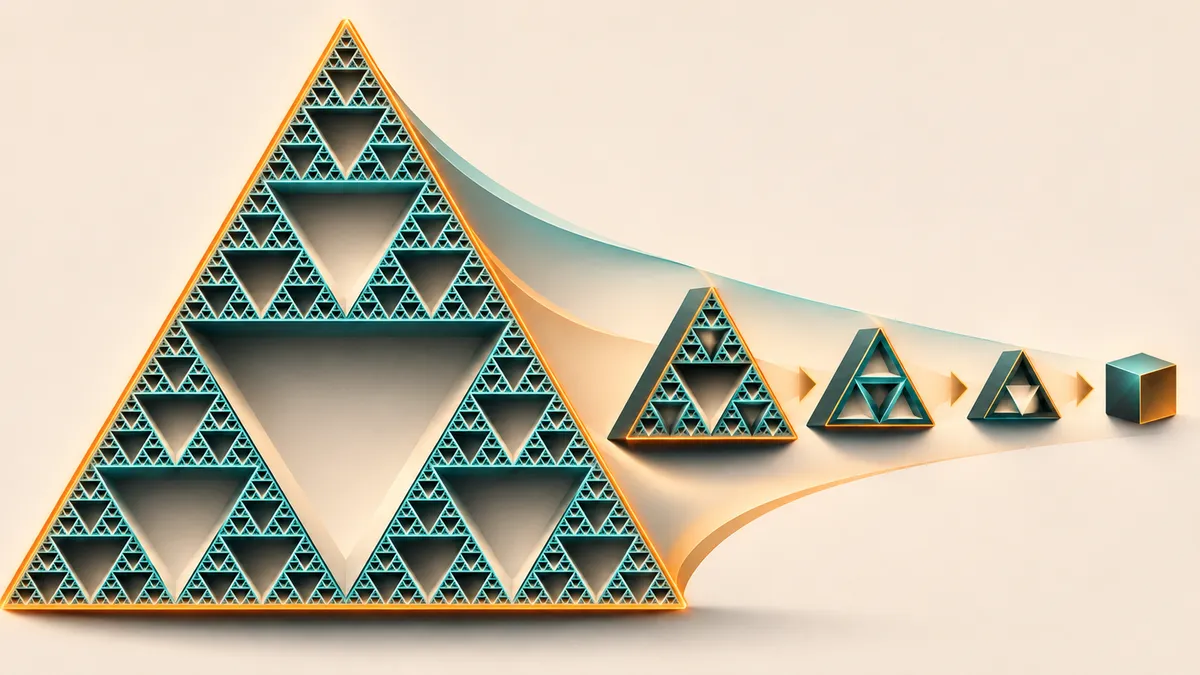
On a triangle riddled with smaller triangular holes, where does the interior end and the edge begin? A new computational study explores that question for quantum states, using the fractal’s own repetition to make enormous calculations manageable.
When boundaries appear at every scale
Some quantum materials have topological properties that connect their interior states to distinctive states along their boundaries. But that familiar distinction becomes harder to draw on a fractal, where holes and their edges recur at many scales.
In a preprint submitted to arXiv on November 9, 2026, Zebedeus F. Osseweijer and colleagues develop a compact computational representation of such a system. They calculate an energy spectrum for a fractal lattice containing more than 100 million sites, then investigate topology on a smaller lattice. This is theoretical and numerical research, not an experiment demonstrating a new material.
Their geometry is the Sierpiński gasket: start with a triangle, divide it into four smaller triangles, remove the middle one, and repeat. Its Hausdorff dimension is about 1.58. That number describes how the structure scales; it does not mean the lattice occupies a fractional number of ordinary spatial directions.
Turning repetition into compression
The researchers study a single-particle tight-binding model, which describes quantum hopping between neighboring lattice sites. Their version, called the flux kagome model, assigns phases to the hopping amplitudes, breaking time-reversal symmetry. On the ordinary two-dimensional kagome lattice, this model can form a Chern insulator, a type of topological system.
The computational challenge is that each additional fractal generation multiplies the number of sites. Storing and manipulating a full Hamiltonian—the matrix describing the hopping rules—quickly becomes costly.
The authors instead identify each site through a sequence of choices: at each scale, select the top, bottom-right or bottom-left subtriangle. They encode the Hamiltonian as a matrix product operator, a chain of small numerical building blocks called tensors.
The geometry blocks repeat from scale to scale, while a final block supplies the model-specific hopping details. Only seven internal states are needed to encode connectivity, regardless of the fractal generation. The Hamiltonian representation is exact: compression exploits the lattice’s repeated rules rather than approximating its shape. Subsequent numerical calculations still have convergence and resolution limits.
Huge spectra, smaller topological calculations
Using this representation and the kernel polynomial method, the team calculates the density of states for a 17th-generation gasket with over 100 million sites. The density of states describes how densely the available quantum states are distributed across energy.
Without the hopping phases, the fractal produces large spectral gaps. Introducing finite flux narrows gaps and reveals a more intricate, self-similar pattern.
On a 10th-generation gasket, the authors also project the spectral function onto plane waves associated with the periodic kagome lattice. Band-like features and crossing structures reminiscent of Dirac dispersions appear. However, the fractal lacks translational symmetry: these projections do not make momentum a good quantum number, and the visual resemblance alone does not establish topology.
For that, the researchers calculate a real-space Chern number, a diagnostic suited to systems without spatial periodicity. They find plateaus near +1 and −1 in different energy ranges, supporting distinct topological regimes in the model.
The difficult step remains
Calculating this diagnostic requires a projector that selects all states below a chosen energy. Constructing it becomes difficult when gaps are narrow or contain edge-like states. An iterative tensor-network procedure called purification can converge slowly or fail.
The authors therefore combine purification at a suitable reference energy with sparse diagonalization, explicitly calculating additional states needed to reach the target energy. This improves resolution without calculating every occupied eigenstate. But it requires storing the sparse Hamiltonian, giving up some of the memory advantage. The detailed topology results are therefore not a demonstration of equally resolved topology across the entire hundred-million-site system.
An edge depends on the energy
Finally, the team compares a local Chern marker, which maps the spatial topological response, with the local density of states, which shows where states have weight at a selected energy.
The maps indicate that regions behaving more like an interior in one gap can behave more like an edge in another. Edge-like structures extend across larger regions in the −1 regime than in the +1 regime.
The authors hypothesize that these larger structures explain why larger sampling regions are needed to obtain a well-quantized Chern number there. Recurrence across still deeper scales remains a conjecture, not an established result. Their advance is a practical way to investigate that possibility, while the difficult distinction between bulk and boundary—and the numerical bottleneck in narrow gaps—remains.
- quantum topology
- Sierpiński gasket
- tensor networks
- Chern insulator
- fractal lattices
- computational physics
Related reading
Automatically matched by shared topic keywords. These links do not imply that the sources agree or establish a consensus.
AI-guided simulations trace how a plasma pinch releases energy
Source published
Shared keywords: computational physics
Tensor networks sharpen a mathematical guarantee for the Haldane gap
Source published
Shared keywords: tensor networks
When different quantum networks describe the same state
Source published
Shared keywords: tensor networks
Quantum computing proposal puts ‘over-squeezed’ atoms to work
Source published
Shared keywords: tensor networks
A smaller way to represent Boolean rules—without losing a unique form
Source published
Shared keywords: tensor networks