TRANSMISSION // 2611.12540v1
Calculating collision odds when both orbits change shape
Source published
A preprint extends collision calculations to pairs of bodies whose orbits undergo Lidov–Kozai cycles. An idealized simulation supports the method, while a mathematical result explains when long-term collision rates can become independent of the bodies’ starting orbital states.
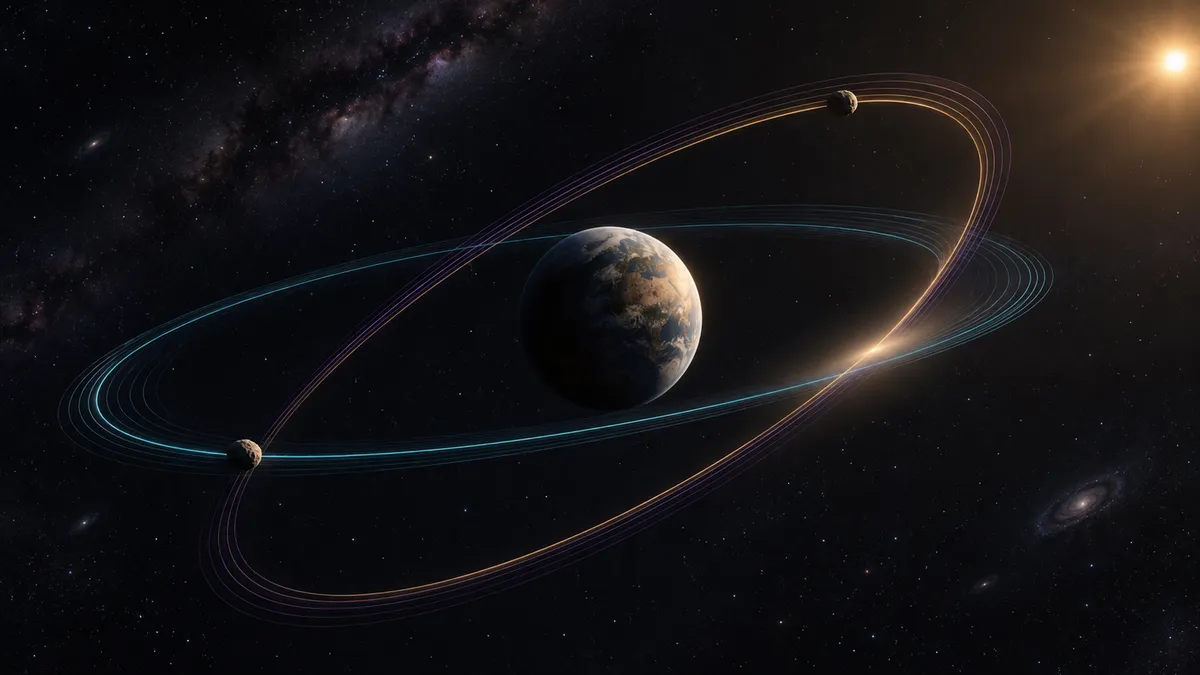
Two orbits can cross without their occupants ever meeting. Predicting collisions becomes harder when both paths slowly change shape and tilt. A new calculation follows those changes together, estimating how often a moving pair of orbits creates an opportunity for impact.
When crossing paths keep changing
An orbital intersection is not a collision. Two bodies must reach the same small region at the same time. Over long periods, gravity from a distant companion can also reshape their orbits, changing where—and whether—those encounters are possible.
One mechanism behind such changes is Lidov–Kozai evolution. Under suitable conditions, an external gravitational perturber drives coupled variations in an orbit’s eccentricity, which describes its elongation, and inclination, its tilt relative to a reference plane. The orbit’s orientation also changes.
In a new preprint, Youpeng Liang and Xiaodong Liu extend an existing collision-frequency method to a situation in which both bodies undergo this evolution. Their calculation addresses a restriction in the preceding framework: the target’s orbital size, eccentricity and inclination were held fixed, while its orientation changed at prescribed constant rates.
That restriction is unsuitable when the target’s orbit itself changes substantially.
Counting opportunities, not just intersections
The researchers consider two bodies orbiting the same central object, with a distant companion on a fixed circular orbit. Both smaller bodies are treated as test particles: their mutual gravity and their gravitational effects on the larger bodies are neglected.
Their slow orbital evolution is calculated using a doubly averaged quadrupole model. This averages over the rapid orbital motion of each smaller body and the external perturber, retaining a leading contribution to the long-term gravitational disturbance. Within this model, each smaller body’s semimajor axis—the measure setting its orbital size—stays constant, while its shape and orientation evolve.
The calculation first identifies exact intersections between the two evolving orbital ellipses. For noncoplanar orbits, these can occur only along the line where their orbital planes intersect.
Finite-sized bodies do not require their orbital paths to intersect exactly. Nearby paths can also permit an impact. Around each exact intersection, the method therefore estimates a time window during which the local separation of the orbits remains within the combined radii of the bodies.
Crucially, that window depends on how both orbits move, rather than treating the target’s path as fixed. A second probability accounts for whether the bodies arrive in the encounter region together, using a statistical treatment of their rapid orbital motion. Summing these contributions gives a collision frequency for each projectile Lidov–Kozai cycle; averaging successive cycles gives the long-term estimate.
A test around an idealized Earth
For their numerical example, the authors place two test bodies around Earth, with the Sun supplying the external perturbation. Their initial orbits are highly inclined, and each body has a radius of 50 kilometres. Gravitational focusing—the enhancement of collisions by mutual gravitational attraction—is neglected.
The baseline calculation yields a mean collision frequency of approximately 7.8 × 10⁻¹⁴ per second.
To test its consequences, the researchers also run direct gravitational simulations with the REBOUND software. These follow a target and 1,200 projectiles whose starting orbital states are distributed along the same modeled Lidov–Kozai cycle, with randomized orbital orientations and positions along their orbits.
Using the calculated frequency as a constant collision rate predicts an exponential decline in the surviving population. After 1.5 million years, the direct simulations have removed 96.25 percent of the projectiles through collisions, compared with approximately 97.51 percent in the statistical prediction.
The overall depletion trends are similar. This supports the method for the example examined, rather than establishing its accuracy across all orbital systems.
When starting states cease to matter
The preprint also asks whether choosing different starting points on the same long-term orbital cycles changes the eventual mean collision frequency.
Its answer is conditional. At the beginning of successive projectile cycles, the target’s position within its own cycle and the relative orientation of the orbital planes must jointly sample their possible combinations uniformly over the long term.
The authors identify a mathematical condition for that sampling: no nontrivial integer relation may connect the cycle-period ratio, the relative average nodal-precession increment and an integer. Merely having two irrational increments is not sufficient.
Under this condition, changing the initial cycle positions or nodal orientations does not change the long-term average, provided both bodies retain the same semimajor axes, conserved Kozai constants and original closed evolutionary curves.
Eight altered starting configurations produce estimates within about 0.32 percent of the baseline. However, three reach the calculation’s cycle limit without satisfying its numerical stopping criterion. The agreement supports the theoretical result, but does not establish a universal error bound.
A useful, bounded extension
The framework excludes coplanar configurations, equilibrium states and separatrices—the boundaries between different kinds of secular motion. It also relies on local approximations to encounter geometry and an averaged description of orbital evolution.
Within those limits, it offers a way to estimate collisions between two changing orbits. The authors suggest irregular satellites around giant planets as a possible application. The present demonstration remains an idealized test, not a measured collision rate for an actual satellite population.
- Lidov–Kozai evolution
- orbital collisions
- collision frequency
- secular dynamics
- celestial mechanics
- REBOUND
- irregular satellites
Related reading
Automatically matched by shared topic keywords. These links do not imply that the sources agree or establish a consensus.