TRANSMISSION // 2611.12504v1
ALMA spots a faint signal from dust around GQ Lup B
Source published
A faint submillimeter signal strengthens evidence for a compact dusty disk around GQ Lup B. Its size and mass remain uncertain, while crossings of its star’s gas disk could help explain how the companion keeps gathering material.
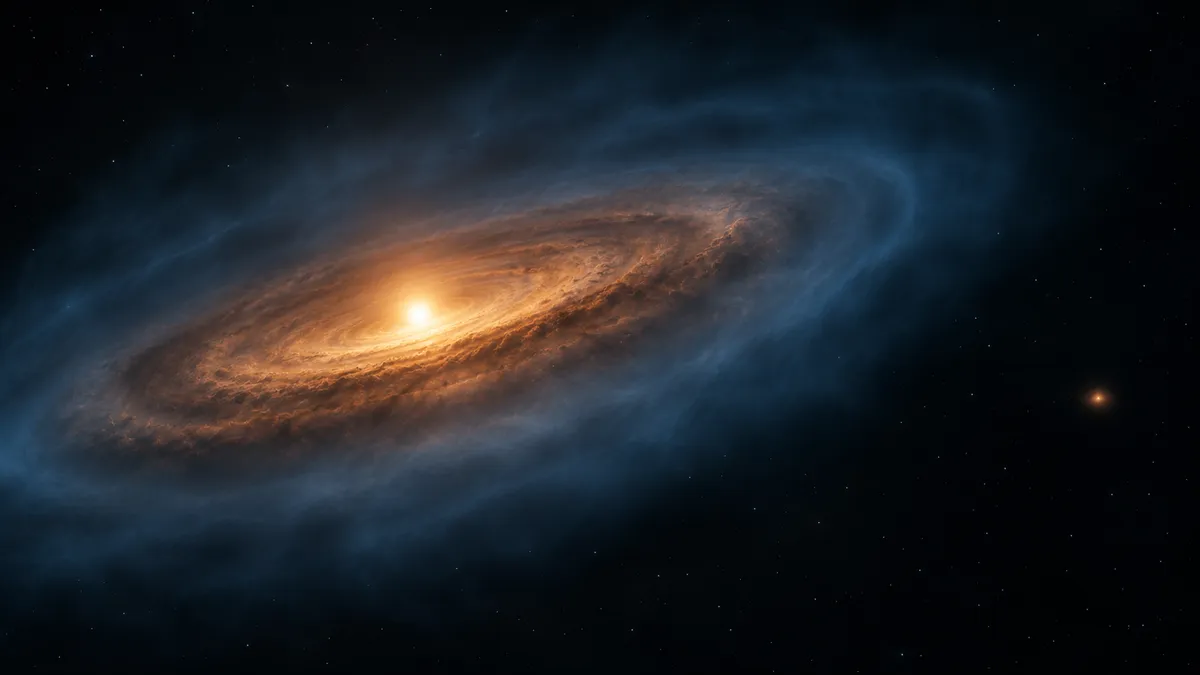
How does a young companion keep feeding when its apparent supply of material looks small? A new ALMA detection around GQ Lup B sharpens that question—and suggests its tilted orbit could provide fresh gas.
GQ Lup B orbits a young star with a disk of its own, but the companion appears to carry a much smaller reservoir. Astronomers now report a faint signal at a wavelength of 0.89 millimeters that they interpret as emission from dust surrounding the companion. The detection adds a colder-wavelength measurement to earlier infrared evidence for a disk, without yet establishing exactly how much material it contains.
Led by Pietro Pirola, the study is available as an arXiv preprint. The manuscript also lists acceptance by Astronomy & Astrophysics on November 5, 2026.
Finding a faint companion beside a bright disk
GQ Lup lies about 154 parsecs away. Its companion has an estimated mass of 10–40 Jupiters, spanning the planetary and brown-dwarf mass regimes, and appears roughly 110 astronomical units from the star. One astronomical unit is the average Earth–Sun distance.
The researchers combined observations from the Atacama Large Millimeter/submillimeter Array, or ALMA, collected between July 2024 and June 2025. Different antenna arrangements supplied complementary sensitivity and resolution. They aligned and calibrated the datasets, excluded channels containing identified gas emission lines, and reconstructed images of the remaining continuum emission.
At the companion’s location, they measured a peak intensity of 54.5 microjanskys per beam, with a noise estimate of 9.4. That gives the headline detection significance of 5.8 sigma: the signal is 5.8 times the measured noise level.
That significance depends on where the noise is measured. Using a region closer to the star raises the noise estimate and reduces the significance to 3.8 sigma. The authors note that this nearby region may contain genuine faint emission, rather than noise alone. Both estimates matter when judging a weak source beside a bright disk.
To check whether image reconstruction created the signal, the team varied the balance between resolution and sensitivity. The peak brightness remained consistent. They also reconstructed the primary disk without allowing the algorithm to model a source at the companion’s position. The signal persisted as the primary disk’s reconstruction became more thorough, arguing against contamination from its imaging sidelobes.
A compact source, not a measured disk edge
The emission lies close to the companion’s independently measured position. Together with previous infrared observations, this supports a dusty-disk interpretation. The authors describe it as the third such millimeter-regime continuum detection around a bound companion in the planetary-to-brown-dwarf mass range, after PDS 70 c and SR 12 c.
ALMA did not resolve the source into a disk with a visible edge. From the smallest beam retaining a signal above three times the noise, the researchers adopt a conservative upper limit of about 2.3 astronomical units on the dust-emission radius.
Two different physical assumptions give different interpretations of the same brightness. If the dust is optically thin—allowing most emitted radiation to escape—the measured flux can estimate its mass. Assuming millimeter-sized grains and a modeled average temperature near 56 kelvin, the team derives about 0.0032 Earth masses of dust. This is not a direct measurement of the gas reservoir.
If the dust is optically thick, material underneath the emitting surface can remain hidden. Brightness then constrains emitting area more readily than total mass. Under the authors’ heating and geometry assumptions, an emitting radius of about 0.2 astronomical units reproduces the signal. Neither this radius nor the optically thin mass is a uniquely measured property.
Could the orbit replenish the supply?
Combining dust-based disk-mass estimates with an assumed gas-to-dust mass ratio of 100 and a previously estimated accretion rate suggests a depletion timescale of roughly 10,000 years or less. That is much shorter than the system’s age of several million years.
But this is not a countdown. Accretion varies, its inferred rate depends on extinction corrections, and the gas-to-dust ratio is unknown. An optically thick disk could also conceal additional mass.
The orbit offers another possibility. Tilted by about 63 degrees relative to the primary disk, GQ Lup B is expected to cross its extended gas component twice per roughly 1,000-year orbit. This tilt describes the companion’s orbit; the orientation of its own disk is unconstrained. Those encounters could replenish the companion’s reservoir, although this study does not directly measure that transfer.
Finally, one wavelength cannot establish that all the signal comes from dust. Radiation from ionized gas associated with accretion shocks could contribute. Observations at additional wavelengths are needed to separate those mechanisms and determine what this faint source reveals about the companion’s supply of material.
- GQ Lup B
- ALMA
- circumplanetary disks
- submillimeter astronomy
- dust emission
- accretion
- brown dwarfs
Related reading
Automatically matched by shared topic keywords. These links do not imply that the sources agree or establish a consensus.
Star-forming clouds show a recurring polarization difference, but no clear environmental order
Source published
Shared keywords: submillimeter astronomy
A longer look at weather on brown dwarfs
Source published
Shared keywords: brown dwarfs
Teaching AI to account for uncertain molecular physics in brown-dwarf atmospheres
Source published
Shared keywords: brown dwarfs