TRANSMISSION // 2611.12496v1
LISA could find elusive black holes long before their companions fall in
Source published
A preprint maps how LISA could detect intermediate-mass black holes through small orbiting companions. Many potential discoveries would come from systems whose final plunge happens after the mission ends.
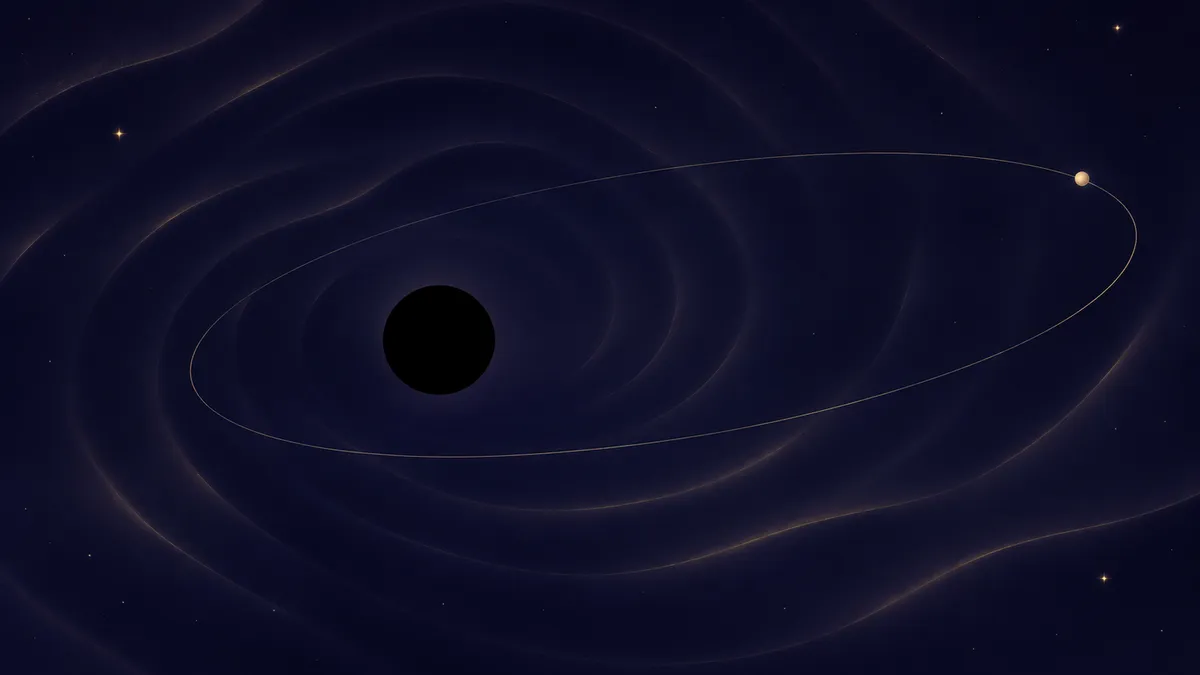
Finding a black hole need not mean witnessing its final encounter with another object. A new study suggests that years of gravitational waves from a small companion could reveal an intermediate-mass black hole while the pair still has decades—or longer—to go.
Looking between the familiar extremes
Black holes weighing roughly 100 to 100,000 Suns occupy an observationally difficult middle ground. Candidates exist, but their abundance remains uncertain. Are these intermediate-mass black holes genuinely scarce, or simply hard to find? Answering that question would help researchers understand black-hole growth and the dense stellar environments where these objects might live.
In a preprint on arXiv, Jean Maurice Meus, Christian Chapman-Bird and Alberto Vecchio investigate how the planned Laser Interferometer Space Antenna, LISA, could reveal them through gravitational waves from much smaller orbiting companions. Their central finding is that searches should not concentrate solely on binaries approaching their final plunge during the mission.
Mapping a long approach
The team modelled binaries in which the companion has between one hundred-thousandth and one hundredth of the central black hole’s mass. They explored nearly circular orbits and highly elongated ones, calculating the gravitational-wave signal that a four-year observation could collect at different stages of the inward spiral.
Their calculations combine models from the FastEMRIWaveforms software framework: an approximate treatment at wider separations and a more fully relativistic treatment closer to the black hole. They compare the predicted signals with LISA’s expected noise, adopting a signal-to-noise detection threshold of 15.
To compare systems without first assuming how common they are, the researchers calculate a quantity called sensitivity time-volume. It combines the volume of space accessible to LISA with the span of a binary’s evolution over which a four-year observation could detect it.
That distinction matters: a system can offer many possible observation windows before its final plunge. This does not mean LISA would observe for centuries; it means the mission could catch a source at any of many earlier stages.
The final plunge is not the whole opportunity
For favourable binaries containing a central black hole of about 10,000 solar masses, the calculated maximum reach extends to a cosmological redshift of roughly five. Systems with central masses around 1,000 Suns have a much shallower reach, around redshift 0.1. These are detection horizons for particular binary configurations, not promises that every black hole of those masses would be visible that far away.
More importantly, including systems that will not plunge during the mission substantially enlarges the discovery opportunity.
For one model binary—a 1,000-solar-mass black hole with a one-solar-mass companion on a circular orbit—the total sensitivity time-volume is about 92 times that obtained by counting only observation windows containing the plunge. Almost all of that model’s opportunity therefore comes from earlier inspiral stages.
The advantage is smaller for many heavier systems, but remains relevant. Where sensitivity time-volumes are large, including non-plunging sources typically increases the total by a factor of about 1.1 to three. Searches limited to imminent endings would miss part of the accessible population.
Orbital shape changes the window
Eccentricity measures how elongated an orbit is. Here, the quoted initial eccentricities refer to a model reference point 1,000 years before plunge—not necessarily the orbit’s shape when LISA observes it.
Orbital shape changes the maximum detection distance relatively modestly, but can strongly change how much of the inspiral is detectable. Elongated orbits distribute gravitational-wave power across multiple frequencies. Whether that helps depends on where those frequencies fall relative to LISA’s most sensitive band.
For light companions, increasing eccentricity can reduce sensitivity time-volume by orders of magnitude. For some heavier companions, it instead improves detectability. There is no universal rule that a more elongated orbit makes a better target.
White dwarfs and uncertain numbers
A white-dwarf companion introduces another possible ending: tidal disruption before plunge. The team models this by stopping the signal when the star first passes within a calculated disruption distance. Disruption can reduce the accessible signal, especially around lighter central black holes. The treatment simplifies a process that can also involve heating and gradual stripping of stellar material.
Other limitations remain. The calculations restrict orbits to the black hole’s equatorial plane, and some highly eccentric cases require less accurate waveform approximations. The adopted detection threshold is a forecasting choice, not a demonstrated performance level for a completed search pipeline.
Finally, sensitivity is not abundance. The rates at which these binaries form and merge are poorly known. The authors discuss possibilities ranging from very few detections to around a thousand, depending on population assumptions; detections are not guaranteed. The clearest practical conclusion is narrower: to exploit LISA’s opportunity, researchers need searches capable of recognising long-lived inspirals, not just their final moments.
- LISA
- intermediate-mass black holes
- gravitational waves
- compact-object inspirals
- orbital eccentricity
- white dwarf tidal disruption
Related reading
Automatically matched by shared topic keywords. These links do not imply that the sources agree or establish a consensus.
Separating black hole signals from glitches in simulated LISA data
Source published
Shared keywords: gravitational waves
The Milky Way’s leftover signals could blur LISA’s search for a gravitational-wave background
Source published
Shared keywords: gravitational waves
Phentax adapts black hole waveform calculations for LISA’s crowded signals
Source published
Shared keywords: gravitational waves
Cosmic phase-transition simulations reveal a two-scale gravitational-wave signal
Source published
Shared keywords: gravitational waves
Could daily pulsar observations probe a gravitational-wave blind spot?
Source published
Shared keywords: gravitational waves