TRANSMISSION // 2611.12494v1
Could timeless shapes offer a route beyond quantum theory?
Source published
A speculative preprint explores whether scale-invariant arrangements of particles could underpin quantum phenomena. Its geometrical structures are intriguing, but it does not reproduce quantum predictions or demonstrate entanglement.
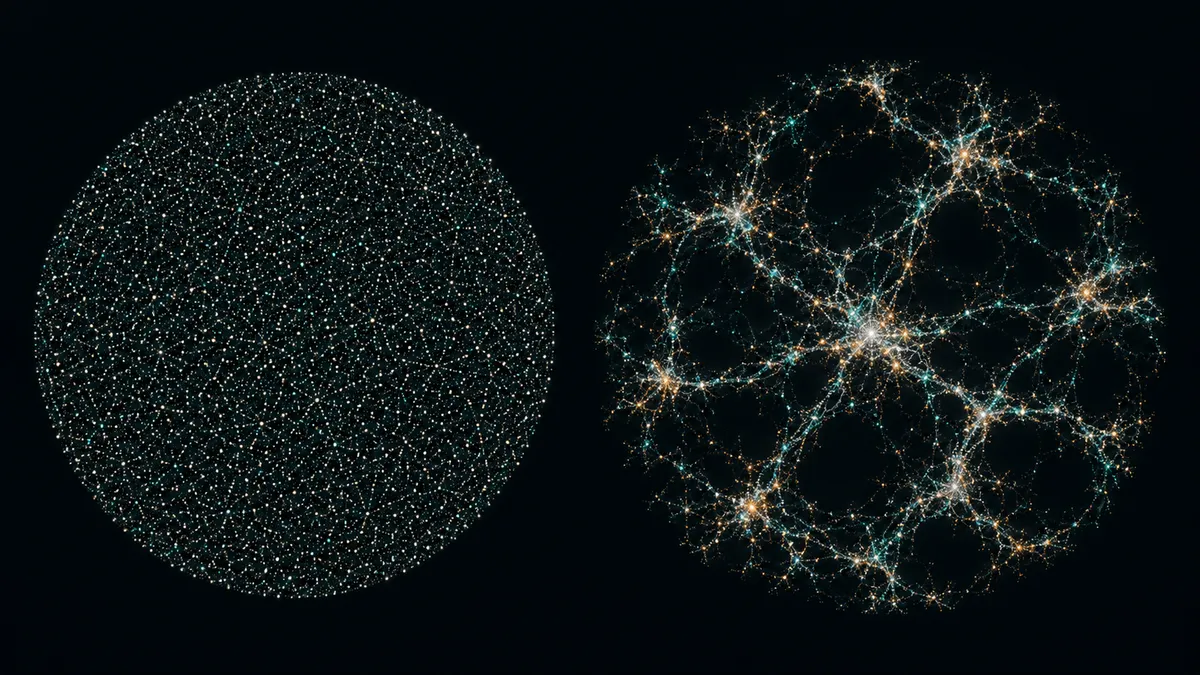
What if explaining nature began not with particles changing through time, but with the relationships within complete arrangements of particles? A new proposal investigates that possibility, while acknowledging the large gap between interesting geometry and a working replacement for quantum mechanics.
Quantum mechanics predicts experimental results with extraordinary success. Yet questions about what its mathematics says about reality continue to motivate alternative approaches. In An Alternative to Quantum Theory, Julian Barbour and Maria I. R. Lourenço ask whether a radically different starting point could eventually recover the same observations: timeless arrangements of points, described through ratios rather than absolute distances.
Their proposal is not a completed alternative to quantum mechanics. It is a research programme motivated by mathematical and numerical findings about particle configurations. The distinction matters: finding elaborate patterns is not the same as explaining atomic spectra, interference or quantum entanglement.
A universe described by proportions
Imagine enlarging every separation in an arrangement of points by the same factor. Its size changes, but its shape does not. The authors make this scale invariance foundational. Their basic ingredients are points in ordinary three-dimensional Euclidean space, with relative masses and relative separations. Charge ratios are envisaged for future extensions.
Instead of describing how positions evolve, they investigate a function called the variety, which assigns a number to an arrangement. It is the ratio of two characteristic lengths: a mass-weighted root-mean-square separation and a mass-weighted harmonic separation. The latter is particularly sensitive to close pairs.
Because both lengths grow together when the configuration is enlarged, their ratio stays unchanged. Variety therefore measures something about shape and clustering, not overall size. An external ruler is unnecessary.
What the calculations show
The mathematical investigation concerns special arrangements called central configurations. These correspond to critical points of the variety: minima and saddle points, where small changes in shape produce no first-order change in its value.
The paper draws on earlier mathematical and numerical studies of these configurations. Near the absolute minimum, particle distributions are highly uniform; three-dimensional examples have nearly spherical boundaries. At slightly higher critical values, elaborate filamentary structures appear.
One illustrated comparison uses two planar arrangements of 5,000 equal-mass particles. Their variety values are approximately 0.585701 and 0.595574, a difference of about 1.7%. The higher-value configuration contains an extended filament network rather than the comparatively uniform distribution of the lower-value example.
These are geometrical configurations, not frames from a simulation showing one structure evolving into another. Their significance for the proposal is that a simple scale-invariant function can support unexpectedly organised patterns.
The authors also suggest ordering shapes by their excess variety above the minimum, calling this quantity an “age.” That is a proposed geometrical ordering, not an established measurement of elapsed physical time.
Why geometry is not yet entanglement
The authors are interested in correlations extending across whole configurations. Distances between points cannot vary independently: they must fit together consistently within Euclidean geometry. Such constraints require no signal travelling between points to establish them.
But long-range geometrical relationships alone do not demonstrate quantum entanglement. Quantum experiments produce particular statistical correlations, including violations of Bell inequalities, which constrain explanations based on local properties and specified independence assumptions. The paper explicitly acknowledges that its configurations have not been shown to reproduce those correlations.
Its wider ambition is holistic. Rather than treating a particle separately from its apparatus, the framework would describe an entire arrangement containing the system, detector, environment and physical records. The authors speculate that correlations within such arrangements might account for phenomena normally explained through evolving wave functions or propagating photons. They do not derive those results here.
What a successful theory would still need
A replacement must do more than contain shapes resembling molecules or experimental records. It must explain why the observed outcomes occur with the quantitative frequencies quantum mechanics predicts.
The mathematical extension incorporating charge remains undetermined. The proposed infinite-particle framework is also unfinished. Atomic and molecular predictions, quantum statistics and the value of the fine-structure constant remain goals rather than demonstrated achievements.
This article is based on the supplied extracted paper text, not solely its abstract. The source is an arXiv preprint, with no peer-reviewed status established by the supplied material. Its contribution is a speculative connection between rich geometrical structures and foundational questions—not evidence that quantum theory has been superseded.
- quantum foundations
- scale invariance
- central configurations
- relational physics
- geometrical correlations
- timeless physics