TRANSMISSION // 2611.12481v1
A 10-kilometre optical link delivers control to superconducting qubits
Source published
Researchers report sending phase-preserving microwave control through optical fibre between two refrigerators, preparing an entangled state of two qubits inside the receiving refrigerator. The experiment demonstrates a classical control link, not entanglement shared across the fibre.
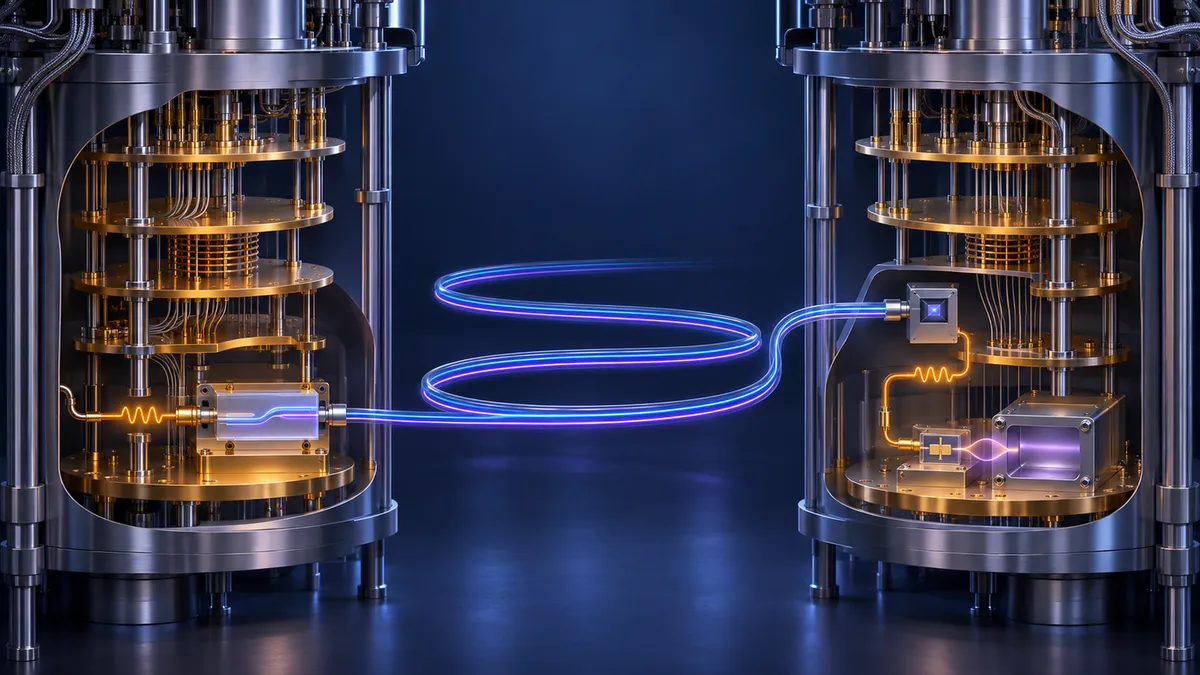
How can quantum processors coordinate when they no longer fit inside one refrigerator? A new preprint explores one part of the answer: carrying precisely timed control waveforms through 10 kilometres of optical fibre.
Superconducting quantum processors operate at temperatures close to absolute zero, inside dilution refrigerators. Connecting and controlling more qubits adds wiring, heat and hardware, making modular systems an attractive direction. But separate modules would need both quantum connections that distribute entanglement and classical connections that coordinate operations.
Chuanlong Ma and colleagues report an experiment addressing the classical side. Their coherent optical link sends microwave control waveforms between two refrigerators through 10.1 kilometres of fibre. At the receiving end, those signals control a superconducting transmon and a second qubit encoded in a microwave cavity.
The essential distinction is where the quantum action happens: both qubits are inside the receiving refrigerator. The experiment does not transmit an unknown quantum state through the fibre or entangle qubits in different refrigerators.
Turning a microwave waveform into light
Quantum control requires more than delivering the right frequency. A pulse’s amplitude, duration and phase determine how it changes a qubit’s state. Phase sets the orientation of many qubit rotations, so a connection must preserve a meaningful reference for it.
The team uses a laser and a microwave-to-optical converter in the first refrigerator. Inside a lithium niobate waveguide, an applied microwave signal generates a travelling acoustic wave. Through Brillouin scattering—the interaction of light with sound—that wave shifts some pump light to a different optical frequency. The shifted light carries the microwave waveform’s amplitude and phase information.
The control pulses themselves originate in room-temperature electronics; the experiment does not require a quantum processor in the sending refrigerator.
The converted signal travels along the fibre together with optical reference light derived from the same laser. In the receiving refrigerator, photodiodes turn the combined light back into microwave signals. Their response produces a beat note at the difference between the signal and reference frequencies.
Choosing the reference frequency allows the researchers to generate a drive resonant with either the transmon or the cavity, despite their different frequencies. Because signal and reference share the laser and fibre path, much of their common phase noise cancels when the beat note forms. This cancellation is not perfect immunity to fibre fluctuations, but it helps retain usable control phase.
Testing control, then creating entanglement
Measurements of the complete link gave a bandwidth of about 3.6 megahertz, suitable for the microsecond-scale pulses used here. The researchers first demonstrated transmon rotations and interference measurements, testing whether the remotely delivered pulses could manipulate both quantum populations and relative phase.
Randomized benchmarking, which measures how performance degrades over sequences of gates, yielded an estimated average elementary single-qubit gate fidelity of 95.36%, with a reported uncertainty of 0.13 percentage points. This characterizes the implemented control operations, not simply the fibre’s transmission quality.
Next, the team controlled the coupled storage cavity. Its nonlinearity makes the transition from zero to one photon distinguishable from subsequent photon additions. With a sufficiently weak drive, the researchers could largely restrict operations to those first two states, making them a second qubit.
The coupling between cavity and transmon also makes the transmon’s transition frequency depend on the cavity’s photon number. That dependence enables conditional operations: a pulse can act differently depending on the other qubit’s state. Together with individual-qubit control, these operations provide the reported universal gate set—the ingredients needed to construct arbitrary two-qubit operations.
Using preparation pulses delivered through the optical link, the team created a Bell state combining two possibilities: a ground-state transmon with one cavity photon, and an excited transmon with an empty cavity. State reconstruction gave a fidelity of 80.6%, with a reported uncertainty of 13.1 percentage points. Fidelity measures overlap with the intended state; the substantial uncertainty matters when judging the result.
A control connection, not yet a quantum network
The demonstration retains important local infrastructure. Readout and Bell-state tomography use conventional microwave lines at the receiving refrigerator. The experiment therefore does not show fully optical operation of an entire processor.
Control quality also remains limited. The authors identify drive-amplitude fluctuations associated with optical coupling instability, alongside relaxation and dephasing. They report very low microwave-to-optical photon-number conversion efficiency for the sending device in this setup, leaving considerable room for improvement. Carrying quantum states would require further advances beyond successful classical waveform delivery.
This account is based on the supplied extracted paper text, rather than only its abstract. The work is an arXiv preprint, not established here as peer-reviewed. Its demonstrated contribution is specific: optical fibre can deliver coherent control that prepares local two-qubit entanglement in another refrigerator, providing one component that future modular quantum systems could use.
- superconducting qubits
- coherent optical link
- quantum control
- microwave-to-optical conversion
- Brillouin scattering
- modular quantum computing
- Bell state
Related reading
Automatically matched by shared topic keywords. These links do not imply that the sources agree or establish a consensus.
Shortened pulse sequences could make geometric quantum gates more resilient
Source published
Shared keywords: quantum control, superconducting qubits
Slow drives could connect distant superconducting qubits through a shared cavity
Source published
Shared keywords: superconducting qubits
What does a Laughlin state hide beyond its particle counts?
Source published
Shared keywords: superconducting qubits
Could a quantum chip’s defects become its thermometers?
Source published
Shared keywords: superconducting qubits
When a Quantum Computer Finds Good Answers—but Misses the Best Ones
Source published
Shared keywords: superconducting qubits