TRANSMISSION // 2611.12416v1
Parker finds an orderly magnetic pattern near the Sun’s busy maximum
Source published
A preprint combining two Parker Solar Probe encounters finds that the Sun’s outer magnetic field resembled a tilted dipole during a relatively quiet interval near solar maximum. Smaller magnetic structures still divided the solar wind into fast and slow streams.
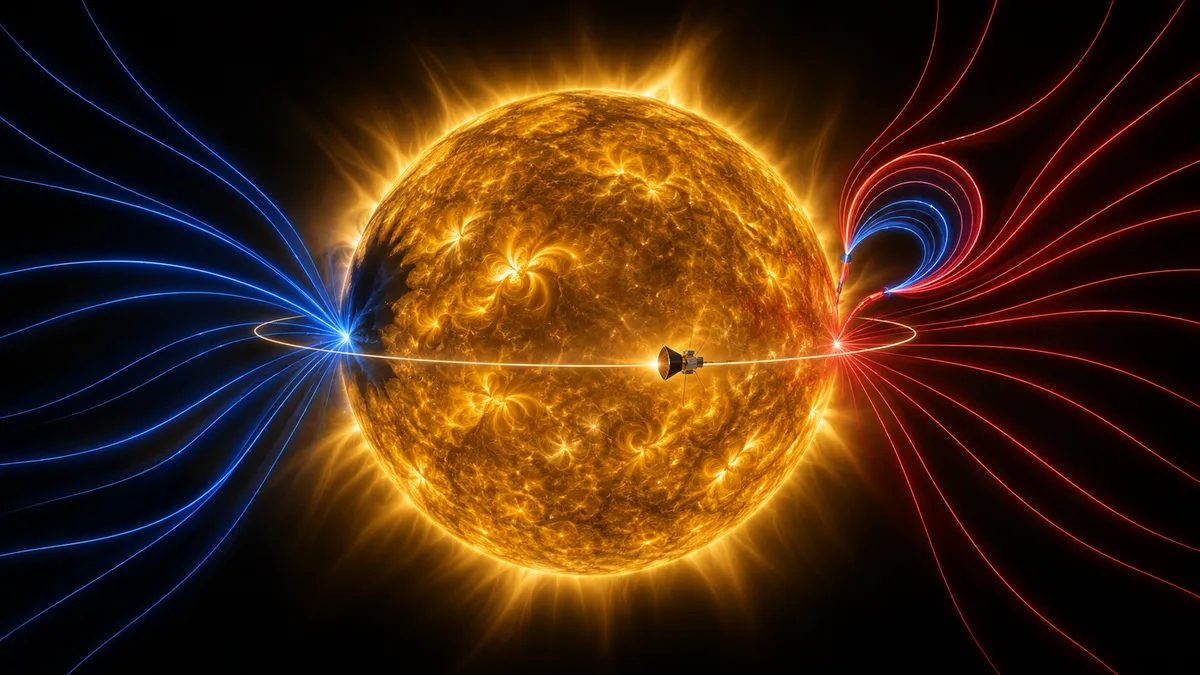
How can a spacecraft staying near the Sun’s equator explore both magnetic poles? In 2025, the Sun’s large-scale magnetic axis lay almost sideways, giving Parker Solar Probe an unusual route through its magnetic geography.
Magnetic poles are not geographic poles
Near solar maximum, the Sun is usually pictured as a complicated magnetic landscape: sunspots emerge, loops arch through its atmosphere, and eruptions disturb the outward-flowing solar wind. But complexity close to the surface need not erase every larger-scale pattern.
In a preprint, Yeimy J. Rivera and colleagues report that Parker Solar Probe encountered a surprisingly organized magnetic field during close approaches in March and June 2025. Its broad structure resembled a dipole—a field with two opposite magnetic poles—even though the Sun was near the maximum of its activity cycle.
The crucial twist was orientation. The dipole axis lay almost in the Sun’s equatorial plane, rather than approximately along its rotation axis. Parker therefore did not need to fly over the geographic poles. By moving around the Sun near the equator, it could sample regions near both ends of the tilted magnetic axis.
Two close passes, one combined view
The researchers analyzed Parker measurements from March 21–24 and June 18–20, 2025. At each closest approach, the spacecraft reached about 9.86 solar radii from the Sun’s center. The two encounters covered complementary ranges of solar longitude, together providing an approximately full-circle view near the equatorial plane.
This was not a simultaneous global survey: the encounters were three months apart. Combining them depended on evidence that the dipole’s orientation and broad configuration remained relatively stable across that period.
The team used solar-surface magnetic maps to reconstruct the dipole axis, then compared Parker’s magnetic-field and plasma measurements with observations farther out from Wind and Solar Orbiter. They also used a simplified coronal magnetic-field model to trace likely connections between the measured wind and its source regions on the Sun.
Parker sampled near both magnetic poles below the Alfvén surface, the boundary where the outward wind becomes faster than Alfvén waves can travel back toward the Sun. That proximity offered access to young solar wind before distant interactions substantially reshaped it.
An orderly field, but unequal wind streams
Parker’s radial magnetic field separated into two broad sectors of opposite polarity, rather than a thoroughly mixed pattern. The sectors were unequal: the positive-polarity region occupied about 134 degrees of the combined longitude coverage, while the negative region occupied about 226 degrees.
The wind’s speed revealed more structure than this simple magnetic division.
On the positive side, the dipole axis lined up with a large coronal hole: a region where magnetic field lines extend outward and allow plasma to escape. Associated wind reached about 800 kilometers per second at Wind, far from the Sun, where acceleration was largely complete. That speed should not be confused with Parker’s local measurements of still-accelerating wind.
The opposite magnetic pole was different. It lined up with a pseudostreamer, a magnetic structure involving closed loops beneath outward-extending fields of the same polarity. Slow wind near this structure interrupted the surrounding faster outflow. Parker measured speeds around 100 kilometers per second there, while Solar Orbiter observed a corresponding slow feature around 300 kilometers per second. Elsewhere in the negative sector, Solar Orbiter measured fast wind reaching about 800 kilometers per second.
The largest enhancements in the study’s particle-flow measure occurred near pseudostreamers and crossings of the heliospheric current sheet, which separates opposite magnetic polarities. The overall dipole therefore organized the field without making the wind uniform: smaller structures strongly affected how plasma escaped.
Why the view differs from Ulysses
The older Ulysses mission found well-organized fast wind above both geographic poles near solar minimum, but a much more complicated pattern near solar maximum.
Rivera and colleagues argue that observing strategy helps explain the contrast. Each Ulysses scan used here lasted 323 days, mixing many solar rotations, changes in the Sun itself, and interactions between streams farther from the Sun. Each Parker encounter sampled its longitude range within a few days.
That does not mean Ulysses measured incorrectly. Nor does Parker establish that every solar maximum hides a simple dipole. These encounters occurred during a particularly favorable, relatively quiet interval when the dipole dominated the larger-scale coronal field.
Source connections also remain model-dependent. The authors note that their wind-backtracking method does not capture interactions between neighboring fast and slow streams, and Parker and Solar Orbiter sometimes mapped to different parts of a source region.
The result is a qualified picture of order: during this interval, a sideways dipole provided the broad magnetic framework, while coronal holes, pseudostreamers and their boundaries determined much of the wind’s finer structure.
- Parker Solar Probe
- solar magnetic field
- solar maximum
- solar wind
- coronal holes
- pseudostreamers
- Alfvén surface
Related reading
Automatically matched by shared topic keywords. These links do not imply that the sources agree or establish a consensus.
Changing red-dwarf winds could reshape magnetic links with nearby planets
Source published
Shared keywords: alfvén surface
Shared solar wind noise could skew space-based gravitational-wave searches
Source published
Shared keywords: solar wind
Cosmic-ray fluctuations reveal disturbed space weather, but fail a storm-warning test
Source published
Shared keywords: solar wind