TRANSMISSION // 2611.12372v1
How Galileo’s clocks could search for hypothetical cosmic walls
Source published
A preprint uses Galileo satellite-clock data and simulated signals to develop a search for hypothetical ultralight-field domain walls. Seven-clock coincidences offer a promising compromise between rejecting noise and recovering signals, but changing, correlated noise prevents a definitive interpretation.
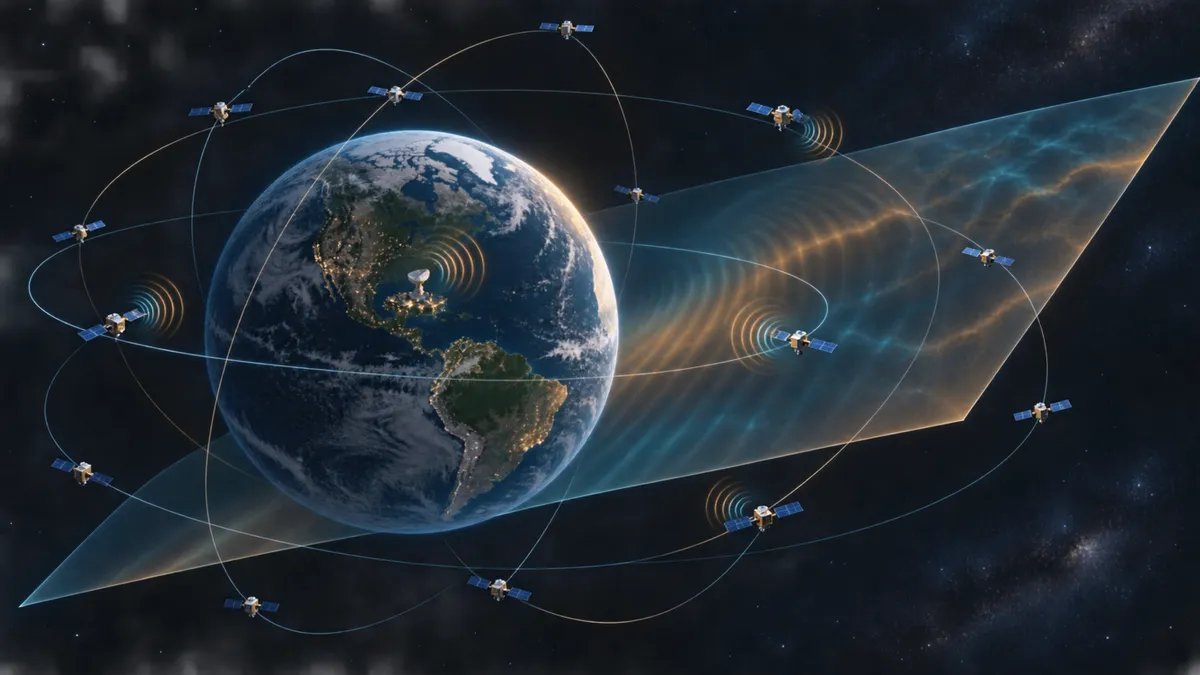
Could a passing cosmic field briefly disturb satellite clocks? A new study explores how to recognize that hypothetical pattern in Galileo data—and how ordinary timing noise could imitate or erase it.
Galileo’s atomic clocks support satellite navigation, but their timing records could also help test speculative particle physics. A preprint by Alessandro Di Marco and colleagues investigates how a hypothetical domain wall might disturb a network of these clocks. Its contribution is a preliminary statistical framework, not a discovery of dark matter or a completed exclusion of the proposed objects.
What would a cosmic wall do?
A domain wall is a boundary between regions where a field settles into different states. Some theories predict that such structures could have formed as the early universe cooled. The study considers an ultralight scalar field: a hypothetical field whose associated particles have extremely small masses.
Here, Earth-sized refers to the wall’s thickness, not its full sideways extent. The model treats the wall locally as a broad sheet. Whether such walls formed, survived and contribute to dark matter remains hypothetical; the paper does not establish those premises.
The proposed clock effect comes from interactions between this field and ordinary matter. In the model, crossing a wall temporarily changes the electron mass and the fine-structure constant, which governs electromagnetic interaction strength. Those changes would shift the atomic transition frequencies used to keep time.
The simplest signal pattern assumes that the electron interaction dominates. Different interactions or clock species can produce more complicated responses, including contributions that partly cancel.
Looking for a moving pattern
The researchers do not have a direct, isolated readout of each satellite clock. Instead, they use clock-bias solutions: estimated differences between satellite time and a ground reference, reconstructed alongside satellite orbits from tracking observations.
A wall could disturb a satellite clock first and the reference clock later, or vice versa. In the simplest case, the resulting time difference resembles a temporary step followed by a return toward its original level.
The data are sampled every 30 seconds. To make brief changes easier to identify, the researchers examine differences between successive clock-bias measurements. These differences retain units of time; they are not directly measured fractional frequency shifts.
A crossing could produce opposite-sign spikes: one when the wall reaches a satellite and another when it reaches the ground reference. Because every satellite is compared with that reference, its disturbance could appear simultaneously across multiple records. The satellite disturbances would instead be distributed in time as the wall moves through the constellation.
That spatially ordered pattern matters. Ground operations can also create simultaneous disturbances, so a shared spike alone would not establish a cosmic origin.
Testing noise and missed signals
The team analyzed eleven Galileo satellites during their common operating periods, totaling 578 days within a larger 2014–2017 dataset. They cleaned residual trends and explicit daily discontinuities before studying the remaining noise.
Two questions guided the analysis: how often could noise imitate a coincidence, and how often would a genuine injected signal survive?
For the first, the authors compared a calculation assuming independent satellite noise with an empirical procedure that locally shifted the records relative to one another. These time shifts disrupt genuine simultaneous events while aiming to preserve local noise characteristics. The resulting coincidence probabilities differed systematically from the independent-noise predictions, especially for coincidences involving many satellites. The authors interpret this as evidence that the simplifying independence assumptions are inadequate.
For the second question, they simulated roughly 1,000 wall crossings, accounting for satellite geometry, ground references and assumed wall motion, then added synthetic signals to the real data.
Requiring all eleven satellites to cross a threshold is demanding. Noise can obscure individual responses. A satellite and the reference can also encounter the wall within the same sampling interval, allowing their opposite contributions to cancel.
A useful benchmark, not a final limit
The combined analyses point to seven-clock coincidences as a useful starting point. One benchmark uses a threshold around 150 picoseconds and an injected signal amplitude around 166 picoseconds. A picosecond is one trillionth of a second. These values describe a tested search configuration, not a universal sensitivity to every possible wall.
The paper also illustrates how a hypothetical search finding no compatible events could constrain encounter rates. But those limits depend on detection efficiency, background estimates and checks that candidate patterns match a propagating wall. They are not presented as a completed, robust constraint from this analysis.
The central obstacle is that the background changes with time and contains correlations. A fixed threshold high enough for noisy intervals can discard weaker signals during quieter ones. The authors propose locally adjusted thresholds and propagation-pattern checks as future improvements. Even a convincing candidate would require complementary measurements to distinguish different possible field interactions.
- Galileo
- atomic clocks
- domain walls
- ultralight scalar fields
- dark matter
- false alarms
- satellite navigation
Related reading
Automatically matched by shared topic keywords. These links do not imply that the sources agree or establish a consensus.
Could ancient cosmic walls have left a gravitational-wave background?
Source published
Shared keywords: domain walls
A last-second warning for AI-agent disclosures comes with false alarms
Source published
Shared keywords: false alarms
Teaching a jamming detector to act without hindsight
Source published
Shared keywords: false alarms
Galactic dust offers a tentative clue to dark matter—not a verdict
Source published
Shared keywords: dark matter
Cosmic-ray boosts sharpen model-dependent limits on lightweight dark matter
Source published
Shared keywords: dark matter