TRANSMISSION // 2611.12279v1
Before quantum keys, Sweden’s fiber links need a checkup
Source published
Tests of Swedish optical fibers show why distance alone cannot predict quantum key distribution performance. Background light, signal loss and polarization changes matter—and one 81-kilometer link sustained key generation for a month.
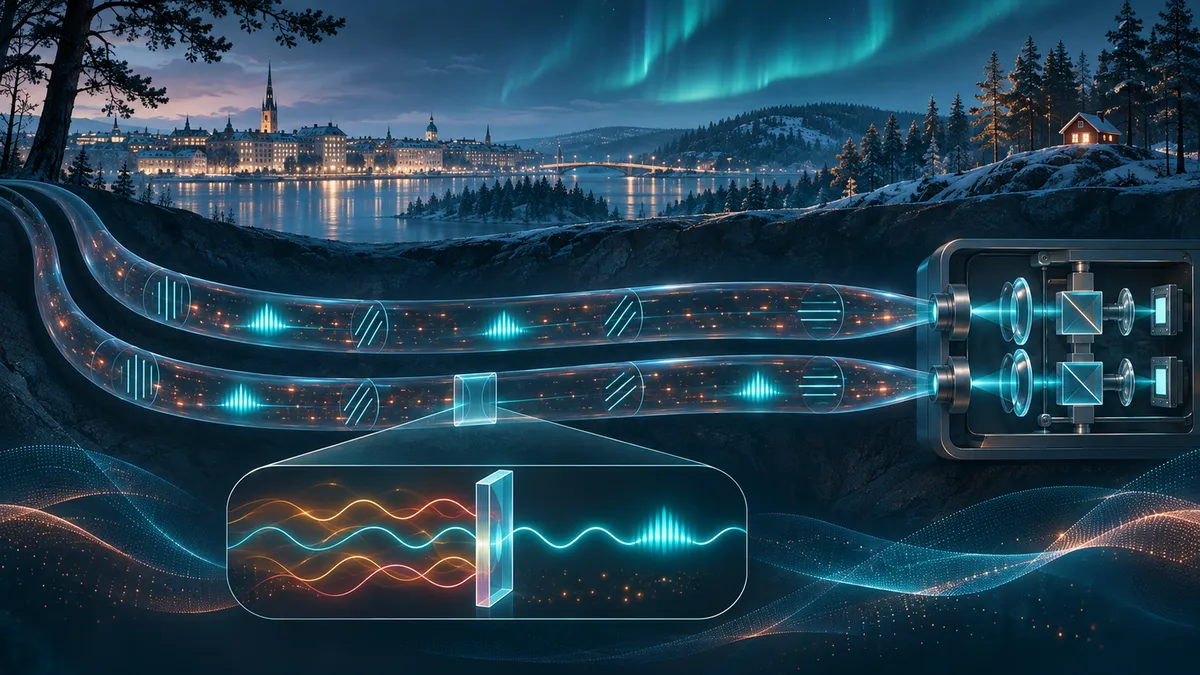
A fiber reserved for quantum communication is not necessarily dark, and two strands following the same route can perform differently. Measurements in Sweden show what network builders need to check before choosing quantum key distribution equipment.
What makes an ordinary telecommunications fiber suitable for quantum communication? Its length is only the beginning. Researchers at KTH Royal Institute of Technology report that stray light, imperfect connections and changes in light’s polarization all help determine whether a deployed link can generate secret keys.
Their study examines four connections in the National Quantum Communication Infrastructure in Sweden, a testbed centered on Stockholm. It also reports a month-long demonstration of quantum key distribution on an approximately 81-kilometer link. The practical message is to measure the fiber and match those measurements to the equipment—not simply buy a system rated for a certain distance.
Three things that determine useful keys
Quantum key distribution, or QKD, lets two parties establish shared secret keys using quantum signals. Those keys can subsequently be used for encryption; QKD is not itself the transmission of an encrypted message.
The researchers organize their assessment around three quantities: how much signal reaches the receiver, how often background events trigger detections, and how often quantum states are read incorrectly. Together, these influence the secret key rate: the amount of usable secret key remaining after processing the measurements.
Their simplified model describes a version of the BB84 protocol using weak laser pulses and different pulse intensities called decoy states. These help assess security when some pulses contain more than one photon.
Loss reduces the number of useful detections. Background light and detector noise become increasingly damaging as the signal weakens. Errors also consume the margin available for extracting secret keys. Crucially, all three quantities depend on both the fiber and the receiving equipment.
Distance does not tell the whole story
The four connections each contained two exclusively rented fiber strands. Their lengths ranged from roughly 19 to 164 kilometers. The team used an optical time-domain reflectometer, which examines returning light from test pulses, to measure lengths and locate losses. The longest connection exceeded the instrument’s range, so its length came from the supplier.
At a wavelength of 1550 nanometers, measured losses ranged from about 7 to 38 decibels. Short metropolitan connections had greater loss per kilometer than the long-distance links. Their reflectometer traces showed more localized imperfections, consistent with the effects of numerous splices and connectors.
Even neighboring strands differed. The two strands of each long-distance connection differed in loss by more than one decibel. Choosing between them could therefore matter despite their nearly identical lengths.
A dark fiber can still contain light
The team measured background photons using sensitive superconducting detectors, recording each connection for 24 hours. Unfiltered background rates ranged from approximately 6,900 to 476,000 photons per second and did not increase consistently with length.
Measurements across different wavelengths revealed distinct peaks. The authors interpret these as evidence consistent with leakage from communications in nearby fibers, rather than proof that every noise source had been identified.
A narrow wavelength filter substantially reduced the background. On one metropolitan strand, the rate fell from about 13,300 to eight photons per second. Elsewhere, filtering was less effective because the background spectrum differed.
This makes wavelength selection a practical decision involving both loss and noise. A wavelength with slightly better transmission may not be the best choice if it also admits much more unwanted light. Changes in neighboring communications could alter that balance after installation.
Keeping polarization aligned
For systems that encode information in polarization—the orientation of light’s electric field—the receiver must track changes introduced by the fiber.
The researchers monitored two connections for a week, joining their outgoing and returning strands into loops. Polarization drift was faster and more irregular on the longer loop. Without compensation, their model’s chosen error threshold would be reached after about 55 minutes on the metropolitan loop and 12.5 minutes on the longer one. These are model-dependent estimates, not universal QKD failure times.
They also measured tiny arrival-time differences between polarization modes. On the longer loop, the average difference at 1550 nanometers was 0.81 picoseconds. Their calculation indicates little resulting error for the example pulse duration considered, although shorter future pulses could be more sensitive.
A month of operation, with limits
A commercial QKD system generated a positive secret key rate throughout the reported month-long test on the 80.85-kilometer L3–A strand. Its average yield was 2.4 millionths of a secret bit per transmitted pulse—not a rate in bits per second.
The result supports feasibility on that connection, not demonstrated operation across every surveyed link. Actual performance also reflects effects omitted from the simplified model, including finite data samples, detector limitations and imperfect error correction. The authors speculate that a rate decrease after about eight days involved automated alignment, but do not establish that explanation.
This account is based on the supplied extracted paper text. The work is an arXiv preprint, with peer review not established by the supplied source. Its strongest lesson is a deployment procedure: characterize real fibers, compare them with device requirements, and verify the combination experimentally.
- quantum key distribution
- optical fiber
- quantum communication
- Sweden
- background photon noise
- polarization drift
- BB84
Related reading
Automatically matched by shared topic keywords. These links do not imply that the sources agree or establish a consensus.
Can quantum key distribution stay secure when devices remember?
Source published
Shared keywords: quantum key distribution
When a quantum key begins with incomplete clues
Source published
Shared keywords: quantum communication, quantum key distribution
Quantum grid codes could extend direct secure messaging beyond 1,000 kilometres
Source published
Shared keywords: quantum communication
Two parity checks can filter errors in paired-state quantum keys
Source published
Shared keywords: quantum key distribution
Waiting to measure can unlock an unbounded quantum communication advantage
Source published
Shared keywords: quantum communication