TRANSMISSION // 2611.12236v1
Extra qubits make quantum error checks agree
Source published
A theoretical proposal adds auxiliary qubits so that checks used in logical quantum measurements commute even outside the protected code space, preserving error protection under stated circuit assumptions.
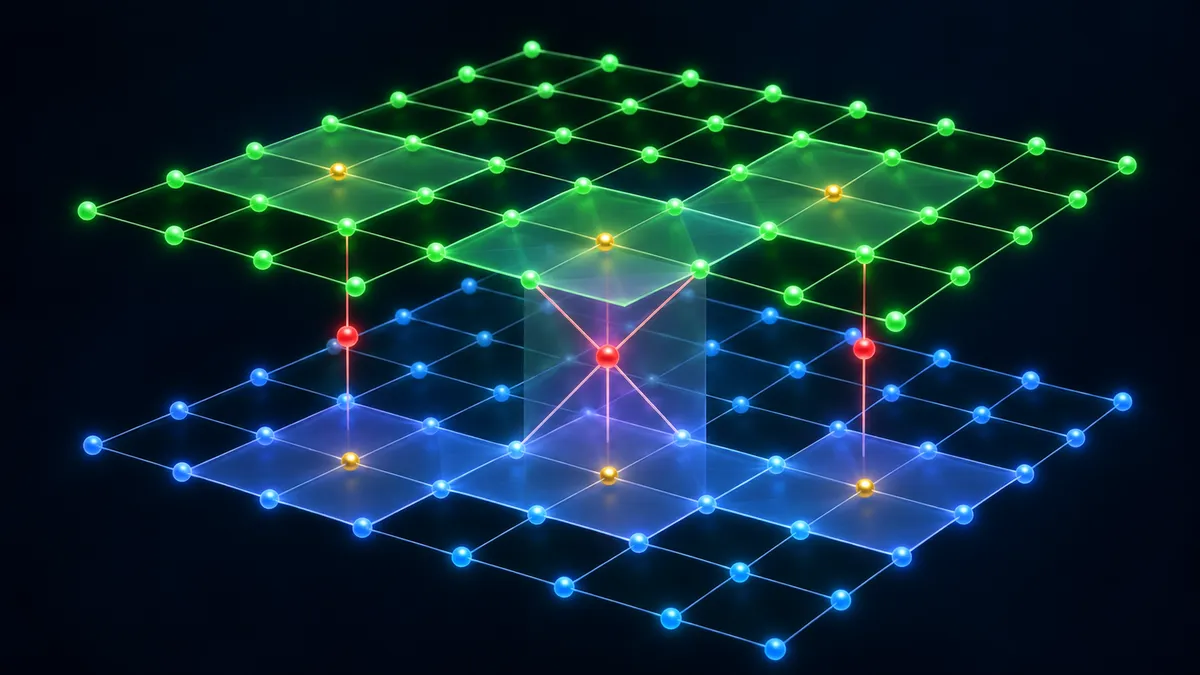
Measuring a quantum computer’s encoded information can require many smaller measurements. But if those measurements disturb one another, errors become harder to track. A new preprint describes how extra qubits can remove this conflict without weakening the underlying code.
How can a quantum computer measure protected information without compromising its protection? Quantum error-correcting codes spread an encoded, or logical, state across many physical qubits. Small measurements called checks reveal departures from the allowed code space without directly reading out the information stored inside it.
Logical measurements require something more: extracting a chosen property of the encoded state while preserving superpositions consistent with that result. In lattice surgery, this involves joining and separating encoded systems through check measurements. A theoretical preprint by Zongyuan Wang proposes a way to make a broader class of these checks compatible—even when faults push the system outside its intended code space.
Why compatible checks matter
Two quantum measurements commute when their operators can be applied in either order with the same result. Repeating ideal commuting checks produces a stable pattern of outcomes, called a syndrome, until another fault occurs.
Some existing logical-measurement constructions have checks that commute only within the protected code space. Outside it, measuring one check can randomize another’s outcome. That is precisely where error correction needs dependable information: after something has gone wrong.
Wang studies a procedure called gauging. It introduces auxiliary gauge qubits so that a logical operation can be read through a collection of smaller checks. Combining selected check outcomes reveals the logical operation’s eigenvalue, here a sign of plus or minus one. Ungauging then removes the auxiliaries and returns the remaining state to the original code.
The main construction concerns qubit stabilizer codes and order-two Clifford symmetries: operations that preserve the code, square to the identity, and factor into operations on disjoint, bounded-size groups of qubits. Clifford operations form an important class in quantum error correction, but measuring their logical eigenvalues can have uses beyond ordinary stabilizer-state processing.
Completing the checks
The proposed repair adds one “completion qubit” for every pair of conflicting raw checks. Each member of the pair receives an additional operation involving that qubit. These additions cancel the original failure to commute.
Further measurements, called pinning checks, ensure that the completion qubits occupy a fixed state within the intended code space. The resulting full check family commutes across the enlarged physical state space, not just where the encoded state ideally lives.
The paper proves that completion preserves the gauged code space, apart from the appended fixed-state qubits, and leaves its code distance unchanged. Code distance measures the smallest support of an error that can evade detection while changing encoded information.
Completion also preserves sparse checking when the raw construction already has it: each check still involves a bounded number of qubits, and each qubit participates in a bounded number of checks. This is the low-density parity-check property. The extra resources scale by a constant factor under those assumptions, rather than becoming arbitrarily dense.
Following faults through a measurement
Global commutation provides a useful foothold for the fault analysis. Once a fault-free round has established a syndrome, further fault-free rounds cannot change it. Wang also bounds the effective spread of individual faults independently of how many measurement rounds follow, provided check sizes, participation counts and extraction circuits remain bounded.
With additional graph and circuit conditions, the complete gauging-and-ungauging procedure has circuit fault distance proportional to the parent code distance, using a number of rounds proportional to that distance. Circuit fault distance here counts the fewest faulty circuit locations capable of producing an incorrect logical measurement while passing the specified detection tests.
A concrete example starts with two toric codes, gauges them into a code associated with the quantum double D(D4), and returns them to the parent codes. For the specified schedule on an even-sized square torus of linear size L, the circuit fault distance is the smaller of L and the number of gauged rounds. Taking L gauged rounds, plus L parent-code rounds on either side, preserves distance L across the full operation. Including measurement ancillas, completion raises the qubit count from 12 times L squared to 18 times L squared.
What remains unresolved
These are mathematical constructions and circuit proofs, not experimental performance measurements. The fault-distance results assume ideal encoded input and an ideal final projection onto the parent code. They do not establish a practical noise threshold or supply an efficient decoder for general faulty measurement records; decoding applications are left to separate work.
The construction offers a route toward logical measurements useful for preparing magic states, resources for quantum computation beyond stabilizer operations. It does not demonstrate a working magic-state factory. This account is based on the supplied extracted paper text, including its supplemental material. The work is an arXiv preprint, not an established peer-reviewed result.
- quantum error correction
- logical measurement
- commuting checks
- lattice surgery
- completion qubits
- fault tolerance
- toric codes
Related reading
Automatically matched by shared topic keywords. These links do not imply that the sources agree or establish a consensus.
Moving atoms could make globally controlled quantum computers programmable
Source published
Shared keywords: fault tolerance, quantum error correction
Quantum turbo codes reveal a trade-off between decoding rounds and computing cost
Source published
Shared keywords: quantum error correction
Quantum grid codes could extend direct secure messaging beyond 1,000 kilometres
Source published
Shared keywords: quantum error correction