TRANSMISSION // 2611.12229v1
Can gravity’s quantum phase survive an entanglement washout?
Source published
A theoretical preprint proposes testing gravitational phase dynamics even when noise prevents entanglement, but its conclusions depend on precisely defined classical alternatives and independently calibrated environmental noise.
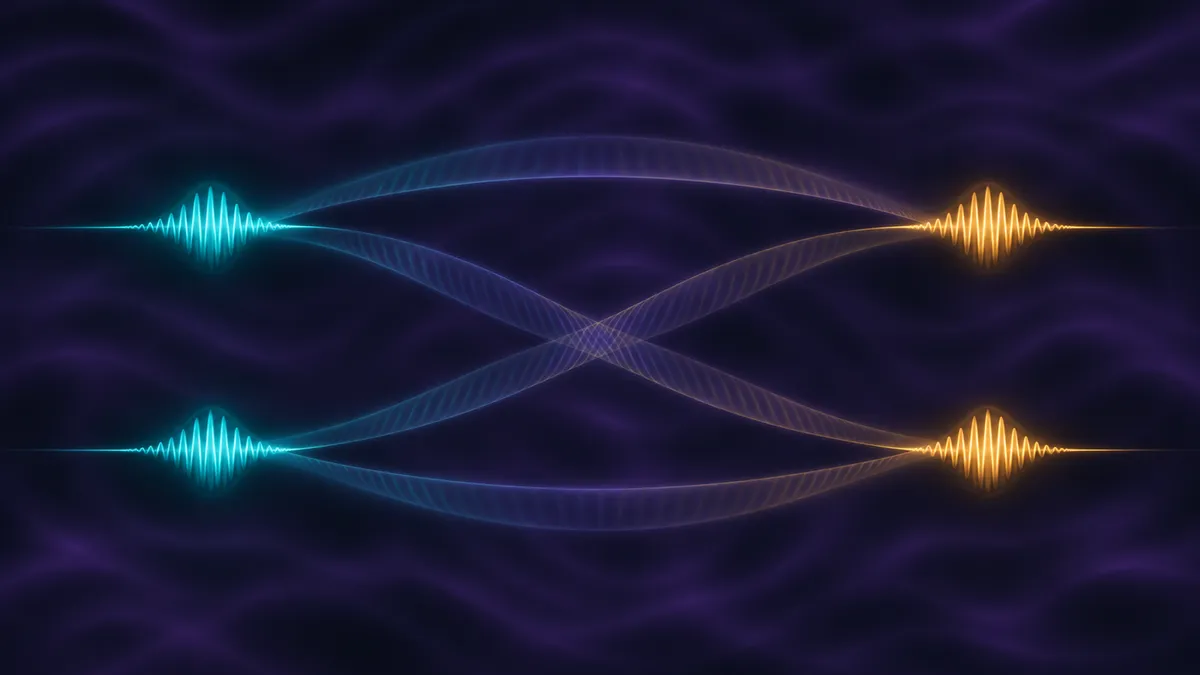
Noise could erase the entanglement sought in experiments probing quantum gravity without erasing every useful signal. A new analysis asks what the remaining phase patterns could reveal—and what they cannot establish.
Would failing to detect entanglement mean that a gravity experiment had nothing left to tell us? A theoretical preprint by Tianfeng Feng and Vlatko Vedral argues otherwise. Under specified assumptions, gravitationally induced phase patterns could remain distinguishable from particular classical mechanisms even when the two masses never become entangled during the experiment.
The qualification matters: this is not a universal test excluding classical gravity. It is a mathematical comparison between carefully defined models, with the environmental noise held fixed.
Two masses, four possible separations
The analysis uses the proposed Bose–Marletto–Vedral experiment. Each of two tiny masses is placed in a quantum superposition of two spatial paths. Together, they have four possible path combinations, each associated with a gravitational potential energy.
Quantum waves accumulate phase as they evolve. When paths are recombined, relative phases affect interference outcomes. Here, the gravitational phase experienced by one mass depends on which path the other occupies. This conditional phase can generate entanglement: correlations that cannot be described as a statistical mixture of separate states for the two masses.
But the environment can acquire information about the occupied paths. That process, called dephasing, weakens interference without necessarily moving either mass between its arms. The authors solve a model combining the conditional gravitational phase with equal, constant-rate local dephasing. For their chosen initially unentangled superposition, sufficiently strong dephasing keeps the output separable at every interaction time.
Separability, however, does not mean that every proposed mechanism reproduces the same phase-sensitive measurements.
Comparing mechanisms rather than entanglement alone
The first comparison concerns passive classical fluctuating potentials. In each realization, these give each mass its own local phase shift. The fluctuations may be correlated between the masses, but the mechanism does not measure one mass’s path and use that information to control the other.
The gravitational model produces opposite phase rotations in one mass’s interference coherence depending on the other mass’s path. Passive random local phases cannot reproduce that pattern for the selected input.
The authors derive the exact smallest trace distance between the gravitational output and this entire passive comparison class. Trace distance measures how distinguishable two quantum states are through measurements. Their result is half the surviving single-mass interference visibility multiplied by the absolute sine of twice the gravitational phase.
This separation can remain positive after entanglement has disappeared. It vanishes when visibility is completely lost or when the phase makes that sine zero. A suitable measurement combines one mass’s path label with an interference measurement on the other.
The paper then admits a more capable classical alternative: local path measurements followed by communication and phase feedback. Such operations can partly imitate the conditional response, but learning path information disturbs coherence. Using a mathematical optimization over population-preserving channels, the authors find a remaining distinction at weak gravitational phases. They also construct a classical measurement-and-feedback protocol attaining that optimum. Testing this broader class requires more than the single observable sufficient for the passive comparison.
Noise creates a timing problem
Waiting longer builds gravitational phase but also erases interference. For the passive comparison, the authors calculate the best interaction duration exactly. Under strong dephasing, it approaches the time over which single-mass coherence decays by a factor of e.
The optimized distinction then falls approximately in proportion to gravitational coupling divided by dephasing strength. That is a mathematical sensitivity result, not a demonstration that an experiment can collect enough accurate measurements.
An illustrative calculation uses masses of 10 trillionths of a gram, interferometer centers 40 micrometers apart, a 10-micrometer path separation and a one-second hold. With an assumed visibility of 0.1, the predicted passive-model correlation is about 0.01. These are model choices, not an observed gravitational signal.
The boundary of the claim
The essential assumption is that the full, independently characterized environmental dephasing acts identically in both hypotheses, in addition to any disturbance introduced by a classical mediator. If some observed dephasing is instead assigned to measurement back-action, the authors acknowledge that the total noisy dynamics can admit a classical measurement-and-feedback realization in the all-time separable regime.
Experiments must also bound electromagnetic interactions that mimic the conditional phase, phase drift, detection bias and unintended path changes. Wavepacket-overlap and gravitational-deflection estimates support the phase-dominated approximation, but do not establish feasibility or exclude every classical theory.
This account is based on the supplied extracted paper text, not only its abstract. The work is an arXiv preprint, not an experimental detection or an established peer-reviewed result. Its contribution is a conditional route for extracting information when the usual entanglement test fails—not proof that gravity has already been shown to be quantum.
- quantum gravity
- gravitational phase
- dephasing
- entanglement
- matter-wave interferometry
- classical measurement and feedback