TRANSMISSION // 2611.12179v1
Could daily pulsar observations probe a gravitational-wave blind spot?
Source published
An idealized study finds that frequent pulsar timing could improve gravitational-wave limits at microhertz frequencies, but telescope time and unmodelled noise remain major obstacles.
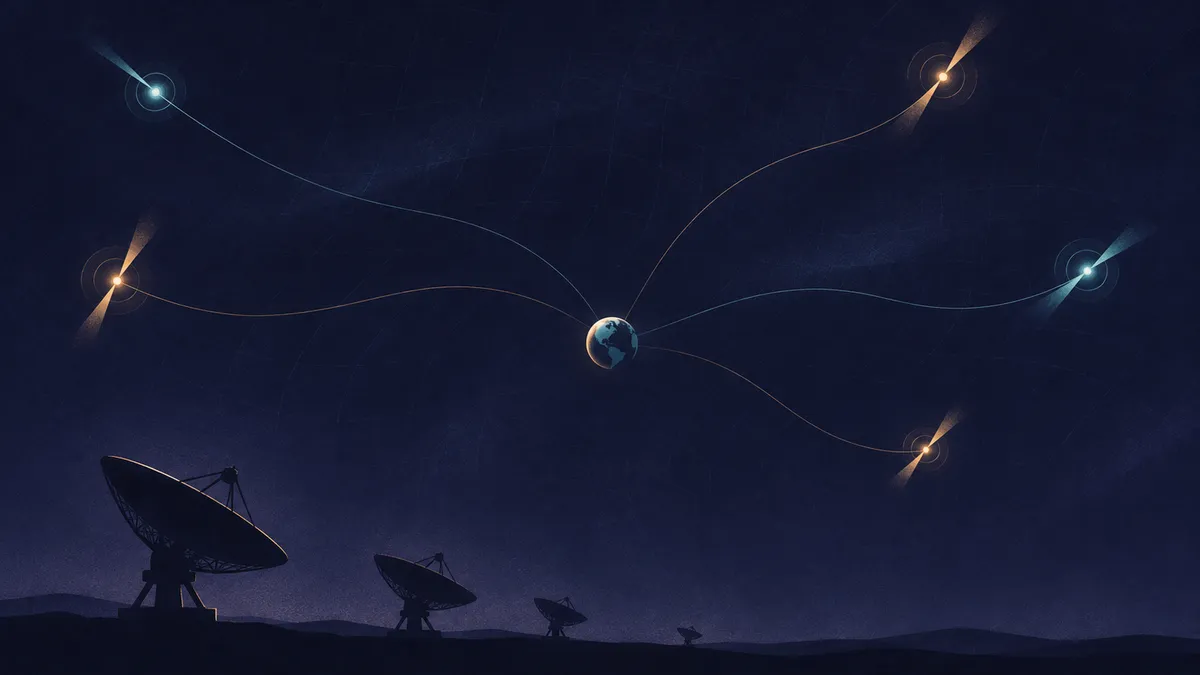
Some gravitational waves take days or months to complete a cycle. A new preprint asks whether observing pulsars much more frequently could help radio telescopes explore this poorly measured band.
Listening between existing detectors
Could a different observing schedule open a relatively unexplored part of the gravitational-wave spectrum? In a preprint submitted to the Open Journal of Astrophysics, C. F. Sheridan and E. F. Keane calculate how well dedicated, high-cadence pulsar observations might perform at microhertz frequencies. Their work forecasts sensitivity; it reports neither a new detection nor an observing campaign already carried out.
One microhertz means one cycle roughly every 12 days. This frequency band lies between the main targets of conventional pulsar timing arrays and the planned space interferometer LISA. The authors focus particularly on 0.1–1 microhertz, where cycles last roughly four months to 12 days.
Pulsars are rotating neutron stars whose radio beams sweep past Earth. The fastest, called millisecond pulsars, can provide exceptionally stable timing references. Astronomers compare measured pulse arrival times with predictions that account for rotation, orbital motion and other effects. Gravitational waves can leave tiny deviations in those arrival times. Comparing multiple pulsars helps distinguish a shared gravitational-wave pattern from unrelated timing variations.
Trading telescope time for faster sampling
Existing timing arrays generally combine decades of observations taken weekly or monthly. More frequent measurements extend their reach toward faster-changing signals. The researchers model three alternative schedules using established sensitivity calculations implemented in the hasasia software library.
The first two campaigns observe four known pulsars with either a Westerbork-like, 100-metre-class instrument or a FAST-like, 500-metre-class telescope. Campaign A collects two timing measurements per pulsar each day for one year. Each measurement integrates an hour of observations, requiring eight telescope hours daily.
Campaign B doubles the daily measurements and runs for two years. That consumes 16 hours a day, or 11,680 hours overall: an enormous allocation on a heavily demanded telescope.
The third proposal shares observations between the upcoming Deep Synoptic Array and SKA-Mid. Each instrument would time 12 pulsars daily for two years, giving 24 pulsars in total. The calculation assumes 50-nanosecond measurement uncertainty and half-hour integrations. With four simultaneous observing beams per telescope, the proposed schedule would require about 1.5 hours daily on each instrument. That saving depends on the assumed multibeam capabilities and observing arrangement.
Promising thresholds, not detected sources
The calculations consider both a diffuse gravitational-wave background and individual sources, such as pairs of supermassive black holes. Background sensitivity is evaluated for signals whose strength follows a power law with frequency. Example early-Universe spectra illustrate what the proposed observations might constrain; they are not established signals awaiting guaranteed detection.
The smaller telescope offers limited gains. Its modelled background sensitivity remains above the illustrative cosmological signals, while its individual-source sensitivity falls short of the comparison threshold used in the study.
The FAST-like configurations perform substantially better. At one microhertz, the predicted faintest detectable individual-source strain in the most favourable sky direction is approximately 3.5 × 10⁻¹⁴ for Campaign A and 1.7 × 10⁻¹⁴ for Campaign B, using a signal-to-noise threshold of five. Strain describes the fractional stretching associated with a gravitational wave.
Both values lie below the previously reported upper limit of 8.9 × 10⁻¹⁴ used as a benchmark. But an upper limit is not evidence that a source exists at that strength. Detection would still require a sufficiently strong source in a suitable direction.
The combined DSA–SKA-Mid model reaches background sensitivity of the same order as FAST Campaign B, with much less assumed telescope time. Its best individual-source threshold is about 3.3 × 10⁻¹⁴: competitive with FAST Campaign A, rather than matching Campaign B on every measure.
The noise still to be confronted
These forecasts deliberately describe optimistic conditions. The calculations include measurement uncertainty from radio reception but omit time-correlated noise, pulse jitter and other systematic effects. Those omissions matter particularly when a large telescope makes ordinary reception noise very small.
The European Pulsar Timing Array comparison is also an idealized reconstruction, not a direct comparison with fully analysed observational data. And the combined-array proposal assigns pulsars random sky positions rather than selecting an actual observing roster.
The defensible conclusion is therefore conditional: frequent observations could improve microhertz limits if sufficiently precise timing survives realistic noise and scheduling constraints. A larger, shared pulsar programme looks more practical than dedicating most of a giant telescope’s day to four stars. Establishing its real reach requires the noise modelling that this feasibility study intentionally leaves out.
- gravitational waves
- pulsar timing arrays
- microhertz
- millisecond pulsars
- FAST
- SKA-Mid
- Deep Synoptic Array
Related reading
Automatically matched by shared topic keywords. These links do not imply that the sources agree or establish a consensus.
Seven pulsar binaries sharpen measurements of stellar orbits and distances
Source published
Shared keywords: millisecond pulsars
Why Bigger Telescopes Alone Cannot Perfect Pulsar Timing
Source published
Shared keywords: gravitational waves, millisecond pulsars, pulsar timing arrays
A simpler strategy holds up in searches for gravitational-wave memory
Source published
Shared keywords: gravitational waves, pulsar timing arrays
Catching a Neutron Star Merger’s Light Before It Fades
Source published
Shared keywords: deep synoptic array, gravitational waves
Which exoplanets could the SKA hear? A radio forecast with important caveats
Source published
Shared keywords: ska mid