TRANSMISSION // 2611.12158v1
Earth-watching radar satellites pick up echoes of orbital debris
Source published
Reprocessing Sentinel-1 radar recordings revealed 76 catalogued space objects, including debris fragments. The preprint demonstrates a possible additional use for Earth-observation data, but sensitivity to millimetre-scale debris remains a prediction rather than an observed result.
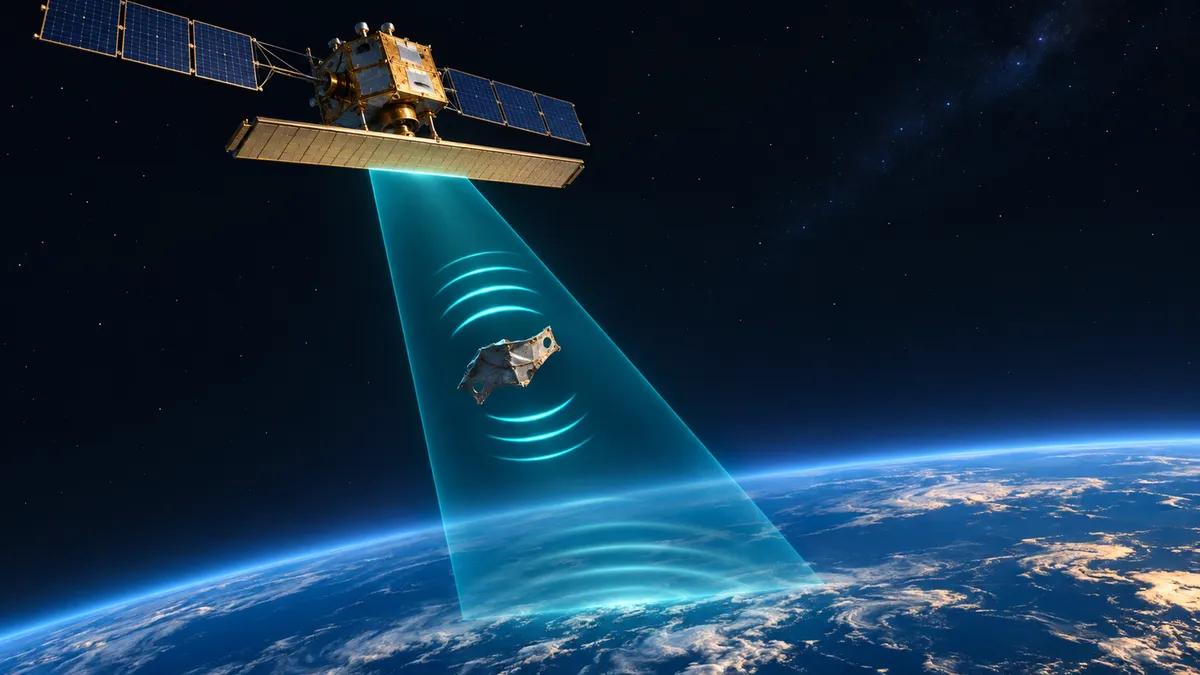
Could satellites that map Earth also help monitor the debris around them? Researchers have recovered space-object echoes from routine Sentinel-1 recordings, while exposing the difficulties of separating those signals from reflections off the ground.
A radar pointed at Earth does not receive echoes only from Earth. An orbiting fragment crossing its beam can also reflect a transmitted pulse. The challenge is finding that brief return in recordings designed for a different purpose.
In a November 2026 preprint, Juha Vierinen and colleagues report recovering echoes from 76 distinct catalogued objects in Sentinel-1C and Sentinel-1D data. Their sample includes satellites, rocket bodies and debris fragments, at distances ranging from 41.7 to 492.9 kilometres. The work demonstrates detection using existing instruments, not yet a calibrated census of small orbital debris.
Finding moving echoes
The researchers analysed approximately 21.2 minutes of raw radar recordings collected across six calendar days. These preserve the received waveforms rather than just the finished images used to study Earth's surface.
Ordinary processing combines radar pulses to form images of the ground. An orbital object moves differently, so its echo shifts in arrival time and phase between pulses. Combining those pulses without accounting for that motion can weaken the signal.
The team instead calculated what an echo should look like along a trial trajectory. They adjusted distance, radial velocity—the speed toward or away from the radar—and radial acceleration so successive returns would reinforce one another. Most detections were guided by catalogue orbit predictions and then manually inspected.
The resulting sample is deliberately selective. When an object appeared in several accepted encounters, the researchers retained its strongest return for their radar-response comparison. Consequently, the 76 detections do not establish how often objects were missed or how abundant debris is.
A limited blind-search demonstration
Could the technique find an object without being told its orbit? The researchers tested that question on two selected recordings containing known debris passages, from DELTA 1 and FENGYUN 1C fragments.
Their blind search recovered both echoes without using orbital predictions during detection. Catalogue comparisons and manual inspection supplied the final identifications afterward. This is evidence that the signals can be recovered without an orbit-guided search, but not a demonstration of unattended discovery across routine recordings.
Reflections from Earth were the main obstacle. At the chosen detection threshold, the two searches produced 676 false-positive ground-scatter peaks across about 2.2 seconds of observations. All occurred in the DELTA excerpt; the FENGYUN excerpt produced none. Many peaks were repeated appearances of a persistent ground feature, rather than separate objects.
The recordings and threshold were selected using known encounters. Broader tests with a predefined sampling procedure are needed to measure detection efficiency and false-alarm performance.
Improving an orbit estimate
A short radar passage can also provide tracking information. Echo timing measures distance, while the Doppler frequency shift constrains motion along the line of sight. The way the echo brightens and fades as an object crosses the antenna beam adds an angular constraint.
For DELTA 1 debris, the team combined these measurements in an idealized orbit update. Under their assumed initial uncertainty, pointing accuracy and noise model, the three-dimensional position spread predicted 49 minutes later fell from 500 metres to 354 metres—a 29% reduction.
That spread is a modelled uncertainty, not an independently verified position error. Establishing operational tracking accuracy would require calibration and comparison with independent observations.
Small-debris sensitivity remains a forecast
Close encounters offer a powerful advantage: under otherwise identical conditions, an object ten times nearer produces an echo 10,000 times stronger. But it also crosses the beam faster, leaving less time to accumulate a signal.
Accounting for that trade-off, the authors calculated ideal sensitivity to perfectly conducting spheres. At 10 kilometres, their receiver-noise comparison gives diameters of about 3.4 millimetres for Sentinel-1 and 0.6 millimetres for EarthCARE's cloud radar.
Those are calculated diameters giving a signal-to-noise ratio of one, not demonstrated detection limits. They assume complete echo recording, accurate motion compensation and favourable illumination; real fragments need not scatter like conducting spheres. Ground reflections further degrade Earth-looking observations, and EarthCARE would need adapted recording settings to realize the proposed capability.
The preprint therefore supports a concrete but bounded conclusion: routine Earth-observation recordings contain useful orbital echoes. Turning them into reliable debris surveys or collision-warning support requires measured detection efficiency, calibrated measurements and practical processing. The analysis software also remains private pending manuscript publication, limiting independent reproduction for now.
- space debris
- Sentinel-1
- spaceborne radar
- Earth observation
- orbit refinement
- EarthCARE
- ground clutter
Related reading
Automatically matched by shared topic keywords. These links do not imply that the sources agree or establish a consensus.
A nuclear burst in orbit could disable satellites long after the flash, model suggests
Source published
Shared keywords: space debris
Satellite trails touch many HETDEX observations—but mask little survey area
Source published
Shared keywords: space debris
A two-stage reasoning system helps AI choose Earth-observation evidence
Source published
Shared keywords: earth observation
A Language Model Helps Search for Better Satellite Imaging Schedules
Source published
Shared keywords: earth observation
CARM adapts trust masks as scientific super-resolution data change
Source published
Shared keywords: earth observation