TRANSMISSION // 2611.12147v1
Infrared-bright galaxies occupy the middle ground between steady star formation and starbursts
Source published
ALMA observations of 22 infrared-bright galaxies place the gas-detected objects between ordinary star-forming galaxies and intense starbursts. Their estimated gas-consumption times are hundreds of millions of years. Minor mergers offer one possible explanation, but these observations do not establish an evolutionary pathway.
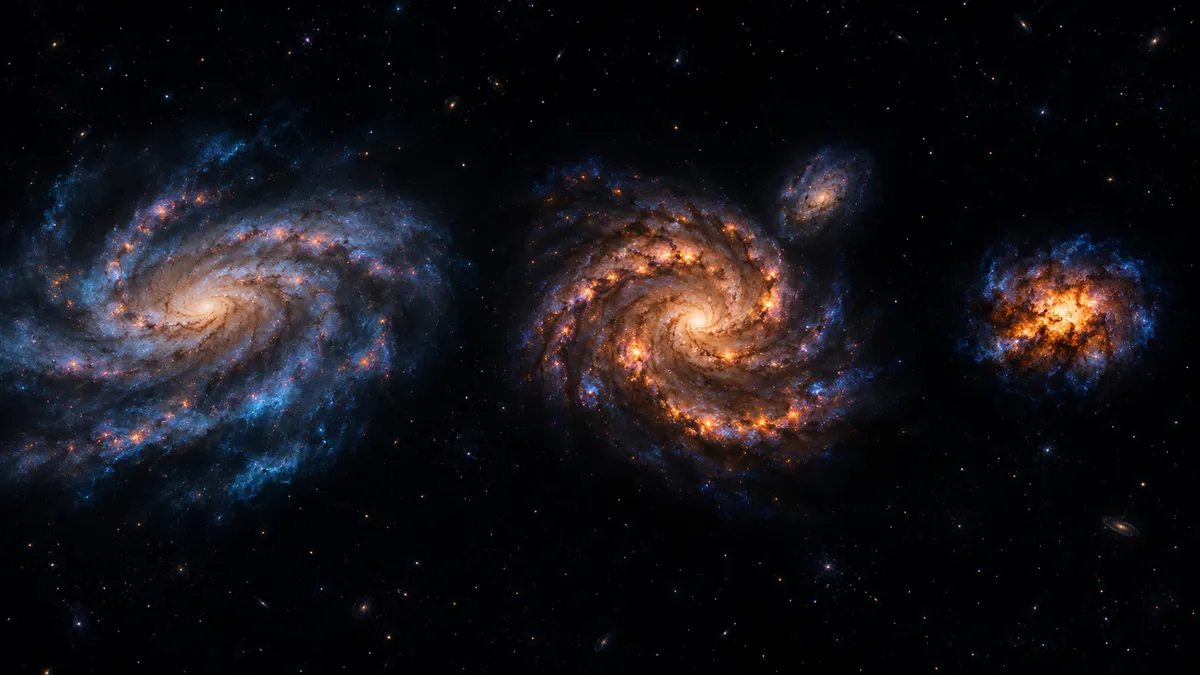
A galaxy can form many stars without being an extreme starburst: its activity also depends on its stellar mass and available gas. In an arXiv preprint, Jee-Ho Kim and colleagues investigate galaxies whose enormous infrared output might conceal an intermediate mode of star formation. Their observations support that middle-ground classification, while leaving open how these galaxies arrived there and what happens next.
What makes these galaxies interesting?
Ultra-luminous infrared galaxies, or ULIRGs, emit more than a trillion times the Sun’s luminosity in infrared light. Their infrared emission helps researchers estimate star formation, while molecular gas supplies the material for new stars.
Astronomers describe a typical relationship between a galaxy’s stellar mass and its star formation rate as the star-forming “main sequence.” Starbursts form stars unusually rapidly relative to that relationship. The question here is whether ULIRGs at intermediate redshifts occupy the space between these regimes, rather than fitting neatly into either category.
Measuring the fuel and the activity
The researchers observed 22 galaxies with the Atacama Large Millimetre/submillimetre Array, ALMA. The paper describes their redshifts as approximately 0.46–0.81. Targets came from Herschel survey catalogues, with selection at two infrared wavelengths designed to include both cooler and warmer dust rather than favouring only one temperature range.
ALMA searched for CO(2–1), a spectral line emitted by carbon monoxide. This molecule acts as a tracer of the cold molecular gas associated with star formation. The team reports clear line detections in 14 of the 22 targets, or 64%. Two undetected targets were excluded from subsequent analysis because their previously assigned redshifts were unreliable or inconsistent.
The researchers fitted models to measurements spanning optical through submillimetre wavelengths to estimate stellar masses, star formation rates and dust properties. They converted CO luminosities into molecular gas masses using a conversion factor dependent on chemical abundance. Because individual abundance measurements were unavailable, they adopted a shared abundance based on earlier work on comparable galaxies.
Their central measure, star formation efficiency, is the star formation rate divided by molecular gas mass. Its inverse is the depletion time: how long the estimated gas reservoir would last at the current star formation rate. This is a characteristic timescale, not a prediction that a galaxy will actually exhaust its gas on schedule.
What the observations show
For the CO-detected galaxies, inferred depletion times are on the order of hundreds of millions of years. In the paper’s comparisons, that places them between normal star-forming galaxies with depletion times around a billion years and particularly intense local ULIRG starbursts with much shorter timescales.
Two diagnostic approaches support the intermediate classification. One compares star formation with stellar mass, accounting for the expected main sequence at the galaxy’s epoch. The other compares infrared and CO luminosities, reducing reliance on some model-derived quantities. Both place the sample overall between main-sequence and starburst populations, although they do not agree exactly for every galaxy.
The authors also find that relative star formation efficiency tracks a galaxy’s position between those populations. That is an observed association, not evidence that efficiency independently causes a galaxy to move between them.
A possible role for smaller encounters
Archival optical images show disturbed structures in roughly half the objects examined, including possible companions and tidal features. The authors suggest that minor mergers—interactions with substantially smaller galaxies—could temporarily enhance star formation and efficiency.
This remains a proposed explanation. The images do not securely establish companion masses or physical proximity, and major mergers and other evolutionary pathways remain possible. Detailed analysis of gas motions is deferred to future work. Most importantly, occupying an intermediate position in comparison plots does not demonstrate that an individual galaxy is being observed moving from one regime to the other.
Limits and publication status
The sample is small and selected for high infrared luminosity, not an unbiased census of star-forming galaxies. ALMA’s detection threshold can miss CO-faint galaxies that have high infrared-to-CO ratios, potentially leaving out high-efficiency objects.
Gas masses and depletion times carry substantial conversion-factor uncertainties, including uncertainty from adopting one chemical abundance across the sample. Stellar masses depend on modelling assumptions. Some gas emission is only marginally resolved, limiting surface-density estimates and interpretation of internal structure.
The supplied source is arXiv version 1, posted on 9 November 2026, and labelled a preprint; it does not establish final journal acceptance. Its strongest supported conclusion is that the detected sample has intermediate star-forming properties. The proposed merger-driven history remains unresolved.
- galaxy evolution
- star formation
- ultra-luminous infrared galaxies
- ALMA
- molecular gas
- starbursts
- minor mergers
- preprint
Related reading
Automatically matched by shared topic keywords. These links do not imply that the sources agree or establish a consensus.
ALMA measures dust in less metal-rich galaxies at cosmic noon
Source published
Shared keywords: galaxy evolution, molecular gas, star formation
How two young stars may draw gas from a shared reservoir
Source published
Shared keywords: molecular gas, star formation
What dust can reveal about galaxies that stopped making stars
Source published
Shared keywords: galaxy evolution
Ammonia Maps Offer a Closer Look at Gas Near the Milky Way’s Centre
Source published
Shared keywords: star formation
Galactic Gas May Preserve Traces of Fading Black Hole Activity
Source published
Shared keywords: galaxy evolution