TRANSMISSION // 2611.12126v1
A looping photonic quantum computer design trades fewer components for repeated optical losses
Source published
A theoretical architecture would reuse optical gates by routing photons through loops. Numerical simulations support a key gate and an example computation, but nonlinear interactions, photon loss and correlated errors remain obstacles to building the device.
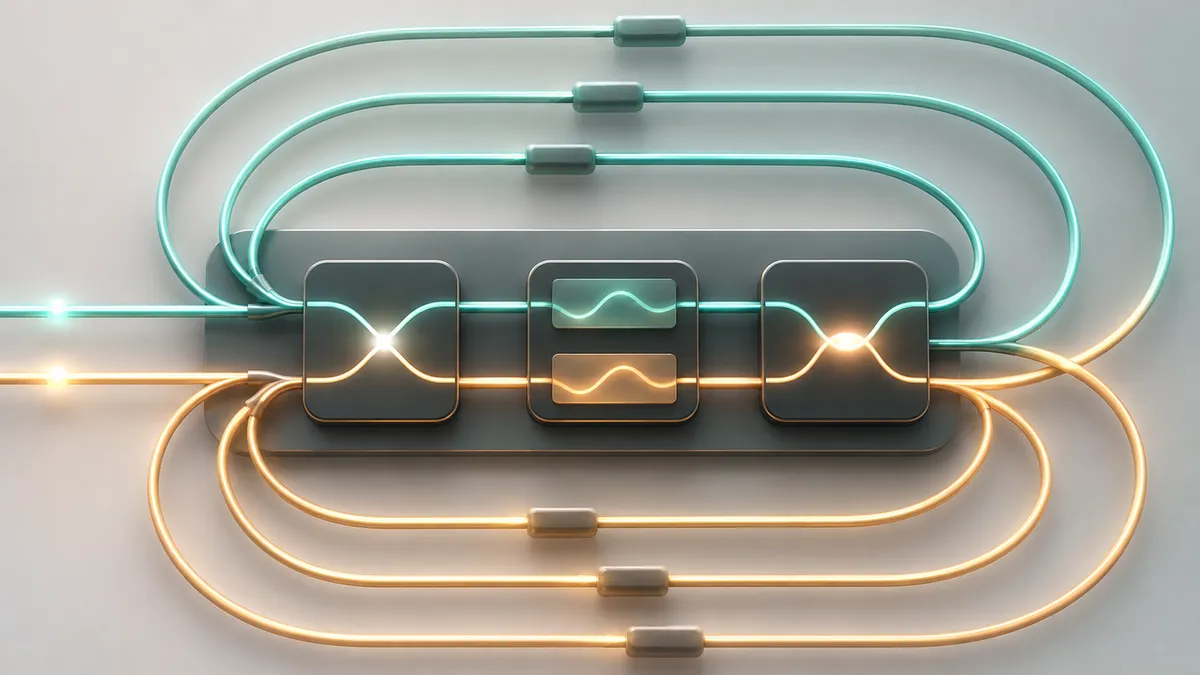
Could a photonic quantum computer run longer programs without adding more gates for every step? Denis Stanev, Nicolò Spagnolo and Fabio Sciarrino propose a modular design that repeatedly sends photons through shared optical components. Their arXiv preprint presents a theoretical architecture and numerical tests, not a working quantum computer.
Reusing the same optical hardware
The proposed Modular and Looping Quantum Photonic Processing Unit, or ML-QPPU, addresses a hardware question: how can an optical processor support general quantum circuits while limiting its physical component count?
The design encodes each qubit, the basic unit of quantum information, in a single photon distributed across two possible spatial paths. This is called dual-rail encoding: a photon in one path represents logical zero, and a photon in the other represents logical one.
Programmable optical switches route these pairs of paths into modules with different functions. Fiber loops then return photons to the modules for subsequent operations. Rather than providing separate hardware for every gate in a long circuit, the processor would reuse its existing gates.
The study is an arXiv preprint, with no journal publication identified in the supplied record. Its results combine a theoretical argument with numerical simulations; the authors do not report construction of the proposed processor.
What makes the design universal?
A universal quantum computer can, in principle, implement arbitrary quantum computations. The authors establish this capability using two ingredients: adjustable operations on individual qubits and a controlled-NOT, or CNOT, gate between any pair of qubits. A CNOT flips the target qubit’s logical value when the control qubit is one.
Beam splitters and phase shifters provide the single-qubit operations. Switches direct any selected pair of qubits into a shared CNOT module. The loops allow these operations to be arranged in arbitrary sequences, reproducing the quantum circuit model.
This routing provides direct connectivity without additional SWAP gates to exchange qubit positions. However, photons must remain synchronized for the interference needed inside the CNOT module. Carefully chosen delays keep photons aligned even when they follow different routes.
The architecture also permits operations to change in response to measurements made during a computation. Its claimed deterministic operation describes the intended gate action, rather than a guarantee that real photons would survive every optical component.
Training the nonlinear gate
The difficult component is the CNOT. The proposed implementation uses a quantum optical neural network: an optical circuit whose adjustable parameters are optimized to produce a target transformation. It combines linear optical elements with Kerr nonlinearities, which provide photon-number-dependent phase changes.
The researchers numerically trained the circuit using four logical basis states and six additional states sensitive to relative quantum phases. Those extra tests matter because a gate can produce the expected logical output probabilities while still introducing unwanted phase shifts that affect later operations.
Their simulated implementation uses two linear optical stages and one effective nonlinear stage, containing four single-mode nonlinearities. They report an average error probability of approximately 3.9 × 10⁻⁷ across the training states, with a maximum of approximately 7.7 × 10⁻⁷. These are numerical training results, not measured hardware error rates.
For a more complex test, the authors inserted the trained gate into a simulated circuit for optimal approximate quantum cloning. This operation produces two imperfect copies of an input qubit, not exact duplicates. Across 1,000 random input states, the average copy fidelity—a measure of agreement with the input—was approximately 0.8333315, close to the theoretical optimum of 5/6.
The simulation evaluated an equivalent circuit rather than physically circulating photons through loops. It therefore supports the intended computation, but does not demonstrate experimental timing or stability.
The cost of repeated circulation
Reusing components reduces hardware requirements, but does not eliminate the cost of longer computations. Each additional passage exposes photons to further transmission losses in loops, gates and switches. Survival probabilities multiply across these passages and across the photons involved.
For the proposed single-CNOT layout, component counts grow at most linearly with the number of qubits and modules, rather than with circuit length. The authors identify fast, low-loss switches as particularly important because photons repeatedly traverse switching networks.
Other unresolved requirements include suitable Kerr nonlinearities, indistinguishable single-photon sources, precise delays and stable optical phases. Optional modules could add parallel CNOT operations, specialized computations or storage, but introduce their own hardware trade-offs.
Finally, reusing the same components can correlate errors between computational steps. The authors leave the consequences for error correction open. Circuit-model compatibility makes established correction methods relevant, but does not establish fault-tolerant operation. The proposal therefore offers a resource-saving architecture whose practical value still depends on optical performance and further error analysis.
- photonic quantum computing
- loop-based architecture
- dual-rail encoding
- quantum optical neural networks
- CNOT gate
- Kerr nonlinearity
- optical losses
- quantum circuit model
Related reading
Automatically matched by shared topic keywords. These links do not imply that the sources agree or establish a consensus.