TRANSMISSION // 2611.12123v1
Cosmic microwave background could limit exceptionally massive primordial black holes
Source published
An arXiv preprint models how primordial black holes capture radiation and alter the cosmic microwave background. Including density and velocity fluctuations produces abundance limits up to 100 times tighter than the authors’ background-only analysis—but the results concern extraordinarily massive hypothetical objects and depend on uncertain modeling assumptions.
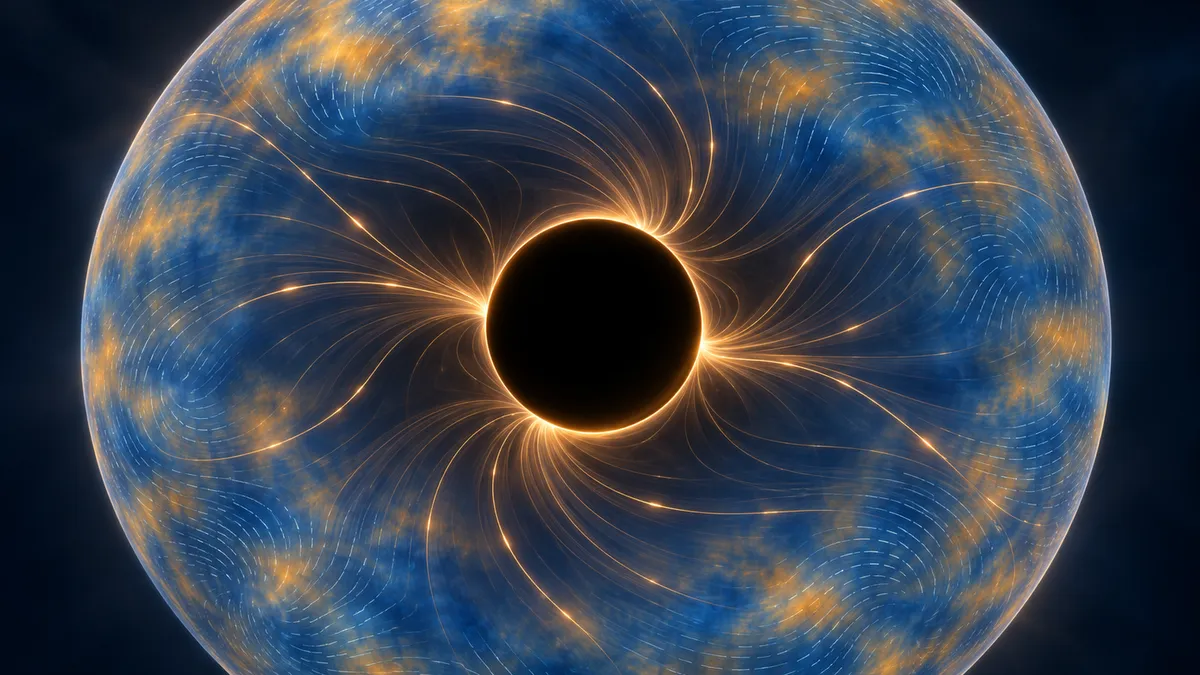
Could black holes formed in the early Universe have swallowed enough radiation to leave a measurable cosmic imprint? M. Farhang and S. M. S. Movahed investigate that possibility by tracking how radiation capture would change both the Universe’s average evolution and its small departures from uniformity.
Looking for radiation capture, not a detection
The cosmic microwave background, or CMB, carries patterns in temperature and polarization that can test models of the early Universe. In this study, the proposed disturbance comes from primordial black holes capturing photons and ultra-relativistic neutrinos. That capture transfers energy and momentum from radiation to the black holes, potentially changing the predicted CMB patterns.
The work is an arXiv preprint, not an established detection of primordial black holes. This briefing draws on the supplied paper text. Its central result is a set of model-dependent upper limits on how much dark matter could consist of these objects.
The relevant black holes are exceptionally massive. The reported Planck constraints cover masses from 10^15 to 10^17 times the Sun’s mass. The authors call such objects “stupendously large black holes” and explicitly acknowledge that a primordial origin for them remains controversial.
What the researchers changed
An earlier analysis by the same authors treated black holes and radiation as spatially uniform fluids exchanging energy. That changes average quantities, including the expansion rate, but does not describe how capture interacts with local density differences and motions.
The new study adds linear perturbations: small departures from that uniform background. The researchers construct a relativistic energy–momentum transfer description that keeps the combined energy and momentum of the interacting components conserved. They then modify both the continuity equations, which govern density evolution, and the Euler equations, which govern fluid motion.
A key physical assumption is that a black hole fully absorbs the momentum of radiation passing through its effective capture cross section. Unlike the homogeneous calculation, the perturbed model therefore includes momentum transfer as well as energy transfer. The authors also assume a monochromatic population, meaning that the black holes have a single mass in each analysis rather than a broad mass distribution.
They implement the modified evolution equations in CAMB, a code that calculates cosmological predictions, and use CosmoMC to explore parameter values. The black-hole fraction, written as f_pbh, is the share of dark matter assigned to primordial black holes. They vary it alongside standard cosmological parameters, using a prior uniform in log f_pbh over the stated interval from −20 to 0.
What the limits say
Using Planck temperature and polarization data, the authors report 3σ upper bounds ranging from approximately f_pbh = 0.05 to 0.002 across masses of 10^15–10^17 solar masses. In percentage terms, those limits span about 5% to 0.2% of dark matter. The limits become tighter as the assumed black-hole mass increases; they are not one universal restriction on all primordial black holes.
Depending on mass, including perturbations tightens the bounds by up to two orders of magnitude compared with the authors’ background-only treatment. That comparison concerns two versions of this radiation-capture model, not an improvement over every other observational constraint on primordial black holes.
The paper also forecasts an idealized, cosmic-variance-limited CMB survey extending to angular multipole 7000. Cosmic variance represents the statistical limitation associated with observing only one realization of the sky. Assuming a fiducial black-hole fraction of zero, the projected upper bounds range from about 10^−2 to 2 × 10^−4 across masses of 10^13–10^17 solar masses. These are sensitivity forecasts, not measurements from an existing survey.
Where the interpretation is fragile
The authors identify important limits to their calculation. Treating black holes as a smooth fluid becomes less clearly justified at the highest masses, where their individual, discrete nature matters. The steady-state approximation used for radiation capture is also least reliable for such objects immediately after formation. A fully time-dependent capture calculation is left for future work.
The treatment is restricted to linear perturbations. It also assumes that higher moments of the neutrino distribution retain their usual collisionless evolution, despite the modeled exchange of energy and momentum.
The result is therefore best read as a conditional test: within this fluid-based capture model, CMB fluctuations provide substantially more information than the average expansion history alone. Whether those numerical limits robustly describe a physically realizable population of enormous primordial black holes remains unresolved.
- primordial black holes
- cosmic microwave background
- radiation capture
- dark matter
- linear perturbations
- Planck
- cosmology
- arXiv preprint
Related reading
Automatically matched by shared topic keywords. These links do not imply that the sources agree or establish a consensus.
Can Ripples in the Universe’s Oldest Light Reveal When New Physics Acted?
Source published
Shared keywords: cosmic microwave background, dark matter
Early Galaxies Narrow a Search for Neutrino Interactions
Source published
Shared keywords: cosmic microwave background
A Python tool traces possible signals from the early universe
Source published
Shared keywords: dark matter, primordial black holes
A late-time dark-matter supply could soften a cosmological trade-off
Source published
Shared keywords: dark matter
Neutrino patterns could leave a different gravitational-wave imprint on the early sky
Source published
Shared keywords: cosmic microwave background