TRANSMISSION // 2611.12047v1
Galactic dust offers a tentative clue to dark matter—not a verdict
Source published
Simulations of 24 Milky Way-like systems tend to contain more dust under a cold dark matter model than a warm one. But galaxy-to-galaxy variation, simplified dust modelling and inconclusive present-day comparisons prevent a clear distinction.
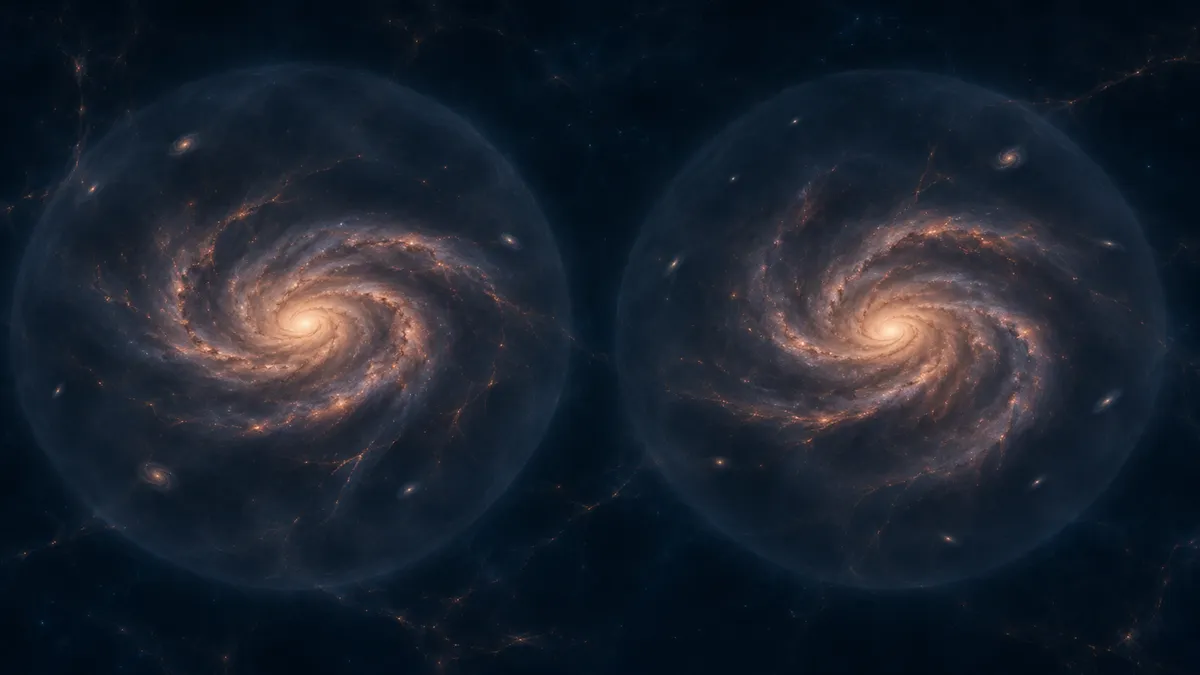
Could ordinary cosmic dust help reveal the nature of dark matter? A study led by Adam J. Ussing tests that possibility in simulated galaxies. Its larger sample tempers an earlier promising result: dust retains some potential as an indirect clue, but does not yet reliably separate the competing models.
Why look at dust?
Dark matter helps shape galaxies through gravity, while dust is ordinary material associated with processes such as stellar winds and supernova explosions. The proposed connection is indirect: different dark matter models change how galaxies assemble, potentially altering star formation, chemical enrichment and ultimately dust.
Cold dark matter allows more small-scale structure to develop than warm dark matter, whose early particle motion smooths out small concentrations of matter. However, ordinary astrophysics can blur the distinction. Changing how exploding stars affect surrounding gas can make the two models produce similar populations of satellite galaxies. The researchers asked whether dust could reveal differences that satellite counts conceal.
Replaying galaxy formation
The team selected 24 Milky Way-mass targets and resimulated their surroundings at higher resolution using the GADGET-4 code, including gas physics. Each target was run with cold dark matter and a warm dark matter particle mass of 3.5 kiloelectronvolts, with matched random seeds within each comparison set.
They also tested two settings for supernova feedback, the influence of stellar explosions on galaxy evolution. Their main comparison paired cold dark matter with a 10% supernova-efficiency parameter against warm dark matter with 5%. These choices produced similar average satellite populations. Importantly, the headline comparison therefore changes both dark matter and feedback: it is not an otherwise-identical test of dark matter alone.
Dust was assigned afterward using the POWDERDAY software, rather than evolved self-consistently throughout the simulations. The main prescription placed 40% of the gas's metal content—elements heavier than helium—into dust. Two alternative prescriptions used a dust-to-gas relation and a machine-learning-based model.
A modest, uneven dust excess
With the main dust prescription, 17 of the 24 cold dark matter simulations contained more dust than their warm counterparts at the present epoch, labelled redshift zero. Seven showed the reverse.
The median increase across matched comparisons was 6.6%. This describes the typical pairwise difference, not the percentage difference between the two samples' separately calculated median dust masses. Individual systems varied widely, and the present-day 99% confidence interval for the median difference included no difference.
The separation was larger earlier in cosmic history. The median cold-dark-matter dust excess peaked at about 25% around redshift 0.25. At some earlier intervals, the estimated confidence interval excluded zero, suggesting periods worth investigating rather than an established observational test.
Both models placed most dust near the galaxy's centre. On average, 89.1% lay within the inner 25 kiloparsecs in the cold sample, compared with 85.7% in the warm sample.
A promising structural measure falters
An earlier study based on one comparison set suggested that the Gini coefficient could distinguish the models. Here, that statistic measures how unevenly dust is distributed across projected bins outside the central galaxy.
Across the larger sample, it did not consistently separate cold from warm dark matter. Individual satellites and their arrival times dominated the differences.
Revisiting the earlier example exposed a particularly important boundary effect: a large satellite lay inside the chosen halo boundary in the cold simulation but just outside it in the warm one. Expanding the measurement region brought their present-day Gini scores close together. What looked like a useful general discriminator was strongly dependent on one system's geometry and history.
Stronger signals depend on assumptions
The researchers also compared dust mass with stellar mass and star-formation rate. At the present epoch, neither relationship showed a statistically significant separation between the models under any dust prescription. An inconclusive test does not establish that the populations are identical.
Alternative dust prescriptions increased the dust masses and strengthened some earlier-time differences. At redshift 0.17, tests of total dust-mass distributions returned p-values of 0.01 and 0.004. However, only the machine-learning-based prescription brought both scaling-relation comparisons below the conventional 0.05 threshold. The stronger result was therefore neither universal across prescriptions nor persistent across time.
What the evidence supports
The sample is limited to relatively isolated Milky Way-mass systems. The simulations use simplified star-formation and dust treatments, lack a stellar-wind component, and tend to produce overly massive stellar populations. The authors also acknowledge that their chosen warm-particle mass conflicts with several published constraints. Neither dark matter model emerges as a clear observational winner.
The supplied source is arXiv version 1, posted on 9 November 2026. Although presented as a preprint, its manuscript header records acceptance on 21 October 2026; it should not simply be described as unreviewed. This account relies on extracted paper text, which omits images and may distort layout or equations.
The result is a qualified research direction: dust may help identify useful epochs and measurements, but larger samples and more realistic modelling are needed before it can discriminate reliably between these dark matter scenarios.
- dark matter
- cosmic dust
- galaxy simulations
- cold dark matter
- warm dark matter
- Milky Way analogues
- galaxy formation
Related reading
Automatically matched by shared topic keywords. These links do not imply that the sources agree or establish a consensus.
An AI-Built Dark Matter Registry Points to Missing Tools, Not Just Missing Theory
Source published
Shared keywords: dark matter
Self-interacting dark matter deepens a galactic bar puzzle in simulations
Source published
Shared keywords: cold dark matter
CosmicGrain follows dust histories through a simulated galaxy
Source published
Shared keywords: cosmic dust, galaxy simulations
What Star Clusters Could Reveal About Faint Galaxies
Source published
Shared keywords: dark matter, galaxy formation
Tracing the branching roots of dark-matter haloes
Source published
Shared keywords: dark matter, galaxy formation