TRANSMISSION // 2611.12046v1
Could nearby star clusters have helped populate the Milky Way’s crowded centre?
Source published
Simulations suggest that Terzan 2, Terzan 4 and Terzan 5 could supply stars and stellar remnants to the Milky Way’s nuclear star cluster. Their modelled contribution is small, however, and capture estimates depend on a simplified treatment of gravitational slowing.
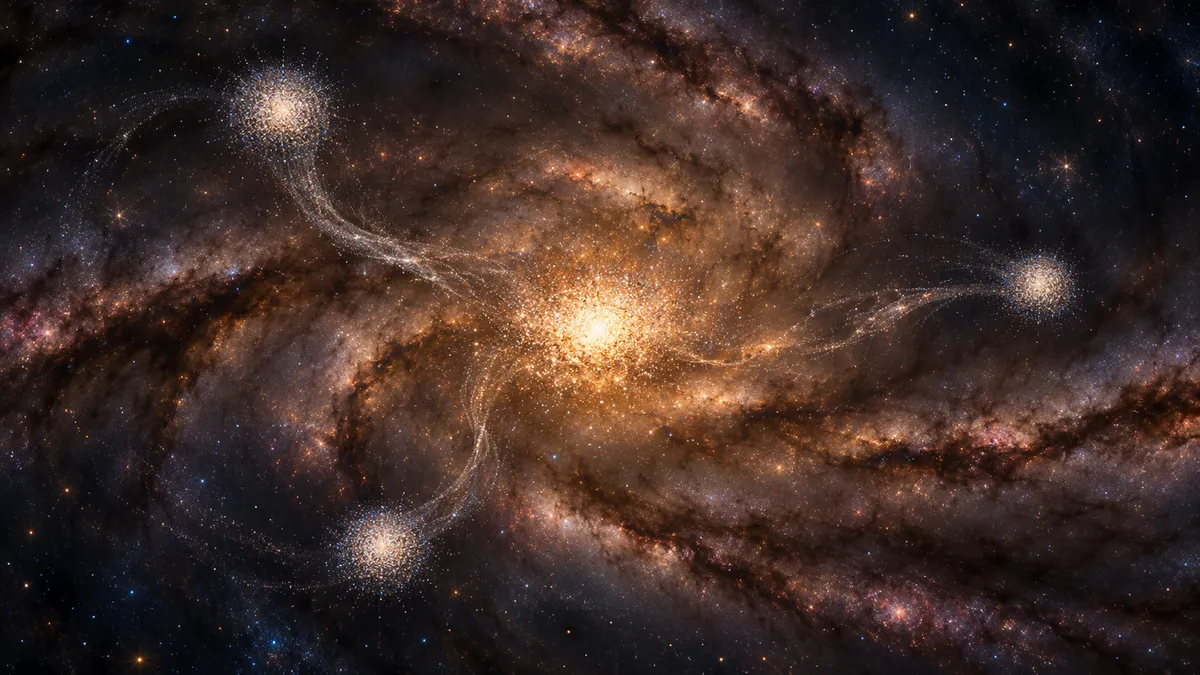
The Milky Way’s centre contains a densely packed nuclear star cluster. How did its stars get there? Some might have formed locally, while others could have arrived from surrounding clusters. A study led by Mukhagali Kalambay examines whether three surviving clusters could have donated stars during repeated passages near the Galactic centre.
Following three clusters through time
The researchers modelled Terzan 2, Terzan 4 and Terzan 5 over eight billion years. These clusters occupy the Galaxy’s inner region, making them candidates for supplying stars without having to dissolve completely. The proposed transfer involves tidal stripping: stars become detached from their original cluster and some may become gravitationally bound to the central nuclear cluster.
The team used direct N-body simulations, which calculate gravitational interactions among simulation particles. Their models included stellar ageing, mass loss and the formation of white dwarfs, neutron stars and black holes—the remnants left behind by different kinds of stars.
The surrounding Galaxy was represented by an evolving gravitational field drawn from a Milky Way-like galaxy in the IllustrisTNG-100 cosmological simulation. Starting cluster properties were selected so that the evolved models would reproduce properties of their present-day counterparts. To reduce computational demands, each numerical particle represented ten real stars of the same type. Reported stellar counts therefore include this scaling; they are not individual observed objects.
What counted as capture?
The researchers tracked particles entering a region within 100 parsecs of the Galactic centre. They then examined each particle’s closest approach and used an energy test to decide whether it qualified as bound to the nuclear star cluster. Entering the central region alone did not count as capture.
A crucial uncertainty is dynamical friction, the gravitational slowing associated with motion through a surrounding population. Its effect in the dense central environment was not explicitly simulated. Instead, the authors introduced a parameter called Vred into the kinetic-energy part of their binding calculation.
At Vred = 1.00, that energy term was unchanged. Smaller values made the binding criterion easier to satisfy. Although the paper calls this a velocity reduction factor, the displayed equation applies it to kinetic energy, so Vred = 0.10 should not be read simply as a simulated speed reduced to one-tenth. These are alternative capture estimates applied to the trajectories, not a fully modelled sequence of friction-driven encounters.
What the models found
With no artificial reduction in the energy estimate, the authors report a combined contribution of approximately 730 stars and remnants, totalling 278 solar masses. At the strongest reduction considered, Vred = 0.10, the reported totals rise to approximately 5,420 objects and 1,175 solar masses. A solar mass is the mass of our Sun.
Terzan 4 contributes the most throughout the tested range. The authors associate this pattern with its closer and more frequent approaches to the Galactic centre. At Vred = 1.00, its reported contribution is about 470 objects and 203 solar masses.
The captured population includes low-mass stars and compact remnants. The authors report a high-mass tail extending to about 20 solar masses, associated with neutron stars and black holes. The remnant contribution increases as Vred decreases. Terzan 4 is also the only model that supplies white dwarfs at every tested Vred value.
The paper reports an unchanged low-mass component across the illustrated parameter choices. That is a result within these calculations, not evidence that low-mass capture is universally independent of gravitational slowing.
What remains uncertain
These results identify possible contributions, not stars whose journey has been observed. Classification as bound at closest approach also does not, by itself, establish permanent residence in the nuclear cluster.
The calculation considers three selected clusters in one adopted Galactic history. Particle scaling and the simplified friction prescription limit how literally its counts should be interpreted. The supplied paper also contains internal inconsistencies: its initial-condition table gives Terzan 5 a half-mass radius of 5 parsecs and concentration parameter of 3, while later prose describes about 2 parsecs and 8. This weakens confidence in the accompanying explanation of its behaviour.
Even the larger reported contribution remains small beside the roughly ten-million-solar-mass nuclear cluster described in the paper. These models therefore do not explain its entire assembly. They leave room for locally formed stars and contributions from clusters that no longer survive, without establishing their respective shares.
Publication status
The supplied record is arXiv version 1, posted on November 9, 2026. However, the supplied manuscript also carries journal publication details and an acceptance date, with online publication listed as September 30, 2026. It should therefore be described as an arXiv posting of a paper that reports journal publication, rather than assumed to be an unreviewed preprint solely because it appears on arXiv.
- Milky Way
- nuclear star cluster
- globular clusters
- Terzan 4
- N-body simulations
- stellar remnants
- dynamical friction
Related reading
Automatically matched by shared topic keywords. These links do not imply that the sources agree or establish a consensus.
Testing a radioactive clock for the Milky Way’s oldest stars
Source published
Shared keywords: globular clusters
GetGaia 2.0 sorts distant stellar systems from the Milky Way foreground
Source published
Shared keywords: globular clusters
Euclid images reveal fainter stars in a remote Milky Way cluster
Source published
Shared keywords: globular clusters
A billion-star search maps the Milky Way’s nested structures
Source published
Shared keywords: milky way
A close galactic encounter could bend the Large Magellanic Cloud’s bar
Source published
Shared keywords: n body simulations