TRANSMISSION // 2611.12016v2
When should a language model’s teacher step in?
Source published
Speculative Self-Distillation lets a context-informed teacher supply individual tokens when its predictions diverge from a student’s. Three QA-task tests found promising efficiency, with important limits.
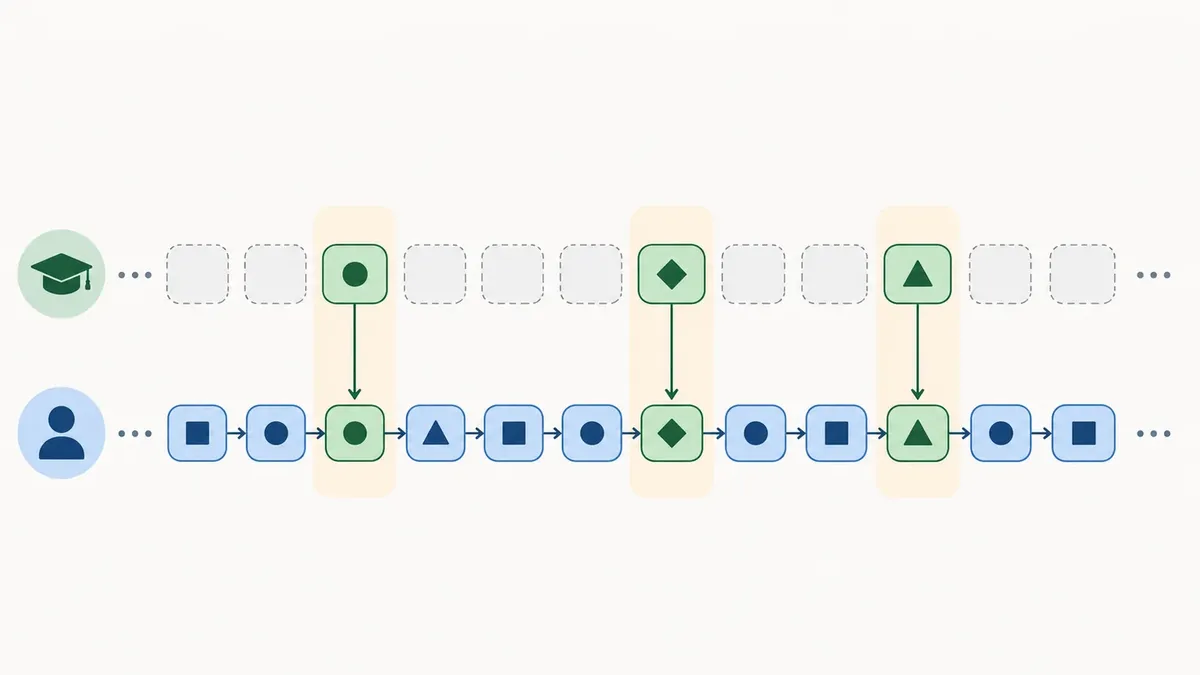
Can a language model be trained to answer questions about particular new material without receiving that material in its prompt? Speculative Self-Distillation explores one way: let the model generate most of an answer, while a context-informed version supplies individual tokens when their predictions differ substantially. Early results are promising, but come from a small set of tasks.
A language model can use information placed in its prompt. But if a particular fact or skill is to be available without that context, one option is to train the model to imitate a context-informed version of itself. The question in this study is how to do that while keeping training useful and closer to the student model’s behavior at test time.
In self-distillation, the same model plays two roles. A teacher receives extra context, such as a document or reference answer; a student sees only the question. The student is trained to match the teacher’s next-token predictions. The goal is for the student to answer “closed-book”—without that extra context—in the tested settings.
The authors compare two ways to generate training responses. In on-policy training, the student writes the response and the teacher evaluates it. This follows the student’s own behavior, but the teacher may offer little new information at many positions. In off-policy training, the teacher writes the response. This provides a teacher-generated trajectory, but the student is then trained on sequences it may not produce itself.
Speculative Self-Distillation (SSD) mixes the approaches token by token. The student generates by default. At each position, the method compares the student’s and teacher’s next-token distributions. If their divergence exceeds a threshold, the teacher supplies that token; otherwise, the student does. The paper calls these points “inflection” positions. The teacher’s predictions and the distillation loss are still evaluated at every response position: SSD changes who generates a token, not which positions receive training supervision.
The researchers tested SSD on three closed-book question-answering tasks: a synthetic memo for a fictional company, questions about a Wikipedia article concerning a natural disaster after the model’s knowledge cutoff, and undergraduate-level chemistry questions. Most main comparisons used Qwen3-4B, with three independent training runs. The authors also tested other model sizes on chemistry and assessed performance on six broader benchmarks after chemistry training.
Across the three tasks, SSD came close to on-policy distillation’s accuracy while using 38–69% fewer supervised tokens, the paper reports. On the company-memo task, SSD scored 1.35 percentage points below on-policy training; on the other two, it scored slightly higher. In a separate chemistry experiment, SSD reached the on-policy accuracy level in about 130 minutes, versus about 414 minutes for on-policy training. This timing depended on the researchers’ implementation, which ran teacher and student models concurrently on separate GPUs; it is not a general estimate of training-time savings.
In the forgetting test, SSD had the highest chemistry accuracy among the compared fine-tuning methods and the smallest average decline across the six general benchmarks. The reported decline was 1.38 points for SSD and 4.47 for on-policy training. This is evidence from one particular setup, not proof that SSD prevents forgetting more broadly. The chemistry experiment with a 14-billion-parameter model used a single run, offering less information about variation between runs.
The scope is limited. The core experiments cover three tasks, and the authors describe their work as focused on closed-book question answering with relatively short answers. They say that performance on reasoning-heavy tasks remains underexplored. The forgetting test uses one model, a particular chemistry split and six benchmarks. Results may also depend on training data, threshold choices and implementation; hyperparameters were selected using held-out data. A comparison with retrieval tested retrieved, solved training examples—not every way of retrieving source material—so it does not establish that storing knowledge in model weights is generally preferable.
The paper lists the 40th Conference on Neural Information Processing Systems (NeurIPS 2026); that listing alone does not establish that the work was presented or accepted. As with any individual study, its results need further testing across models and tasks. SSD offers a specific training rule for deciding when the teacher supplies an individual token, with promising efficiency results in the settings evaluated—not a guarantee that models can reliably or permanently absorb new knowledge.
- language models
- self-distillation
- knowledge internalization
- AI training
- knowledge updates
- machine forgetting
Reviewed cross-references
These connections were reviewed by a model, not independently fact-checked by a human. Similarity does not imply agreement; consult the original papers and the evidence below.
Can visual AI learn to work without its tools?
Shared method: Both papers use privileged information to train a model from its own generated behavior: SSD has a context-conditioned teacher intervene selectively at divergent token positions, while Tool-to-Self uses privileged tool observations for on-policy self-distillation alongside observation supervision and tool withdrawal. This is a methodological connection, not evidence of comparable performance; the tasks and training frameworks differ.
Model review: · openai-codex/gpt-6-luna
Evidence and provenance
Selected excerpts, not complete papers. PDF extraction can omit figures or damage equations, tables and reading order; sources may be preprints.
2611.12016v2 — Original paper
Excerpt reference:
static/papers/2611.12016v2.md:95-140
Basis: Paper text
Source SHA-256:a654fa10dcda412776725f974c12c465db575f125509abf198c43ff8113f116f2611.28564v1 — Original paper
Excerpt reference:
static/papers/2611.28564v1.md:138-184
Basis: Paper text
Source SHA-256:89152de20c57bce4f4da155a9efdd3b4040a33d00fe357013d1eb14e8bd7904e
Teaching language models to forget by contrast
Shared method: Both use token-level distributional supervision along model-generated trajectories. SSD selectively switches rollout generation between student and teacher to internalize knowledge; CPSD keeps student rollouts and reverses the privileged-versus-plain prediction shift to unlearn information. The shared trajectory-based distillation structure does not imply shared objectives or comparable outcomes.
Model review: · openai-codex/gpt-6-luna
Evidence and provenance
Selected excerpts, not complete papers. PDF extraction can omit figures or damage equations, tables and reading order; sources may be preprints.
2611.12016v2 — Original paper
Excerpt reference:
static/papers/2611.12016v2.md:95-140
Basis: Paper text
Source SHA-256:a654fa10dcda412776725f974c12c465db575f125509abf198c43ff8113f116f2611.31932v1 — Original paper
Excerpt reference:
static/papers/2611.31932v1.md:156-218
Basis: Paper text
Source SHA-256:612d58506338c4230d6a894ab1a51d0a352d05030f4995f47deeaa7750aca797
Related reading
Automatically matched by shared topic keywords. These links do not imply that the sources agree or establish a consensus.
How Language Models Balance New and Existing Skills
Source published
Shared keywords: ai training, language models, self distillation
A better signal for choosing AI training prompts?
Source published
Shared keywords: ai training, language models
Can an image generator learn from its own critiques?
Source published
Shared keywords: ai training, self distillation
Teaching Small Vision Models What to Notice
Source published
Shared keywords: ai training
Fine-tuning may forget less when tuned for retention
Source published
Shared keywords: ai training, language models