TRANSMISSION // 2611.11884v1
X-ray polarization narrows the possible shapes of Cygnus X-1’s corona
Source published
Simulations suggest that an accelerating, relatively broad plasma region can reproduce Cygnus X-1’s X-ray spectrum and polarization. The results constrain one family of corona models, rather than directly measuring its size or proving its structure.
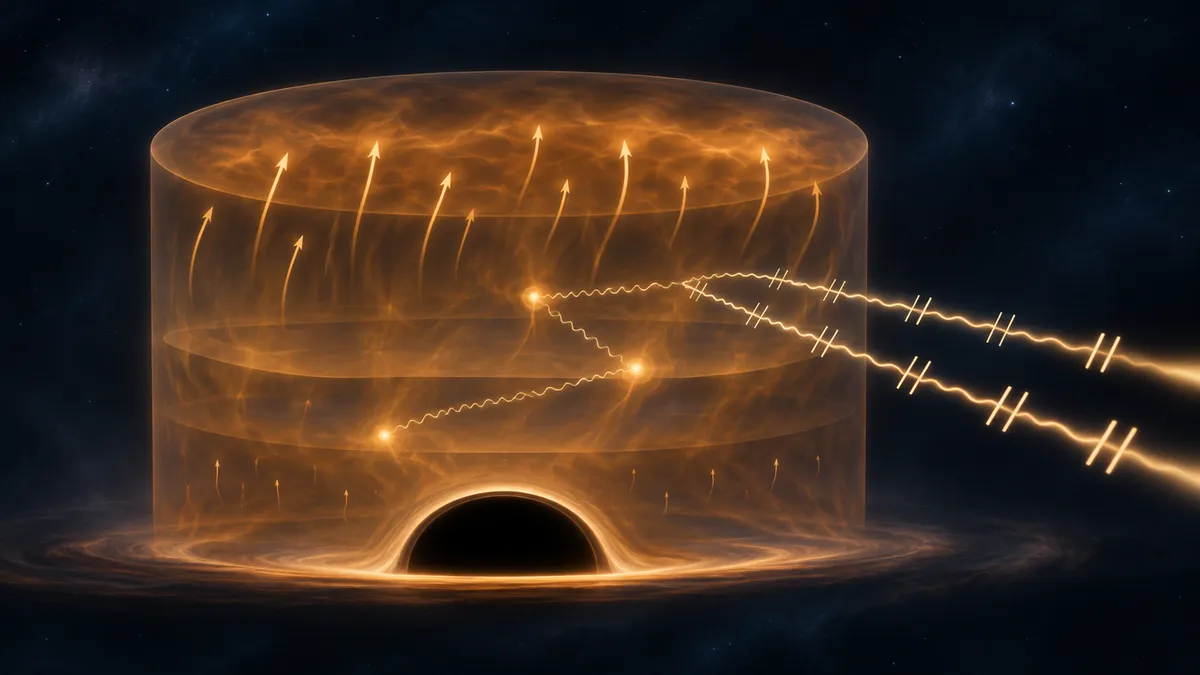
The X-rays from Cygnus X-1 carry clues about the hot plasma surrounding its black hole. A new preprint finds that matching both their energy distribution and polarization requires more than a suitable shape: in the models studied, the plasma must also accelerate.
Two observations to explain
Cygnus X-1’s corona is a hot plasma region that can boost lower-energy photons into X-rays through repeated scattering, a process called Comptonization. Its geometry and motion remain uncertain, but polarization offers a way to test possible arrangements.
The Imaging X-ray Polarimetry Explorer, IXPE, measured a polarization degree of 4.01% ± 0.20% across the 2–8 kiloelectronvolt energy band, with the polarization direction parallel to the system’s radio jet. Polarization describes a preferred orientation of light’s electric field; it does not mean that only 4% of the source emits X-rays.
The challenge is to explain that signal while also reproducing the hard X-ray spectrum. The study targets a photon index of 1.6 across 2–30 kiloelectronvolts, a number describing how photon counts decline with increasing energy. Earlier calculations for laterally extended coronas could explain the polarization direction but often predicted only about 1–2.5% polarization at the system’s viewing angle.
In a preprint posted on November 9, 2026, Henric Krawczynski, Kun Hu and Sohee Chun investigate whether a finite-sized, outflowing corona can satisfy both constraints.
Following photons through moving plasma
The researchers used polrad-3D, a Monte Carlo radiation-transport code that follows simulated photons through a cylinder. The cylinder’s position and shape remain fixed while plasma flows through it along its symmetry axis.
They describe its shape using the aspect ratio h = H/(2R): height divided by diameter. Small values represent flattened structures; large values represent tall columns. Importantly, this ratio does not specify the cylinder’s physical size.
The simulations compare uniform-speed flows with two accelerating profiles. In the latter, plasma starts at one-tenth of light speed, then accelerates either linearly with height or approximately linearly with accumulated scattering depth. Density decreases as the flow speeds up, as required by the model’s steady flow.
The assumed plasma temperature is 100 kiloelectronvolts. Unpolarized seed photons begin at 10 electronvolts, representing synchrotron emission generated within the corona itself. The code follows their energy and polarization changes through scattering, including the effects of plasma motion.
For each shape and velocity profile, the researchers adjusted the amount of scattering material to recover the observed spectral slope. They then searched for the lowest top-of-corona speed that also produced 4% polarization. Final calculations used 640 million simulated photons per run. The authors report checks against analytical calculations, classical scattering results and earlier published simulations.
Acceleration makes the difference
Uniform-speed models failed to reach the required polarization while preserving the spectral slope. Simply making the entire plasma move faster was not enough: polarization generally decreased as speed increased along the matched-spectrum models.
Accelerating flows behaved differently. Faster layers scatter photons generated in slower layers, creating a directional imbalance that can strengthen polarization parallel to the axis. The arrangement of velocities—not just the overall outflow speed—is therefore central to the result.
Successful accelerating models required top speeds of roughly 0.5–0.9 times light speed, with faster flows generally needed as the cylinder became taller relative to its width.
At h = 0.4, for example, the required top speeds were about 0.72 times light speed for acceleration linear in scattering depth and 0.76 for acceleration linear in height. At h = 0.8, the depth-based profile reached the target at about 0.87 times light speed, although the authors label that solution marginal. The height-based profile reached only about 3.2% polarization there.
Neither accelerating profile matched both targets at the sampled aspect ratios of 1.6 and above. Thus, the often-quoted limit h ≤ 0.8 describes the successful region of this model search, not a universal boundary for every possible corona.
Shape is not a size measurement
The authors favor a compact corona close to the black hole, with a radius around one gravitational radius—about 31 kilometres for the mass they adopt for Cygnus X-1. Such a location could efficiently access energy released near the black hole.
That size is a physical interpretation supported by additional energy and radiation arguments, not a direct output of the polarization fit. It depends on assumptions including internally generated seed photons and magnetic energy supply.
The main transport calculations also omit general relativistic effects. The authors estimate some consequences separately, but precise predictions require a specified location and curved-spacetime ray tracing. They do not calculate the full feedback from radiation reflected and reprocessed by the surrounding accretion flow, or simultaneously fit its iron emission line.
Other explanations for the observed polarization remain possible. As a preprint, the work presents provisional, model-dependent constraints: an accelerating, relatively broad corona can explain two important observations, but those observations do not uniquely establish its structure.
- Cygnus X-1
- black hole corona
- X-ray polarization
- IXPE
- Comptonization
- plasma acceleration
- Monte Carlo simulations
Related reading
Automatically matched by shared topic keywords. These links do not imply that the sources agree or establish a consensus.