TRANSMISSION // 2611.11883v1
DART debris may have blanketed the whole surface of Dimorphos
Source published
An analytical model predicts that debris from NASA’s DART impact resurfaced Dimorphos, leaving deposits averaging about two metres thick. The study also explores how slow-moving ejecta could affect estimates of the asteroid’s mass, but its predictions depend on simplified geometry and do not track debris through its subsequent orbital evolution.
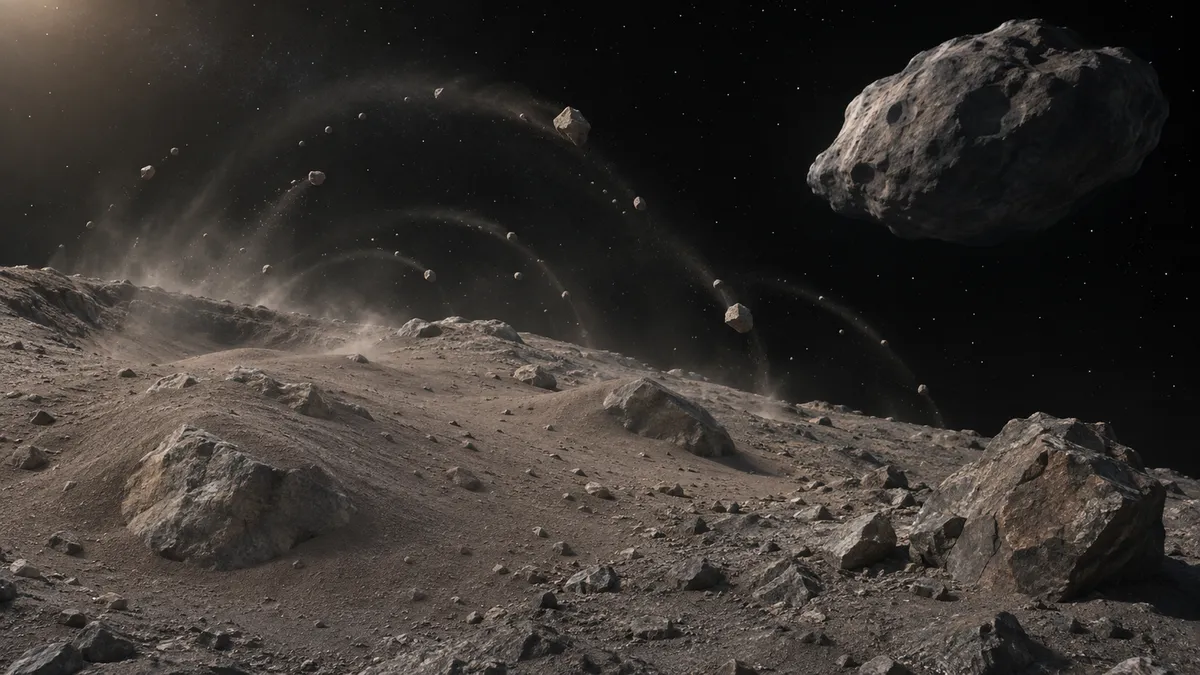
DART changed an asteroid’s orbit by crashing into it. Understanding that deflection also means accounting for the material blasted away—and the material that fell back. A new model predicts widespread burial on Dimorphos, offering a surface-level test for ESA’s Hera mission.
When NASA’s DART spacecraft struck Dimorphos in September 2022 at about 6.1 kilometres per second, the collision shortened the small asteroid’s orbit around its larger companion, Didymos, by approximately 33 minutes. The spacecraft supplied only part of the push: material thrown outward also produced recoil.
In an arXiv preprint posted on November 9, 2026, Kosuke Kurosawa and Satoshi Takada investigate where that debris went and what it could reveal about the collision. Their model predicts a blanket of returning material across Dimorphos, averaging roughly two metres thick. These are calculations, not measurements of the post-impact surface. This account uses the supplied full paper; the supplied material does not establish its final journal-publication status.
Following the slow debris
The researchers extend Maxwell’s Z model, an analytical description of how material flows out of an impact excavation. They adapt it to a curved surface, approximating Dimorphos as a sphere with a radius of 75 metres.
Their calculation divides the excavation flow into narrow bundles of paths. For each bundle, it estimates the available kinetic energy and subtracts the work needed to overcome gravity and material resistance. The remaining energy determines launch speed, while the path geometry determines launch angle. Together, these quantities give the mass and momentum carried away.
This approach avoids resolving every stage of shock propagation, making broad parameter surveys less computationally demanding than detailed shock-physics calculations. For flat targets, its crater sizes and ejecta-speed relationships agree with established scaling behaviour. That comparison supports the approach without validating every prediction for an irregular asteroid.
The team varied the flow geometry, effective material strength and energy available for excavation. They used granite shock-response parameters, but explicitly caution that this does not mean Dimorphos has granite’s composition or bulk density.
A weak target and a returning blanket
The model can reproduce the momentum enhancement inferred from DART observations when approximately 0.3–1% of the spacecraft’s impact energy is assigned to ejecta motion and the target’s effective strength is below about 100 pascals. Here, effective strength describes energy dissipated per excavated volume under an assumed deformation; it is not a direct measurement of a single rock’s strength.
Momentum enhancement, called beta, compares the momentum transferred to the target with the spacecraft’s incident momentum. Ejecta recoil can make this ratio exceed one. Matching it constrains possible impact conditions, rather than uniquely identifying them.
Across compatible calculations, material escaping Dimorphos amounts to about 0.3–3% of its mass. Escaping the small asteroid, however, does not necessarily mean escaping the two-asteroid system.
In a representative calculation, material falling back onto Dimorphos totals about 400 million kilograms. Spread over the modelled surface, it produces an average deposit about two metres thick and a minimum around half a metre. The same calculation gives a maximum excavation depth of roughly 20 metres.
That blanket would modify the entire surface, while leaving some larger boulders exposed. The authors propose comparing boulder burial at different distances from the impact point using Hera, which the paper describes as scheduled to begin investigating the system in late 2026.
Leaving Dimorphos is not the final destination
The model adopts escape speeds of 8.7 centimetres per second for Dimorphos and 24.5 centimetres per second for the binary system. In the representative case, about 80% of material classified as escaping Dimorphos starts between those thresholds.
Crucially, this is an initial-speed classification—not a prediction that 80% remains trapped indefinitely. Later gravitational encounters, Dimorphos’s orbital motion and solar radiation pressure can change the outcome.
The distinction also matters for estimating the asteroid’s mass. The model suggests that a momentum-partition parameter, describing ejecta momentum associated with the two escape thresholds, could be as low as about 0.6. Using a broader assumed range for that parameter and interpolating an earlier study’s sensitivity analysis, the authors estimate a density near 1,700 ± 300 kilograms per cubic metre. This is not a fresh analysis of orbital observations, and it remains consistent within uncertainties with the earlier nominal estimate of 1,540 ± 220.
What remains uncertain
The deposition calculation neglects irregular shape, rotation, density variations and Didymos’s gravitational influence. It also excludes the observed fast ejecta component, whose contribution to momentum remains uncertain.
The work therefore supplies approximate, testable predictions—not a complete reconstruction. Hera’s observations of resurfacing and boulder burial could help determine how closely this simplified picture matches the aftermath of DART.
- DART
- Dimorphos
- Didymos
- Hera
- asteroid deflection
- impact ejecta
- planetary defense