TRANSMISSION // 2611.11853v1
Dust around a yellow hypergiant could make it look brighter than it is
Source published
A model combining infrared measurements and polarized-light images suggests that dust around IRC +10420 channels radiation toward its poles. Viewed nearly pole-on, the star could appear about 1.5 times more luminous than it actually is, although the result depends on the assumed dust geometry and extinction.
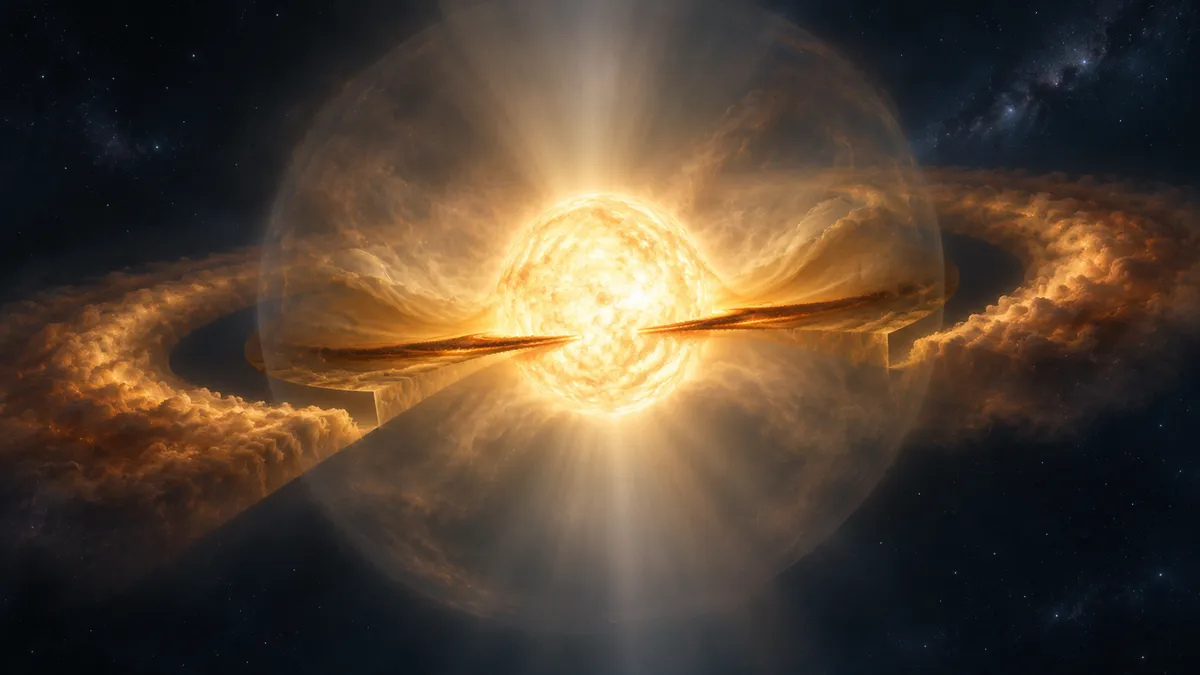
The dust surrounding a massive star is more than debris: it records material the star has shed and changes how its light reaches us. An arXiv preprint by Kyung-Won Suh uses that light to investigate the structure around the yellow hypergiant IRC +10420—and reassess its luminosity.
IRC +10420 is thought to have passed through a red-supergiant phase and evolved toward higher temperatures. Its surrounding nebula contains arcs, condensations and shells, evidence of a complicated history of material leaving the star. Understanding that material matters because mass loss helps determine how massive stars evolve.
In an arXiv preprint, version 1 posted on November 9, 2026, Kyung-Won Suh presents a model that combines measurements of the star’s brightness across many wavelengths with images showing the polarization of scattered light. The central conclusion is conditional but consequential: an uneven dust distribution can make this star look substantially more luminous from our direction.
Combining brightness with polarization
The study uses existing observations rather than reporting a new observing campaign. Its spectral energy distribution—the amount of energy received at different wavelengths—extends from visible light at 0.4 micrometers to millimeter radiation at 1.3 millimeters. These measurements include starlight and radiation absorbed and re-emitted by dust.
Brightness measurements alone cannot uniquely reveal the dust’s arrangement. Different geometries and grain populations can produce similar spectra. Polarization adds another constraint because the orientation and strength of polarized scattered light depend on grain properties and scattering angles.
Suh therefore also uses near-infrared imaging polarimetry obtained in 2012 and published by Shenoy and colleagues in 2015. The radial profiles were digitized from that earlier paper and compared by their relative brightness, without using an absolute intensity calibration. Because the central image was saturated, the comparison begins 0.7 arcseconds from the star.
The RADMC-3D radiative-transfer code follows how radiation heats dust, is re-emitted and undergoes polarized scattering. The model assumes that we look down the system’s polar axis. Components were introduced step by step and adjusted with small parameter grids, rather than selected through a comprehensive mathematical search.
A dusty equator with several zones
The adopted model places most dust around the star’s equatorial plane, inside a more diffuse spherical envelope. At the study’s assumed distance of 5 kiloparsecs, a flared inner component extends from 300 to 3,000 astronomical units, where one astronomical unit is the Earth–Sun distance.
Farther out, a detached ring reaches 16,000 astronomical units. Its surface density rises toward a maximum near 10,000 astronomical units before dropping steeply. A separate, thin equatorial layer contains much larger grains.
These components are not necessarily physically distinct disks. The paper treats them as a smooth, averaged description of a structured outflow.
The rising density within the ring reproduces a broad plateau in polarized brightness. Changing the representative grain radius from 0.3 micrometers in the ring to 0.5 micrometers at its outer edge helps reproduce the subsequent decline. Within the assumed spherical-silicate grain model, representative radii of about 0.7 micrometers or larger in this scattering region would give the wrong polarization pattern or too little polarization.
The model’s fractional polarization peaks at 15%, compared with an observed 14%, at 1.7 arcseconds. Its overall spectral fit has a weighted root-mean-square logarithmic residual of 0.068 dex; individual discrepancies are larger, reaching 0.19 dex in the far-infrared and submillimeter data.
Why the viewing direction matters
The equatorial dust absorbs radiation and redirects energy toward the poles through scattering and re-emission. In the adopted model, a pole-on observer receives enough energy to infer a luminosity 1.55 times the star’s actual output if emission is assumed equal in every direction.
At the Gaia-based distance of 4.26 kiloparsecs, the model gives approximately 330,000 solar luminosities. That would place IRC +10420 below the empirical upper luminosity limit for cool supergiants.
This is not a geometry-independent measurement. The luminosity also depends on how much dimming comes from intervening interstellar dust rather than dust around the star. A different division produces an almost equally good spectral fit with a higher luminosity. Stellar temperatures between 7,000 and 8,500 kelvin likewise fit comparably well.
What remains uncertain
At 5 kiloparsecs, the adopted model contains 0.074 solar masses of dust, mostly in the equatorial components. Its large-grain layer suggests growth and settling in a long-lived reservoir, but does not prove that interpretation. Unmodeled emission from the ionized wind could reduce the dust mass needed to explain the millimeter measurements.
The model assumes smooth symmetry and compact spherical silicate grains; real clumps, different compositions or porous grains could change the conclusions. The equatorial material’s motions are insufficiently constrained to reconstruct its mass-loss history.
There is also an observational warning: subtracting a scaled stellar image can remove genuine nebular light near the star. Higher-resolution polarimetry could test the predicted inner structure. For now, the preprint offers a plausible, non-unique explanation linking dust geometry, polarization and apparent stellar brightness.
- IRC +10420
- yellow hypergiant
- circumstellar dust
- imaging polarimetry
- radiative transfer
- stellar luminosity
- stellar mass loss
Related reading
Automatically matched by shared topic keywords. These links do not imply that the sources agree or establish a consensus.
New model estimates how aging stars replenish a nearby dwarf galaxy
Source published
Shared keywords: radiative transfer, stellar mass loss
Webb separates the dust signals around Tc 1’s carbon cages
Source published
Shared keywords: circumstellar dust
Bright supernovae reveal how surrounding gas shapes their light
Source published
Shared keywords: stellar mass loss
Layered cloud model traces hydrogen’s transition toward star-forming gas
Source published
Shared keywords: radiative transfer
A solar magnetic-field shortcut has stricter limits than it seems
Source published
Shared keywords: radiative transfer