TRANSMISSION // 2611.11835v1
A late-time dark-matter supply could soften a cosmological trade-off
Source published
A cosmology preprint explores whether vacuum energy feeding dark matter could counteract the extra clustering produced by some proposed solutions to the Hubble tension. The exchange lowers a present-day clustering parameter, but its effect on gravitational lensing is smaller—and it does not itself resolve the expansion-rate disagreement.
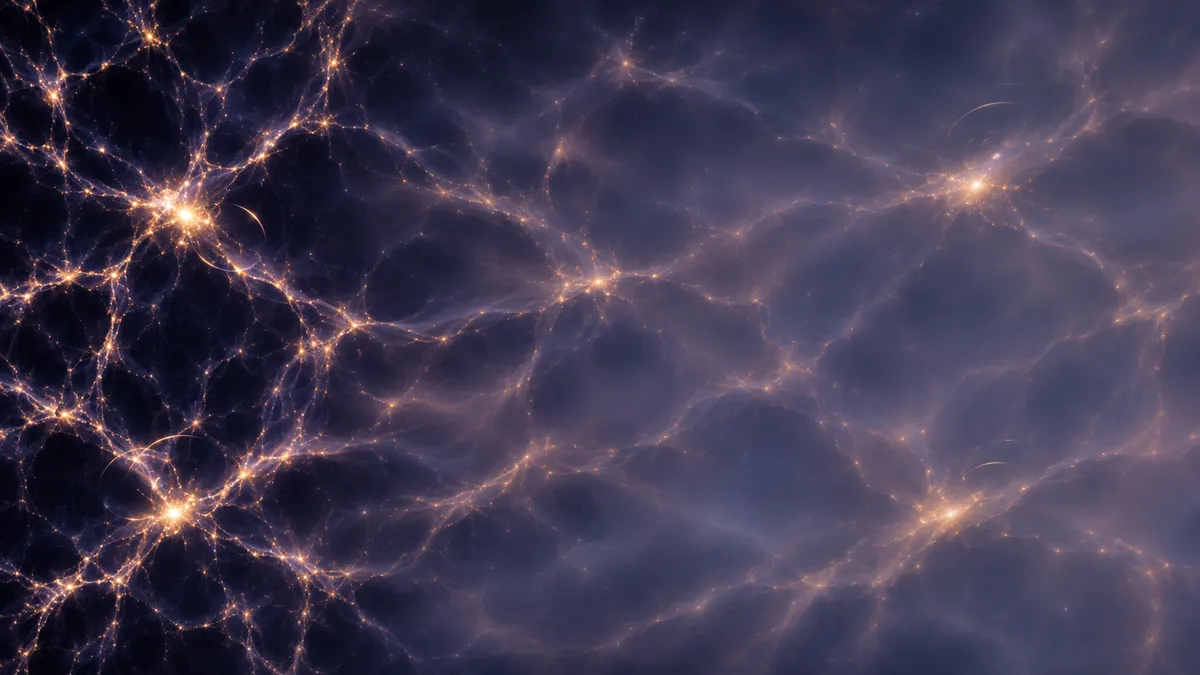
Adding energy to the early universe can help cosmological models predict faster expansion today, but often makes their matter distribution too strongly clustered. Li-Yang Gao, She-Sheng Xue and Xin Zhang investigate a possible counterweight: a late-time transfer of vacuum energy into dark matter. Their calculations show both the mechanism’s potential and the limits of judging it by a single clustering number.
Two problems on a seesaw
The Hubble constant, H₀, describes the universe’s present expansion rate. Measurements of the early universe interpreted through the standard ΛCDM cosmological model give a lower value than the SH0ES distance ladder, which uses Cepheid stars to calibrate supernova distances. This disagreement is known as the Hubble tension.
Some proposed remedies add energy before recombination, the epoch when the universe became transparent. Examples include dark radiation—an additional relativistic component—and early dark energy, a field that briefly contributes to the cosmic energy budget. These additions reduce the sound horizon, a characteristic distance used as a cosmological ruler, allowing a higher inferred H₀.
But fitting the cosmic microwave background then requires changes that also increase matter clustering. The result is an H₀–S₈ “seesaw”: raising the expansion rate can raise S₈, a parameter combining the strength of matter fluctuations with the present matter density. Importantly, the paper notes that the final KiDS-Legacy weak-lensing result is already consistent with standard-model predictions; a universal clustering discrepancy should not be assumed.
Adding matter without adding clumps
The researchers ask whether a separate, late-time process could counteract the clustering increase. Their model permits energy exchange between the vacuum and cold dark matter, and also dark radiation when that component is present. Ordinary matter, photons and neutrinos do not participate; the early-dark-energy field remains separate too.
A central assumption determines the outcome: the transferred energy is unperturbed in the dark matter’s rest frame. When vacuum energy supplies new dark matter, it does not directly add density fluctuations. The existing contrast between denser and less-dense regions is diluted, slowing the growth of structure even as the average matter density rises.
The exchange rate depends on the cosmic expansion rate through an adjustable power, α. For α ≤ −2, the interaction is negligible before recombination, leaving the early-universe mechanism essentially untouched. More negative values concentrate the exchange closer to the present. This timing prescription is phenomenological, rather than a uniquely established microscopic theory.
What the fits show
The team implemented the exchange in the CLASS and AxiCLASS cosmology codes and explored parameter probabilities with MontePython. They fitted Planck 2018 microwave-background observations, DESI DR2 and other baryon acoustic oscillation measurements, and Pantheon+ supernova data. They repeated the analysis with the SH0ES Cepheid calibration included.
Without SH0ES, the fitted parameter distributions mildly favor energy flowing from vacuum into the dark sector, at reported significances of 1.8–2.7 standard deviations. The exchange lowers S₈ by roughly 0.02–0.08 across the models examined, but does not increase H₀. The interacting dark-radiation model gives H₀ = 68.83 ± 0.91 kilometres per second per megaparsec, still 3.1 standard deviations below SH0ES.
Including the SH0ES calibration tests whether the exchange works when the fit is pushed toward higher H₀. In the dark-radiation case, S₈ falls from 0.815 to 0.800 ± 0.016, removing the increase introduced by dark radiation, while H₀ is 71.34 ± 0.70. With early dark energy and α = −2, the exchange removes about one-third of the S₈ increase.
Those higher expansion rates are not independent evidence that the interaction solves the Hubble tension: the calibration is already part of the fit. The preference for exchange also weakens to 1.1–2.0 standard deviations.
Why a lower S₈ is not enough
Weak gravitational lensing measures tiny distortions of distant galaxy images caused by intervening matter. It samples structure along the light’s journey, not just today’s universe. Because the exchange changes how matter density evolves, a present-day S₈ comparison can exaggerate its observational impact.
The authors therefore calculated lensing predictions using each model’s evolving matter density and compared them with 357 KiDS-Legacy correlation-function measurements. Much of the S₈ reduction occurs at redshifts below about 0.3. At the redshifts most relevant to KiDS-Legacy, the lensing amplitude decreases by only around 1–2%. The exchange modestly improves the early-dark-energy predictions but does not eliminate their excess shear mismatch relative to ΛCDM.
A preliminary mechanism, not a detection
The shear exercise is a prediction check, not a joint cosmological fit. It fixes several observational and astrophysical nuisance quantities. Its nonlinear clustering prescription was calibrated without energy exchange, making small-scale predictions especially uncertain for the strongest, latest interactions. The early-dark-energy model also fixes two field parameters rather than exploring their full freedom.
Presented in an arXiv preprint, the findings support a limited conclusion: late-time exchange can counteract some clustering introduced by early-universe modifications. Current data do not require that exchange, and it does not itself ease the Hubble tension.
- cosmology
- dark matter
- vacuum energy
- Hubble tension
- early dark energy
- dark radiation
- weak gravitational lensing
Related reading
Automatically matched by shared topic keywords. These links do not imply that the sources agree or establish a consensus.
Can Ripples in the Universe’s Oldest Light Reveal When New Physics Acted?
Source published
Shared keywords: dark matter, early dark energy
Could ancient cosmic walls have left a gravitational-wave background?
Source published
Shared keywords: dark radiation
Can AI read cosmic structure without becoming overconfident?
Source published
Shared keywords: weak gravitational lensing
Galaxy Distortions Put Limits on Giant Primordial Black Holes
Source published
Shared keywords: dark matter, weak gravitational lensing
A Calibration Gap Challenges a Supernova-Based Hubble Constant Claim
Source published
Shared keywords: hubble tension