TRANSMISSION // 2611.11664v1
A Century of Stellar Eruptions, Recounted in the Small Magellanic Cloud
Source published
An updated census lists 26 nova or nova-like optical eruptions reported in the Small Magellanic Cloud between 1897 and October 2026. Most are probable classical novae, while three raise questions about eruptions involving white dwarfs with Be-star companions.
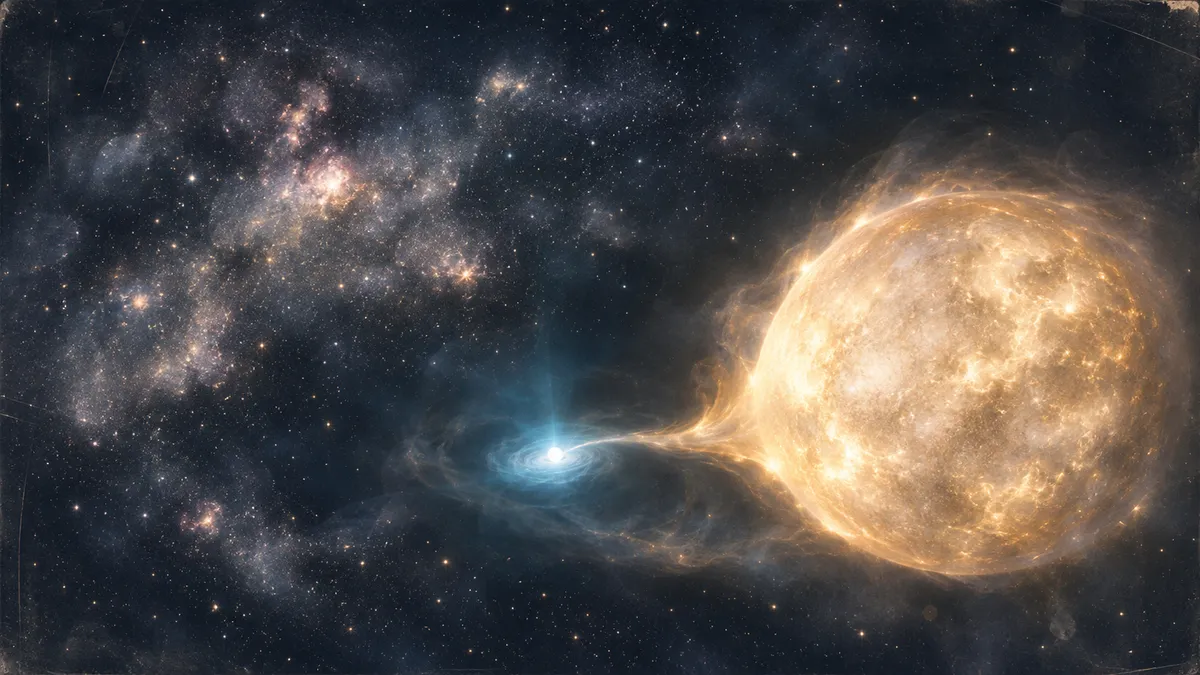
Counting stellar eruptions requires more than collecting reports of sudden brightening. A new census revisits more than a century of observations in the Small Magellanic Cloud, separating probable classical novae from unusual candidates and events that do not meet the same criteria.
The first recorded nova in the Small Magellanic Cloud was not recognized as one when it was observed. Henrietta Swan Leavitt identified HV 849 as a variable star on photographic plates in 1897; its recognition as a nova came in 1951. That historical gap illustrates a central difficulty in building a census: observing an eruption and understanding what erupted can be very different achievements.
In a new arXiv preprint, astronomer Allen W. Shafter of San Diego State University assembles 26 optical transients reported as novae or nova-like eruptions from 1897 through October 2026. Of these, 23 are described as probable classical novae. The remaining three are associated, with differing levels of confidence, with a less familiar possibility: eruptions involving a white dwarf and a Be-star companion.
Building the list—and setting its boundaries
This is a compilation and reassessment of existing observations, not a report of 26 newly discovered eruptions. Shafter draws primarily on an earlier online catalog for records through 2020, incorporates other published reports, and corrects some positions and dates. Earlier compilations stopped in 2020.
The geographical boundary is explicit: candidates must lie within five degrees of the Small Magellanic Cloud’s center, including its Wing region. The table brings together discovery dates, positions, reported brightnesses, available fading times and classification notes.
But proximity and brightening alone are not enough. Four systems identified through supersoft X-ray emission, without observed optical outbursts, appear separately and do not contribute to the total of 26. Several other optical transients are also excluded because their nature is unresolved or their behavior does not support classification as a classical nova.
One instructive exclusion is ASASSN-16oh. Its spectra showed narrow emission lines associated with a disk, with no sign of expelled material. Previous interpretations invoke either accretion onto a massive white dwarf without nuclear burning or a thermonuclear runaway without mass ejection. Shafter argues that neither interpretation makes it a classical nova. The distinction matters: an energetic event involving a white dwarf need not belong in the same category as other nova eruptions.
Unusual companions, unusually brief events
Two included events offer stronger evidence for nova-like eruptions in systems with Be-star companions.
MAXI J0158−744, observed in 2011, produced a very fast X-ray outburst accompanied by brief optical brightening. The 2024 event CXOU J005245.0−722844 had a supersoft X-ray outburst lasting less than 16 days and an optical brightening of about half a magnitude lasting less than seven days. Its companion’s OBe classification was subsequently confirmed through spectroscopy.
Both eruptions are described as super-Eddington: their luminosities exceeded a benchmark associated with the balance between outward radiation pressure and inward gravity. They have been interpreted as nova eruptions on white dwarfs with Be-star companions, rather than established beyond doubt as such.
The third case, SMCN 2002-10a, is much less secure. There are no eruption spectra or X-ray observations. Its identification rests on the properties of the star seen outside the eruption, whose colors resemble those of a Be star. Earlier researchers excluded it from their nova list as a possible low-amplitude Be-star outburst. Shafter retains it as a possible Be-plus-white-dwarf nova, preserving that uncertainty rather than resolving it.
A census, not a complete population measurement
The updated list exposes how much remains unknown. Only four systems have known spectroscopic classes, and fewer than half have measured decline times. One entry, the 2016 eruption, even carries a note questioning whether it belongs to the Milky Way rather than the Small Magellanic Cloud.
Consequently, 26 reported events should not be read as a completeness-corrected total or converted directly into the galaxy’s nova eruption rate. The paper does not establish how many eruptions escaped detection.
The Small Magellanic Cloud’s relatively young, metal-poor stellar population makes it useful for investigating how nova properties depend on their stellar surroundings. This census supplies an updated starting point, not that investigation’s final answer. Posted as an arXiv preprint on November 8, 2026, it organizes the evidence while keeping probable novae, unusual interpretations and weaker candidates visibly distinct.
- Small Magellanic Cloud
- novae
- white dwarfs
- Be stars
- X-ray transients
- stellar eruptions
- astronomy
Related reading
Automatically matched by shared topic keywords. These links do not imply that the sources agree or establish a consensus.
A nova’s fading visible light could guide the search for gamma rays
Source published
Shared keywords: white dwarfs
A close galactic encounter could bend the Large Magellanic Cloud’s bar
Source published
Shared keywords: small magellanic cloud
Radio surveys reveal a faint signal from IX Velorum
Source published
Shared keywords: white dwarfs
Did two stars become one? Clues from the heaviest white dwarfs
Source published
Shared keywords: white dwarfs
Small white dwarf explosions could resemble the faintest Type Iax supernovae
Source published
Shared keywords: white dwarfs