TRANSMISSION // 2611.11642v1
Changing red-dwarf winds could reshape magnetic links with nearby planets
Source published
Simulations based on magnetic maps of six red dwarfs suggest that their changing winds can alter where nearby planets could magnetically communicate with their stars. But the predicted interaction conditions depend strongly on an uncertain wind-heating parameter. These are modeled environments, not new detections of planet-driven signals or measurements of habitability.
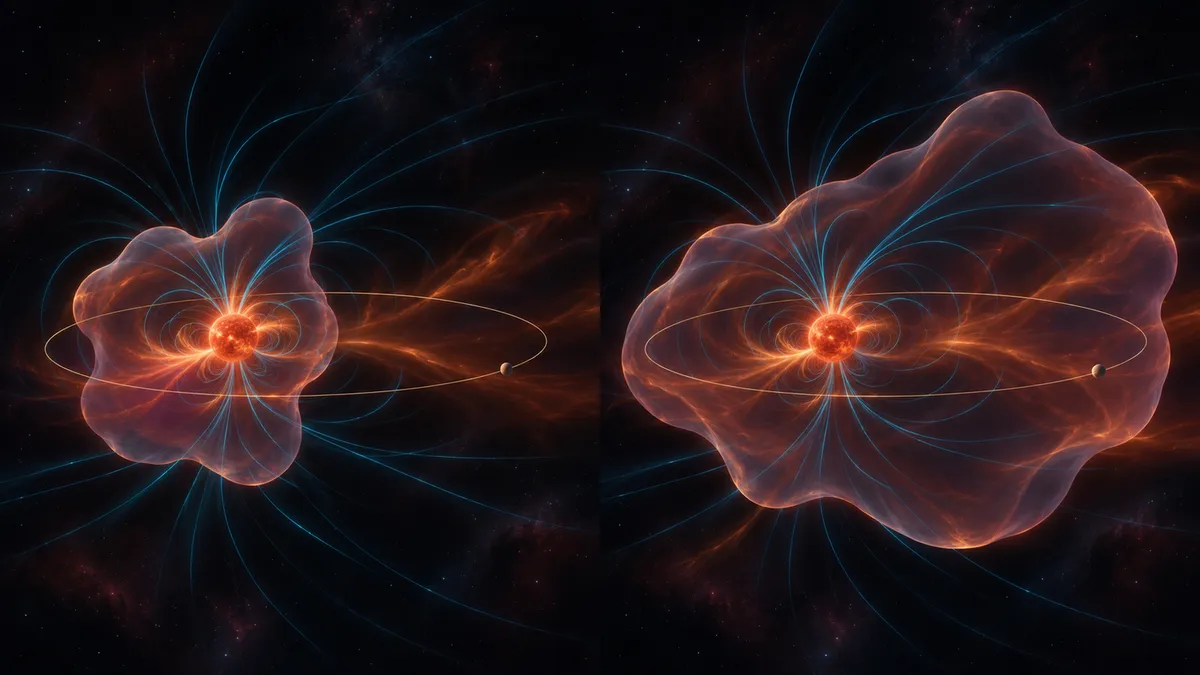
A planet’s space environment need not stay the same from one year to the next. Red dwarfs—the Galaxy’s most common stars—have changing magnetic fields that help shape their outflowing stellar winds. Szymon Petyniak and colleagues used magnetic observations from different dates to model those changes, asking whether nearby planets remain in conditions that allow magnetic disturbances to travel back toward their host stars.
Mapping a changing stellar wind
The team assembled 18 previously published magnetic-field maps for six M dwarfs, also called red dwarfs: CN Leo, EV Lac, DS Leo, YZ Cet, GJ 905 and GJ 1151. Their masses range from about one-tenth to six-tenths of the Sun’s mass, and their rotation periods span 2.7 to 175.6 days.
The maps were reconstructed using Zeeman Doppler imaging, which uses polarization in starlight to infer the strength and arrangement of large-scale magnetic fields. Each map supplied the surface magnetic input for a three-dimensional simulation of electrically conducting gas interacting with magnetic fields.
The researchers used the Alfvén Wave Solar Model, in which magnetic waves supply energy that heats the gas and drives the wind. Each simulation settled into a steady state. Comparing these separate snapshots revealed differences between observed epochs; the study did not continuously simulate the intervening months or years.
From the outputs, the team calculated how much material the wind carried away, how much rotational angular momentum it removed, and the location of the Alfvén surface.
A boundary for magnetic communication
The Alfvén surface marks where the outward wind reaches the speed at which a particular kind of magnetic disturbance travels through the gas. Inside this boundary, in the sub-Alfvénic regime, disturbances associated with a planet can potentially propagate upstream toward the star. Outside it, that upstream communication is not possible through the same mechanism.
This makes the boundary relevant to proposed planet-linked radio emission or changes in stellar activity. Being inside it provides a possible interaction condition—not a guarantee of a detectable signal.
What the simulations found
With the model’s solar-calibrated heating setting, calculated mass-loss rates ranged from 1.0 × 10⁻¹⁴ to 2.3 × 10⁻¹³ solar masses per year. For individual stars, mass loss differed between epochs by as much as a factor of 3.8, while angular-momentum loss differed by as much as a factor of 7.4. Both largest variations occurred for EV Lac. The average Alfvén radius varied by up to a factor of 1.5.
The orbital results illustrate why those changes matter. For DS Leo b, 15% of the modeled orbit was sub-Alfvénic at the 2020.9 epoch, compared with none at 2022.1. For YZ Cet c, the corresponding fraction increased from 22% at 2023.9 to 83% at 2024.8. YZ Cet d went from entirely outside the sub-Alfvénic region to spending 55% of its orbit inside it.
These are simulated fractions of orbital paths, not observed interaction frequencies. They offer a possible explanation for why a candidate magnetic interaction signal might appear at one epoch but not another, without establishing the origin of any particular detection.
The heating assumption changes the picture
A major uncertainty is how much wave energy enters the wind for a given surface magnetic-field strength. The authors repeated the simulations with that ratio reduced tenfold, a choice previous work suggested might better suit M dwarfs.
In their fitted comparison, mass-loss rates were about 16 times lower, while the average Alfvén surface expanded. Crucially, DS Leo b and the YZ Cet planets then remained predominantly sub-Alfvénic at both sampled epochs. The changing mass-loss and angular-momentum-loss trends broadly persisted, but the predicted orbital interaction conditions changed substantially.
The modeled mass-loss rates broadly followed an observational relationship with stellar X-ray flux. That comparison does not uniquely establish the correct heating setting: the X-ray measurements were not contemporaneous with the magnetic maps.
Limits and publication status
Only six stars and a limited number of epochs were available, insufficient to characterize complete magnetic cycles. The planetary orbital inclinations were unconstrained, so the calculations assumed orbits in the stellar equatorial plane. GJ 1151 c lay beyond the simulation domain; its wind conditions were extrapolated and remained super-Alfvénic in the modeled epochs. An additional EV Lac comparison also showed that magnetic-map reconstruction choices affect some outputs.
The study does not determine atmospheric survival or whether any planet is habitable. Its practical recommendation is coordinated radio and magnetic-field observations to interpret possible star–planet interactions.
The supplied source is arXiv preprint version 1, posted November 8, 2026. The manuscript also records acceptance by Astronomy & Astrophysics on November 5, so describing it simply as an unreviewed preprint would be misleading.
- M dwarfs
- stellar winds
- stellar magnetic fields
- exoplanets
- Alfvén surface
- star–planet interactions
- magnetohydrodynamic simulations
Related reading
Automatically matched by shared topic keywords. These links do not imply that the sources agree or establish a consensus.
A nearby star system emits low-frequency radio waves—but what powers them?
Source published
Shared keywords: stellar magnetic fields
A white dwarf’s abrupt magnetic switch hints at compact atmospheric regions
Source published
Shared keywords: stellar magnetic fields
Magnetic field geometry changes the pace of simulated reconnection
Source published
Shared keywords: magnetohydrodynamic simulations
Small magnetic patches can bring a simulated solar eruption forward
Source published
Shared keywords: magnetohydrodynamic simulations
Machine learning connects atomic physics to simulations of stellar winds
Source published
Shared keywords: stellar winds