TRANSMISSION // 2611.11595v1
Tracing reflections yields exact solutions for quantum fields in moving cavities
Source published
A theoretical preprint shows how a geometric method usually used numerically can produce exact formulas for a quantum field confined between a fixed mirror and a moving one. The authors derive solutions for expanding and contracting cavities and extend the method to combinations of analytically tractable mirror motions.
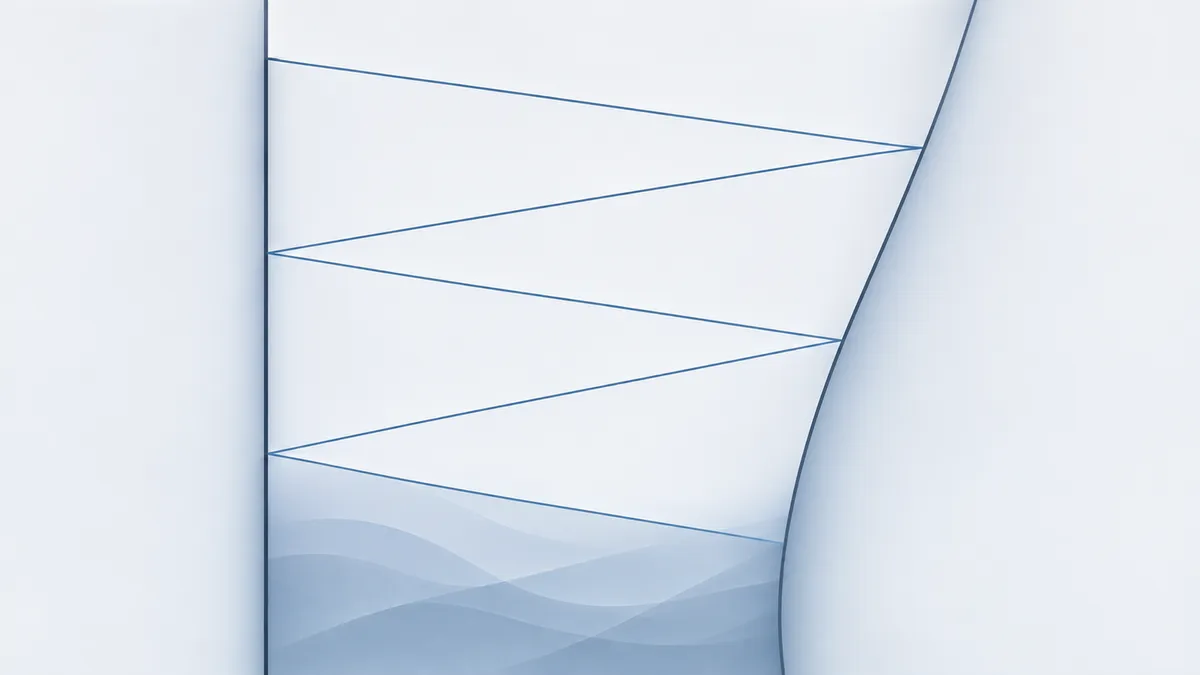
How does a quantum field change when one wall of its enclosure moves? For a simplified cavity, that question reduces to finding a mathematical function that records the effects of successive reflections. Maxwell F. de Araújo and colleagues show that tracing those reflections geometrically can yield exact formulas, not just numerical answers.
Moving mirrors can cause a quantum field initially in its vacuum state to produce particles, a phenomenon called the dynamical Casimir effect. Understanding that process requires calculating how the field responds to changing boundaries. A preprint submitted to arXiv on 8 November 2026 revisits a geometric method for doing so and develops exact analytical solutions for several mirror trajectories.
The work is mathematical rather than experimental. Its central question is whether a construction commonly implemented through numerical calculations can instead deliver explicit formulas—and whether those formulas can be combined to describe more varied motion.
A field between two mirrors
The model has one spatial dimension and time. A fixed mirror stands at one end of a cavity, while the other follows a prescribed trajectory. Between them is a real, massless scalar quantum field: a simplified field described by a scalar quantity rather than the vector structure of an electromagnetic field. Both mirrors impose Dirichlet boundary conditions, meaning that the field vanishes at their surfaces.
The field’s solutions depend on a phase function called the Moore function. It satisfies the Moore equation, which relates the function’s values along incoming and outgoing propagation paths at the moving mirror. Knowing this function makes it possible to calculate quantities including the field’s energy density and, under the conditions described in the paper, particle production.
For stationary mirrors, the relevant solution is straightforward. For moving mirrors, exact formulas have been available only for particular classes of trajectories. An exact analytical solution expresses the answer mathematically without relying on a numerical approximation to solve the equation.
Counting reflections
The authors build on a method introduced by Cole and Schieve in 1995. It follows null lines: paths along which disturbances propagate at the speed of light. Starting from a point of interest, the construction traces these paths backward through successive reflections until they reach a region where the Moore function is already known.
In the original method, that destination is a static region where the field has not yet been affected by the mirror’s motion. Each encounter with the moving mirror contributes a fixed increment to the Moore function.
To turn this construction into explicit formulas, the researchers solve for both the reflection times and the number of reflections needed to reach the known region. The latter is an integer-valued function. They express it using ceiling functions, which round a value upward to the nearest integer. This makes the reflection count an analytical part of the solution rather than merely the outcome of a numerical procedure.
What the calculations produce
The team derives new exact solutions for two cavities whose moving mirror initially rests at a finite distance from the fixed one. In the first, the mirror then moves outward at constant speed. In the second, it contracts toward the fixed mirror asymptotically, approaching it without reaching it at a finite time.
The authors also recover Law’s previously known exact solution for a particular resonant periodic motion. Their treatment explicitly handles the mathematical branches needed to keep the Moore function continuous and gives the reflection-count integer a precise geometric interpretation.
For the expansion and contraction cases, the paper reports checks against the Moore equation and numerical results from the Dynamic Casimir Package. The expansion solution also recovers the stationary-cavity result as the mirror’s speed tends to zero.
Joining solvable motions
A broader extension allows backward tracing to stop in any region where the Moore function is known, even if another technique supplied that solution. The paper uses this to construct examples including uniform expansion followed by resonant motion, a half-cycle of oscillation followed by a halt, and modulated resonant motion followed by contraction. A separate extension addresses uniformly expanding cavities that begin collapsed.
The authors argue that repeatedly joining suitable regimes generates an infinite family of exact solutions. This does not mean that arbitrary mirror motion is now analytically solvable: each added regime must permit the required analytical construction.
The results concern an idealized one-dimensional scalar-field model with prescribed mirror trajectories, including abrupt transitions in some examples. They are not new experimental observations of particle creation. The source is an arXiv preprint, with no journal publication identified in the supplied record. Its contribution is an expanded mathematical toolkit for studying moving-boundary quantum fields within those assumptions.
- quantum physics
- dynamical Casimir effect
- Moore equation
- moving mirrors
- scalar field
- exact analytical solutions
- geometric method
Related reading
Automatically matched by shared topic keywords. These links do not imply that the sources agree or establish a consensus.
Four algorithms extend classical simulation of photonic quantum circuits
Source published
Shared keywords: quantum physics
The control cost of resetting a qubit without revealing its past
Source published
Shared keywords: quantum physics
What a qubit screen can—and cannot—tell an observer
Source published
Shared keywords: quantum physics