TRANSMISSION // 2611.11587v1
Galaxy clusters reveal an ancient cosmic ruler
Source published
A study of 169,679 galaxy clusters detects the imprint of early-universe sound waves in two redshift ranges. The resulting distance measurements agree with standard cosmology, but their precision and dependence on outside calibration limit stronger conclusions.
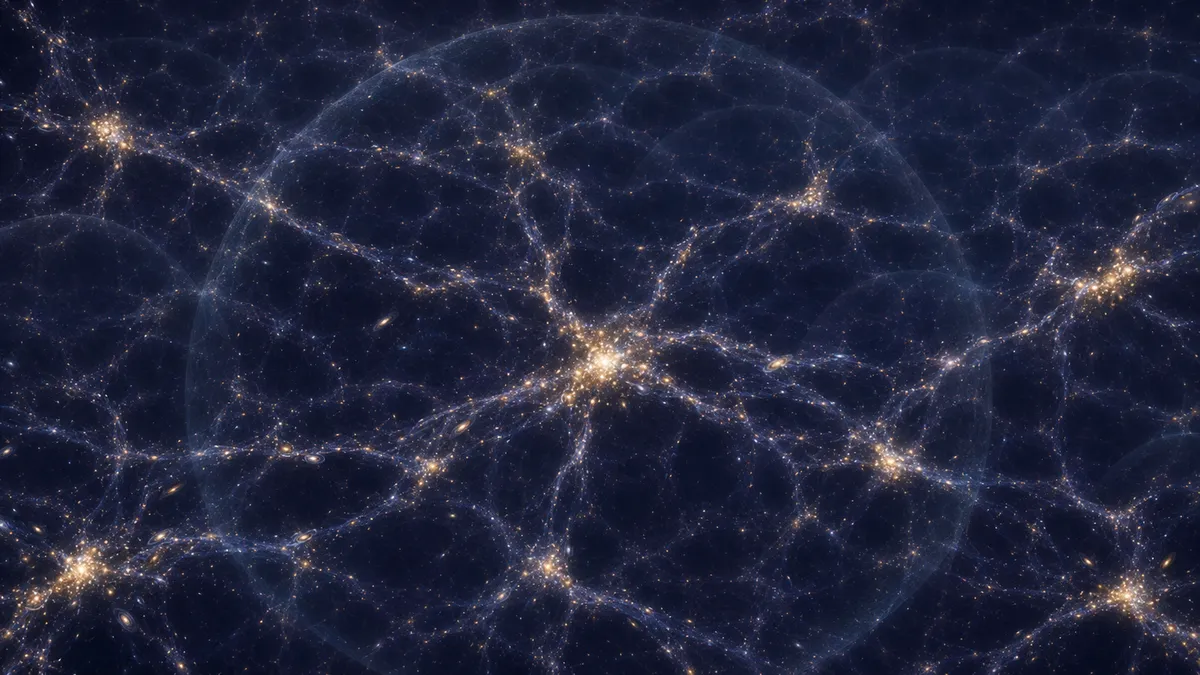
The spacing between galaxy clusters preserves a faint echo of sound waves from the early universe. A new preprint uses that pattern to measure cosmic distances—and finds agreement with a cosmological constant rather than evidence that dark energy must change over time.
A ruler left by ancient sound
Before galaxies formed, ordinary matter and light made up a hot, tightly coupled mixture. Gravity and radiation pressure drove sound waves through it. Those waves left a preferred separation in the later distribution of matter: the baryon acoustic oscillation, or BAO, scale.
This is a statistical pattern, not a regular grid. Astronomers find a small excess of pairs of objects separated by roughly the characteristic scale. Because the underlying ruler can be calibrated through early-universe physics, its apparent size helps researchers reconstruct cosmic distances and expansion.
In their arXiv preprint, Xiaoyun Shao and colleagues measure this pattern using galaxy clusters rather than individual galaxies. Clusters preferentially occupy dense regions of the cosmic web, giving them a stronger clustering signal. The tradeoff is that they are much rarer.
Counting pairs of clusters
The researchers selected 169,679 clusters from the WH24 catalogue, built from the DESI Legacy Imaging Surveys. They required spectroscopic redshifts—measurements based on galaxy spectra—which provide more precise radial information than estimates from imaging alone. A cluster received its spectroscopic redshift from its brightest cluster galaxy.
The analysis restricted the sample to the SDSS spectroscopic footprint and divided it into two redshift intervals: 0.17–0.35 and 0.35–0.5. These contained 78,232 and 91,447 clusters, respectively, with effective redshifts of 0.25 and 0.43. Redshift measures the stretching of light as the universe expands.
To identify the preferred separation, the team measured a two-point correlation function: how often cluster pairs occur at different distances compared with an unclustered reference. Their random catalogue contained 16 times as many objects as the observed sample and matched its sky coverage and redshift distribution.
They estimated statistical uncertainties using 1,000 simulated, log-normal cluster catalogues. These approximate realizations reproduced the survey selection and supplied a covariance matrix, describing how errors at different separations are related.
Two distance measurements
The fitted model included an acoustic feature, adjustable broadening from nonlinear evolution, and smooth terms to absorb other changes in the clustering pattern. To assess detection strength, the authors progressively suppressed the acoustic feature and measured how much worse the fit became. They report approximately four-sigma significance or higher in both redshift bins. That significance concerns the acoustic feature within their analysis, not a detection of new dark-energy physics.
For their adopted distance results, they fixed the nonlinear damping scale at four inverse-h megaparsecs, where h expresses the Hubble constant in units of 100 kilometres per second per megaparsec. The inferred scale shifts relative to their reference cosmology were 0.97 ± 0.07 and 1.01 ± 0.04—both consistent with no shift.
The corresponding distance ratios, D_V/r_d, were 6.70 ± 0.48 and 11.25 ± 0.47. Here, r_d is the early-universe sound-horizon ruler, while D_V combines distance information across and along the line of sight. These are direction-averaged measurements, not separate determinations of those two components. Their fractional uncertainties are about 7% and 4%.
What follows for expansion and dark energy?
Converting a ruler-relative distance into an absolute distance requires knowing the ruler’s length. Adopting the Planck 2018 sound-horizon calibration and a spatially flat ΛCDM model, the authors obtained a present-day expansion rate of 66.6 ± 4.9 kilometres per second per megaparsec.
This is therefore not a calibration-independent measurement of the Hubble constant. It inherits assumptions from both the Planck calibration and the chosen cosmological model. The two cluster measurements alone also leave the matter density weakly constrained.
The team separately combined the cluster distance ratios with cosmic microwave background observations and the Pantheon+ Type Ia supernova compilation. They tested a two-parameter description that allows dark energy’s equation of state—the relationship between its pressure and energy density—to evolve.
A cosmological constant lay inside the combined 68% joint credible region. The result does not require evolving dark energy, but neither does it establish that dark energy is constant. Crucially, these constraints come from the combined datasets, not clusters alone.
A complementary check, not a replacement
The authors report that changing the separation binning, narrowing the fitting range, and removing statistical weights did not significantly alter the inferred acoustic scale. Nevertheless, the analysis depends on survey selection, a reference cosmology for converting redshifts into distances, a clustering template, and approximate mock catalogues for uncertainties.
The study offers two distance measurements over a limited redshift range; the authors explicitly do not expect them to compete with larger galaxy surveys. Its contribution is a complementary measurement using a different tracer population. This article draws on the supplied full-paper extraction. The cited version is an arXiv preprint, and its findings should be treated as provisional rather than established by peer review.
- baryon acoustic oscillations
- galaxy clusters
- cosmic expansion
- cosmological distances
- dark energy
- Hubble constant
- cosmology
- preprint
Related reading
Automatically matched by shared topic keywords. These links do not imply that the sources agree or establish a consensus.
Hiding cosmic answers to help astronomers test their methods
Source published
Shared keywords: baryon acoustic oscillations
Galaxy Motions Help Untangle Models of Dynamical Dark Energy
Source published
Shared keywords: dark energy
Choosing galaxies could shape the science of a future giant telescope
Source published
Shared keywords: dark energy
Could cosmic voids reveal uneven dark energy?
Source published
Shared keywords: cosmic expansion, dark energy
A softly broken symmetry offers a route across the phantom divide
Source published
Shared keywords: dark energy