TRANSMISSION // 2611.11557v1
Why an optically transparent medium can still carry quantum noise
Source published
A theoretical preprint derives optical response and quantum fluctuations from the same microscopic model of a pumped medium. It finds that zero net absorption need not mean zero noise—and that the remaining fluctuations can excite a nearby quantum probe.
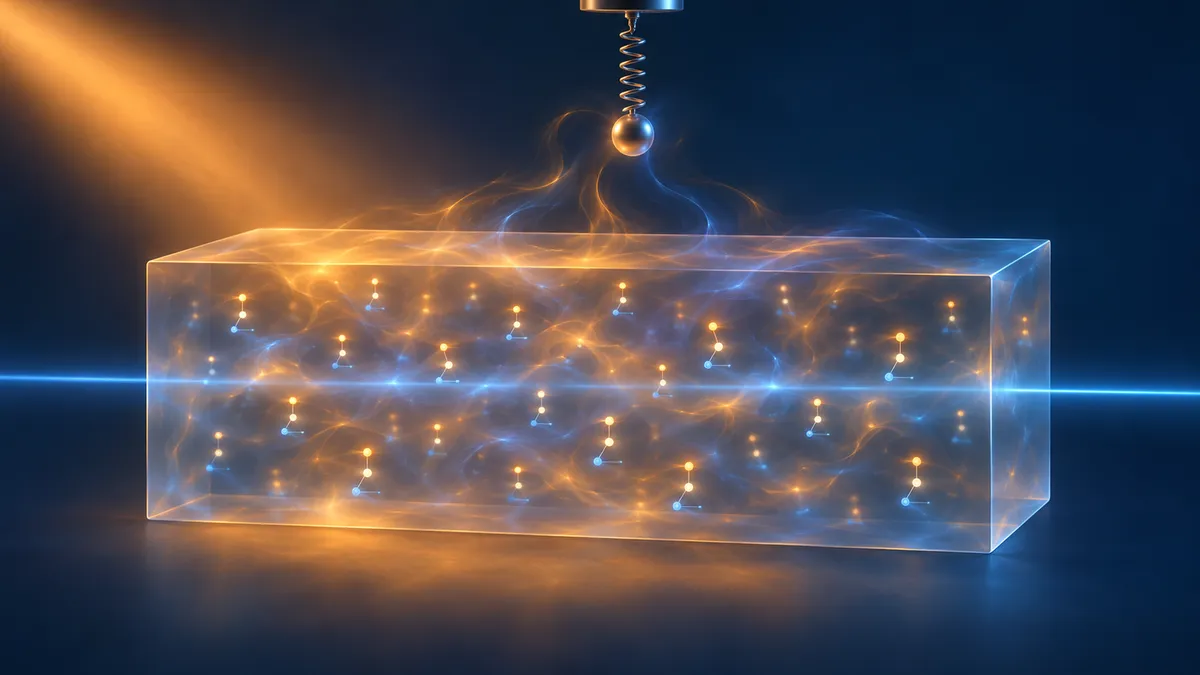
A medium can stop absorbing a weak light signal without becoming quantum-mechanically quiet. Daigo Oue’s theoretical study explains this distinction by tracing both optical response and electromagnetic noise back to the populations of microscopic energy levels.
What does transparency leave behind?
Materials that absorb or amplify light also generate electromagnetic fluctuations. Macroscopic quantum electrodynamics describes these quantum fields using a material’s optical response together with noise operators representing its fluctuating internal degrees of freedom.
For an active medium, external pumping maintains a state that can amplify light. The question addressed in Daigo Oue’s preprint is how the response and noise used in this macroscopic description emerge from the same microscopic, driven system. The work is presented as a theoretical arXiv preprint, not a journal publication.
Its central finding is that the balance determining net absorption differs from the quantities determining noise. At transparency, absorption and amplification contributions can cancel in the linear response while fluctuations remain finite.
Building a medium from energy levels
The calculation begins with an ensemble of identical three-level systems. An external pump drives transitions between the lowest level and an auxiliary upper level, while environmental reservoirs produce relaxation and excitation between levels.
The author simplifies this model to an effective two-level system by eliminating rapidly relaxing auxiliary dynamics. This step requires both a separation of timescales and a negligibly small auxiliary-level population. Rapid relaxation alone does not establish that the upper level can be ignored when normalising the remaining populations.
The two retained levels have stationary populations, called p0 and p1, fixed by pumping and relaxation. “Stationary” means these populations no longer change with time; it does not mean the pumped system is in thermal equilibrium.
Next, a quantum central-limit construction combines fluctuations from many independent systems. Much as an ordinary central-limit argument produces Gaussian statistics from many contributions, this method yields collective Gaussian quantum fluctuations. Their dynamics are written as a Langevin equation: a description combining systematic evolution with a fluctuating driving force.
A separate weak-probe calculation gives the susceptibility—the quantity describing how the medium’s electric polarisation responds to an applied electromagnetic field. Both susceptibility and noise therefore come from the same stationary microscopic state.
Response subtracts; noise retains both populations
In the model, the susceptibility depends on the population difference p0 − p1. More population in the lower level gives absorption; more in the upper level gives amplification. Equal populations produce transparency in the linear response of the modelled transition.
The noise correlations, however, retain p0 and p1 separately. The collective fluctuations can be represented using two independent vacuum modes, with contributions weighted by the square roots of these populations. This mathematical construction reproduces the microscopic fluctuation statistics; it does not identify each microscopic system with two physical oscillators.
At equal populations, the imaginary, dissipative part of the susceptibility vanishes, but both noise contributions remain finite. The cancellation of net absorption is therefore not a cancellation of fluctuations.
The author also expresses the noise through an effective reservoir occupation and an effective temperature associated with the selected transition’s population ratio. This is not a claim that the entire pumped medium is thermal. The resulting fluctuation–dissipation relation connects noise and response, but differs from an equilibrium relation applying at every observation frequency. At transparency, the conventional single-mode normalisation becomes singular; the original two-mode noise description remains regular.
A probe can detect the difference
To illustrate an observable consequence, the paper considers a harmonic-oscillator quantum probe above a pumped half-space. Electromagnetic fluctuations from the medium induce excitation and relaxation of the probe.
At transparency, the medium-induced excitation and relaxation rates are equal and positive. A probe initially in its ground state consequently gains excitations. These rates exclude any independently specified vacuum-field contribution.
This prediction uses weak probe coupling and Markovian approximations, which neglect reservoir memory. It does not establish a finite final probe temperature: without additional damping, the linear model predicts continued growth in occupation. Other losses or nonlinear effects determine long-time behaviour.
The broader construction likewise assumes independent microscopic constituents, local Markovian reservoirs, many systems per coarse-grained volume and a weak optical probe. Within that framework, the result is clear: susceptibility alone does not specify the quantum noise of a pumped medium, even when its net absorption vanishes.
- quantum electrodynamics
- active media
- quantum noise
- optical transparency
- population inversion
- fluctuation–dissipation relation
Related reading
Automatically matched by shared topic keywords. These links do not imply that the sources agree or establish a consensus.