TRANSMISSION // 2611.11548v1
Letting magnetic fields push back on the Sun’s circulating flows
Source published
A solar dynamo simulation lets magnetic fields alter prescribed background flows, reproducing several cycle-linked changes in circulation and rotation. The preliminary results also expose mismatches with observations.
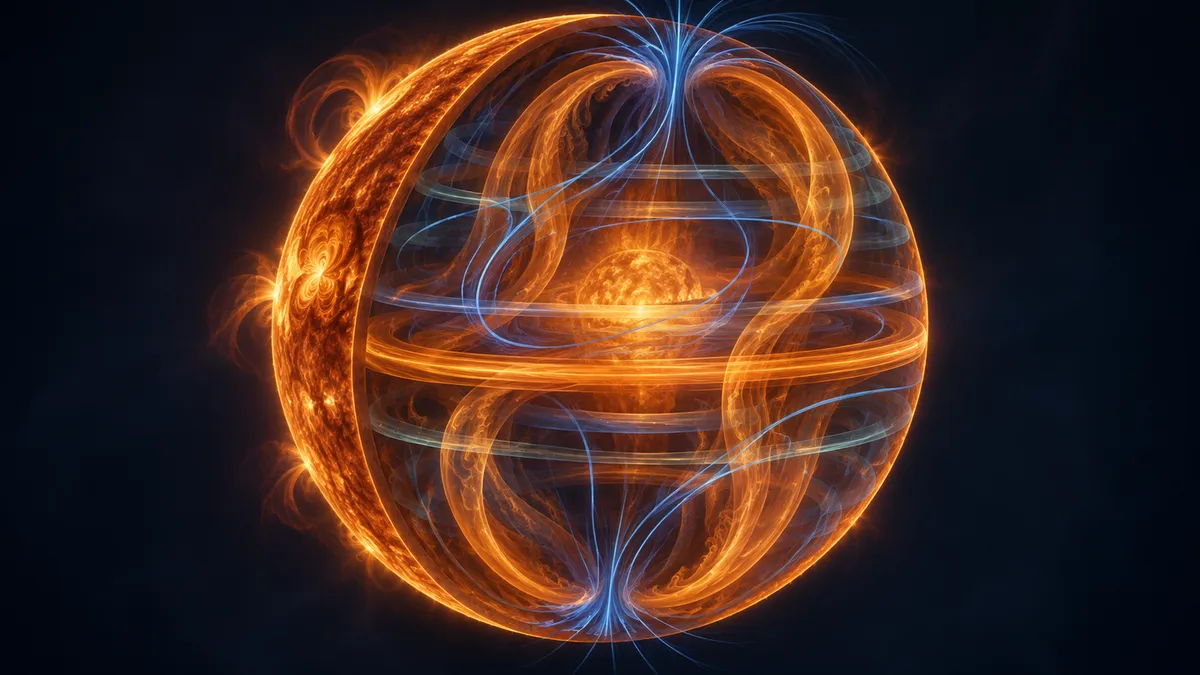
The Sun’s moving plasma helps generate its magnetic field—but that field also pushes on the plasma. A new preprint explores this two-way interaction without trying to calculate every process that maintains the Sun’s large-scale flows.
What changes when the magnetic field pushes back?
The Sun does not rotate at one uniform speed: its equator turns faster than its higher latitudes. Plasma also circulates along north–south paths, moving poleward near the surface and returning at depth. These motions help transport and generate the magnetic field involved in the approximately 11-year solar activity cycle.
But the flows themselves change with that cycle. Surface circulation generally weakens around activity maximum, while bands of slightly faster and slower rotation migrate through latitude. These small rotational changes are called torsional oscillations.
In an arXiv preprint, Bidya Binay Karak and Mark Miesch ask how much of this behaviour a model can reproduce when its magnetic field is allowed to alter the flows that sustain it. Their results capture several observed patterns, but not all their strengths or details.
A prescribed background, with room to respond
Many flux transport dynamo models are kinematic: they calculate how an imposed flow moves and amplifies magnetic fields, without allowing magnetic forces to change that flow. The authors instead prescribe steady background circulation and differential rotation, then calculate departures from those backgrounds alongside magnetic and thermodynamic changes.
This is a deliberate compromise. It avoids having to calculate the turbulent stresses responsible for maintaining the background flows. Those stresses are assumed to exist outside the model rather than derived within it. The approach therefore does not explain the origin of the Sun’s differential rotation or circulation from first principles.
The researchers implement the method in Rayleigh, a code capable of three-dimensional magnetohydrodynamics—the coupled evolution of conducting fluid and magnetic fields. However, the simulations presented here are axisymmetric: they do not resolve differences around solar longitude.
They also prescribe a simplified Babcock–Leighton process. This represents how the decay and dispersal of tilted sunspot groups regenerate the component of magnetic field lying in north–south planes. The model does not explicitly simulate those groups emerging and dispersing. Without this prescribed magnetic source, the authors find that their seed fields decay.
A comparison run holds the flows fixed. The non-kinematic version then allows the field’s Lorentz force—the force a magnetic field exerts on conducting plasma—to perturb the flows, which in turn modify the field.
Circulation slows when magnetism strengthens
Both versions retain basic solar-cycle features, including magnetic polarity reversals and equatorward migration of the deep magnetic field. With feedback enabled, however, successive cycles become less regular and develop weak differences between hemispheres.
This variability appears without adding random fluctuations. It demonstrates an internal source of irregularity in this model, although the authors report less cycle-to-cycle variation than observed on the Sun.
The surface meridional circulation weakens when the model’s magnetic cycle is strongest and strengthens when it is weakest. Averaged over latitudes between 5 and 35 degrees, its reported peak-to-peak variation is about 65%. The observational study used for comparison found roughly 55%, based on about two solar cycles. The correspondence is encouraging, but the numbers are not identical and the observational baseline is limited.
Magnetic feedback also changes the average rotation profile. The pole-to-equator rotation contrast falls from about 25% in the imposed background to about 10% in the resulting flow, reducing the shear available to generate magnetic field.
Rotation bands agree only partly
The simulation produces a faster-rotating band that begins above roughly 50 degrees latitude and moves toward the equator. Its poleward-moving branch is weak. The overall torsional-oscillation amplitude is about 2%, compared with about 1% in the observations cited by the authors.
The rotation variations begin a few years before the model’s magnetic cycle starts, resembling the timing associated with the Sun’s extended cycle. Here, however, cycle onset is measured using magnetic field strength near the convection zone’s base—not actual sunspot emergence.
These preliminary preprint results support the usefulness of calculating magnetic feedback on prescribed flows, rather than holding those flows completely fixed. They do not establish a complete solar dynamo explanation. Explicit active-region emergence, longitude-dependent magnetic structures and tests with more solar-like parameters remain future work.
- solar dynamo
- solar cycle
- meridional circulation
- differential rotation
- torsional oscillations
- magnetic feedback
- Rayleigh