TRANSMISSION // 2611.11490v1
Flexible power planning could cut electricity shortages in Ethiopia and Zimbabwe
Source published
A modeling preprint finds that adjusting power investments as demand and river conditions change greatly reduces projected energy shortages. Its Zimbabwe scenarios also show how carbon policy and cheaper solar financing can jointly shape decarbonization costs.
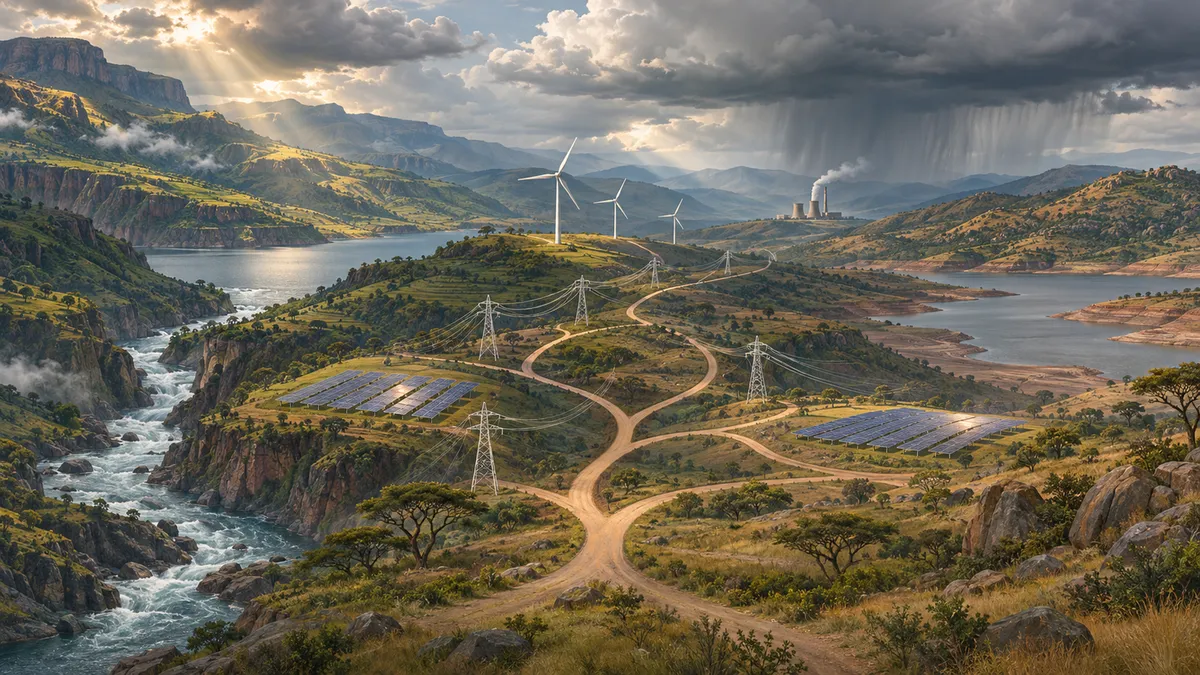
Power stations take years to build, but electricity demand and the water available for hydropower do not follow a fixed forecast. A study of Ethiopia and Zimbabwe asks how national planners could account for that uncertainty while expanding supply and limiting emissions.
Electricity expansion involves commitments that are difficult to reverse. A plant commissioned for future demand may prove insufficient if consumption grows faster than expected, while a hydropower-heavy system can face shortages when river flows decline. Planning around average conditions alone can miss these risks.
An arXiv preprint by Arega Getaneh Abate and colleagues examines investment strategies that change as new information arrives. Applied to Ethiopia and Zimbabwe over 2025–2050, its model finds much lower projected energy shortages than a benchmark that fixes investment around expected conditions. These are simulation results, not observed outcomes or guaranteed investment benefits.
Planning without knowing the future
The researchers use stochastic dual dynamic programming, or SDDP. This optimization method estimates how decisions made now affect future costs without explicitly calculating every possible sequence of events.
Each modeled year, a national planner observes electricity demand and hydrological conditions, then chooses generation, investment and retirement decisions. Future investments can change, but already committed projects remain subject to technology-specific construction times. Hydropower takes five years to build in the model; solar takes one.
Demand fluctuates around a central growth trajectory, with deviations persisting between years. Hydrology follows low-, normal- and high-inflow conditions. The probability of next year’s condition depends on the current one—a structure called a Markov chain. Separate calibrations use reconstructed river-discharge histories from 1980–2024 for the Blue Nile and Zambezi basins.
The model balances investment and operating costs against the economic penalty for electricity demand left unmet. This unmet demand is reported as expected unserved energy: the average annual energy shortfall accumulated across the planning horizon. Main scenarios are evaluated on 5,000 independently generated future paths. Comparisons with fixed-investment and perfect-foresight benchmarks use 200 common paths.
Different systems, different pathways
Ethiopia begins with a large hydropower fleet. In the baseline simulation, hydropower remains its largest electricity source in 2050, supplying about 48% of generation, while wind and solar provide substantial diversification. Lower assumed wind and solar investment costs shift the portfolio further toward wind and reduce resource costs.
Zimbabwe starts with hydropower and an inherited coal fleet. Its baseline combines scheduled coal retirements with expanding solar, hydropower and new gas capacity, while retaining some coal. The authors emphasize that this outcome depends on the assumed costs and retirement conditions of existing assets; it is not a recommendation to build gas plants.
The clearest benefit of adaptive planning appears in shortages. On the common benchmark paths, Ethiopia’s cumulative expected unserved energy falls from 78.09 terawatt-hours under fixed investment to 0.04 under adaptive planning. Zimbabwe’s falls from 15.90 to 0.02 terawatt-hours.
The fixed plans use fewer investment and operating resources, but leave much more demand unmet. Consequently, the very large monetary benefits reported for adaptation mainly reflect avoided shortage penalties. Those penalties depend on an assumed value of lost load—the economic cost assigned to unsupplied electricity—of $10,000 per megawatt-hour. They should not be read as forecasts of cash savings.
Carbon policy meets financing
The Zimbabwe scenarios compare carbon taxes with annual emissions ceilings. Taxes of $30 and $50 per tonne of carbon dioxide reduce average annual emissions from 2.80 million tonnes in the baseline to 1.78 and 1.47 million tonnes. Gross resource costs rise by 2.7% and 4.5%, respectively.
For this accounting, resource costs cover investment, fixed maintenance and variable operation. Domestic carbon-tax payments influence decisions but are recorded separately as transfers, rather than resource use.
At approximately matched expected emissions, annual caps produce modestly higher net resource costs and energy shortages than the corresponding taxes. The finding is specific to this modeled system, not a general ranking of climate policies.
Combining the $50 tax with concessional solar financing changes the trade-off. The financing scenario lowers effective solar investment costs by about 39%. Average annual emissions fall to 1.33 million tonnes, while gross resource costs sit 9.5% below the no-policy baseline.
What the model cannot establish
The annual model does not resolve hourly solar and wind variability, plant ramping, seasonal reservoir operations or storage cycling. Its shortage measure therefore cannot establish detailed operational reliability.
It also excludes off-grid generation, internal transmission constraints and explicit cross-border trading decisions. Technology costs are prescribed, large projects are approximated with continuously divisible investments, and governance and delivery risks remain outside the model.
Within those boundaries, the preprint’s central message is that retaining the ability to revise future investments can matter more than planning around a single forecast. The resulting technology mix—and the cost of cutting emissions—still depends on local resources, inherited plants and financing assumptions.
- electricity planning
- Ethiopia
- Zimbabwe
- hydropower
- investment uncertainty
- stochastic dual dynamic programming
- carbon pricing
- solar financing
Related reading
Automatically matched by shared topic keywords. These links do not imply that the sources agree or establish a consensus.